
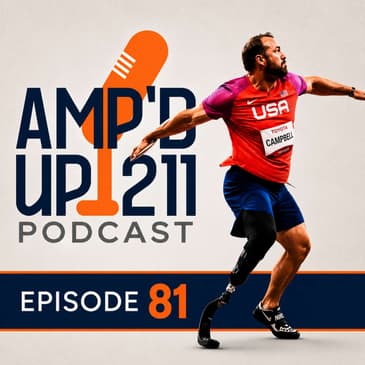
Five Paralymic gold medals. Four world championships. World records. ESPY recognition.
Those are the things you'll find when you search Jeremy Campbell's name.
But that's not the conversation I wanted to have.
When I sat down with Jeremy for this episode of the AMP'D UP211 Podcast, I wasn't nearly as interested in the medals as I was in the man who earned them. What happens after the podium? After the national anthem? After the crowds go home and the cheering stops?
We live in a world that loves accomplishments. We celebrate the highlights, the victories, and the moments that make headlines. What we don't often talk about are the spaces in between. The pressure. The expectations. The sacrifices. The discipline required to keep showing up long after the excitement fades.
Jeremy grew up on a Texas farm where hard work wasn't optional, and excuses weren't part of the culture. That mindset helped shape one of the most accomplished careers in Paralympic history, but what struck me most during our conversation was his perspective on excellence, purpose, and the responsibility that comes with pursuing something bigger than yourself.
This episode isn't really about sports. It's about mindset. It's about identity. It's about what it takes to sustain greatness over time and how easy it is for the world to reduce people to inspiration while missing the very human journey behind the achievement.
Jeremy's accomplishments are remarkable.
His perspective is what you'll remember.
[00:00:00] From a farm in the Texas Panhandle to the top of the Paralympic podium, this week's guest has spent his entire life proving that greatness is built through grit, discipline, and mindset. Jeremy Campbell is a five-time Paralympic gold medalist, world record holder, champion speaker, and one of the most dominant athletes in adaptive sports history.
[00:00:21] But beyond the medals, this conversation dives into pressure, perseverance, mental toughness, and what it truly takes to perform at an elite level when the world is watching. This is the AMP'D UP211 Podcast and the pursuit of greatness starts right now.
[00:00:44] Hey everyone, welcome to the AMP'D UP211 Podcast. I'm Rick Bonkowski. We are very fortunate today. Jeremy Campbell's in the house. How are you, sir? I'm good. How are you? I'm doing excellent. You know, I was reviewing my notes early this morning when I got up. And I appreciate you sending me a bunch of stuff, but you're not hard to find, Jeremy. Let me tell you. There's plenty of stuff out there. I was looking at your list of achievements.
[00:01:13] I gotta say it, man. It just makes me feel very inept. Like, I'm just kind of going through it. And, you know, I consider myself a relatively active amputee. And then you look at what Jeremy's done and you think, uh-oh. Wow. Some people really, really go for it.
[00:01:36] Um, let's just, uh, browse here for a moment. Uh, five-time Paralympic gold medalist, four-time world champion, and world record holder in both discus and pentathlon.
[00:01:53] Glad I said that right. Yeah. He also, that was a word I, I was like, uh-oh, am I going to blow that word? Um, he also became the first amputee to throw a discus over 60 meters, cementing him his place among the elite competitors in adaptive sports history.
[00:02:14] Oy. How many people can say that? His dominance earned him multiple ESPY nominations and a 2011 ESPY award for the best male athlete with a disability. Damn, brother, you've been busy. Busy boy. Been doing it for a long time. You know, I appreciate you saying that because I'm in a career space different than you, but...
[00:02:44] Sometimes people will say to me, you know, wow, you know, you've done so much and this and that. Now, my answer is always, I've been doing it a long time. And all of those experiences, achievements, milestones, if you're dedicated and you're in the pursuit of excellence during that dedication, right, those things just sort of come with it and sort of add up over time.
[00:03:13] And that's the thing that I appreciate about people like yourself in the athletic space is it requires a tremendous amount of focus.
[00:03:26] And as you age, a tremendous amount of reinvention and being able to adapt in a way that allows you to achieve your best self at any given time because who you are as an athlete now certainly is different than you were when you were playing football, let's say. And accepting that, but also challenging yourself continuously, I think is really important.
[00:03:56] But I think the really interesting part of your story that fascinates me because I've been an amputee for only about eight years is that you were essentially born with your amputation. You had an amputation when you were one years old. Your parents made a decision, you know, to amputate your leg.
[00:04:17] And you were raised in an environment that I look at again and think, well, you know, he didn't necessarily have it easy. And he was expected to work. He was expected to perform and he was expected to be part of a working family. And in your words, I'd want you to describe being what I call born amputee, essentially. What was that like? And what was your childhood like?
[00:04:50] Yeah. I love all that and how you frame that and just how you introduced the start of this conversation, because that's why I reached out to you. Because I just I think I read something that you had just written about inspiration. And I've been wrestling with that word. And I was just like, I think I could have a really good conversation with this man. So let me say hi. Hi, friend.
[00:05:21] And so, yeah, you know, being an amputee and growing up with fibular hemimelia, having amputated at one year old, at one years old. It's just been a much larger journey than I ever thought it would be. And I've had to explore so many different things. And so there was a lot of packed, you know, there's so much packed into the conversation of what was it like growing up as an amputee?
[00:05:51] And so, you know, luckily for me, I grew up in an environment that was really just grit and determination. And so there was no opportunity for me to make excuses. And, you know, oh, I have one leg. I can't do it. That just that thoughts, that thought, that mindset just had no oxygen to thrive.
[00:06:19] And so I learned really early on that that you're just going to have to figure out how to adapt. If you want to play sports, if you want to live your life, there's no excuses. And we got a way we got to find a way to work through the things that you got to work through to live a normal life and to play sports and go hang out with your friends and do these things. And so, you know, I and so I oftentimes I feel like it just kind of came naturally because it was so ingrained to me at an early age.
[00:06:48] Via your parents. I'm sorry. Via your parents. Via my parents. Most assuredly, my dad is a West Texas cowboy through and through. And so there's that hard nose, just nose to the grindstone, you know, fun for me doing things on the weekend for me was hauling hay and building fence with my dad. And that's no. And my mom is from New York.
[00:07:17] And so between those two personalities, you could kind of say I had the ingredients for a mindset that was just all grit and determination and no excuses. I've got story after story, you know, just growing up and failing and wanting to, you know, start to make an excuse, kicking my bike when I didn't have the backside mechanics because I was learning how to ride a bike as an amputee. And then my mom barking back at me.
[00:07:47] It's like, you're not about to blame this on your leg, you know, get up, get back on the bike and learn how to ride it. Hmm. So, yeah. So that mindset, really, even though I had my leg amputated at one, I just I wanted to play sports. I grew up just like anyone else and really excelled at sports. And I think that mindset and environment that I grew up in really just helped me to thrive as an athlete.
[00:08:15] And it's always been funny because it's taken me a long time to try to, like, find my voice as far as being someone who has always excelled in sports. And I've represented the United States in the past five Paralympics. And so a lot of people will be kind of just this expectation to be like an inspiration and to have these words of wisdom and all this stuff. And I'm just like, I've always wrestled with trying to find like these things that can motivate.
[00:08:44] I'm also deeply introspective and make things a lie. I live in kind of the deep end of things, layers after layers and metaphors. And so it's hard for me to just say, like, I don't know, I just put my leg on and go at it. Like, there's no secret sauce. Just put it on. Some days it hurts. Some days it sucks. But you got to work out to do. You got to take care of business. Yeah.
[00:09:09] And I appreciate what you said about your parents because there needs to be something that tethers us. And I would imagine you grew up, you know, in some ways similar to all of us in that you had friends and you had insecurities that just normal adolescence brings on, normal teenage life brings on.
[00:09:38] There are all of those components of just rite of passage, right? We all have to go downstream and say, okay, how am I going to navigate this? And being an amputee in that space, I would imagine just kind of adds a layer where it's like, okay, I want to date or I want to hang out or should I drink? Should I not drink? Should I do this? Should I do? Who am I? Right? That was always the thing in my mind growing up. Who am I? Who am I? Who am I?
[00:10:08] And being an amputee, adding that layer of complexity, I would think for yourself, and you can probably describe it much better, sports, I would think, was the thing that empowered you and allowed you a sense of identity to say, you know, I'm really good at this. And I feel my body when I do this.
[00:10:38] And this is kind of like, this is my superpower. This is the thing that whatever cosmic forces have bestowed upon me, I can do.
[00:10:51] And if I really press into it and I dedicate myself on a higher level, I'm sort of surprising myself in terms of not only what I can accomplish, but how much more secure, safe, independent, confident that I feel when I'm thriving in these sort of events and these things.
[00:11:16] Was there a moment in your youth where you sort of had that aha moment or that connection where you thought, man, sports, this is my thing? Yeah, sports definitely helped me to form my identity early on to survive the insecurities that I had, especially as an amputee. As I like got older, I used to always do this thing where I would observe different amputees and people with physical disabilities.
[00:11:46] And I knew their stories. And I would always look and observe the personality traits and the disposition of people who receive their disability later on after their identity had formed and congenital like myself. Yeah. And how much that plays a role in the formation of our identities and our personalities. And there's always outliers, right?
[00:12:09] There's people who just didn't really seem to fork their composition, the early creation of their identity for whatever reason. But there emerges a pattern. And I can see that in my life where sports just really gave me the identity. And that's for so many. You don't have to have a physical disability. That's what sports do.
[00:12:34] They help create that identity and show us what we're capable of and teach us so many valuable lessons in life. And so, yeah, it was there early on. It's what helped me find my place in the world at first. Before I – the older I got, I realized that my identity wrapped around performance.
[00:13:01] I kind of hit this wall. And I had to visit those things that I never thought I had to visit if I wanted to go further. And that was reinvention. That was death to the old, like a lot of part, like identity transformation. Oh, sports and performance and realizing that I'm good even though I had one leg.
[00:13:27] This is how I got so much of my worth and my value and how I was. It was the Band-Aid that I was using to cover up some wounds that I didn't have some key things that a healthy identity has formed in the essence of their being. And so it was all exported externally.
[00:13:54] I created this external exoskeleton. I created this exoskeleton. And when that started to come crashing down, I was like, oh, I have to revisit a lot of things that I didn't think I had to visit. Because early on, I was just taught to kind of ignore it by that mindset, that grit, that determination. And so I thought exploring those things was kind of weakness. And then I hit that wall.
[00:14:22] I'm like, oh, I got to visit how sports showed up early in my life, explore these deeper things. But yeah, it helped me survive early on as an amputee who had a lot of insecurities, who had a lot of doubt, who always wrestled with belonging. Who, you know, the kid who would stay in the pool long after all his friends left when he became self-conscious.
[00:14:49] So he could get out of the pool just to avoid being seen without his leg on. You know, it's like there were those key moments in life. And so sports really helped me to just cover all that up. Funny how the, like you described getting out of the pool, funny how the everyday situations, you know, just the everyday walk of life situations, getting out of a pool, getting out of a car, just being seen in a normal space.
[00:15:17] That can create so much sort of apprehension or caution or I feel vulnerable right now and I'm trying to figure out why. And I've had moments like that. So when you're performing, when you're competing, you're kicking ass. You're like, okay, yeah, bring it. Like this is who I am. I'm strong. I'm proud. I'm independent.
[00:15:45] Like I might be, and I would think there are probably distinctions where you're like, well, I don't consider myself disabled. I consider myself different. Yes, I'm different. But disability, well, that's not the word I would use, right? Because this is not what I was taught. I was taught that that does not exist in my world.
[00:16:07] Yes, I'm different, but that doesn't mean I can't work whatever it takes harder to be able to get it done, right? Because there's always a workaround. And I think what's amazing about, you know, Paralympic athletes is they thrive in those workarounds.
[00:16:25] And I know you've spoken specifically even about your body mechanics, how you throw a discus and, you know, how you make the deficiencies work based on the muscle groups that do not exist on your body. And you've even gotten into the science of it. Like, here's my approach, okay?
[00:16:46] Because you might speak to, let's say, an athlete who has two legs, and they have their approach and how they, you know, reach their milestones. And you've had to look at your body, right? Your physiology and, you know, physics, let's call it, and how weight shifts and how you're going to be able to get the most out of that throw. And you're very receiving of that.
[00:17:13] But I think my original point was more about why is it that when I'm working, when I'm thriving, when I'm doing the things that I love and I'm confident about, and it is external because people see you and they think, hmm, no issues there. That guy's doing it. But there's that moment that arrives, and I've had this happen to me.
[00:17:37] I remember one time I was at a parking lot, parked my car, sitting in like a grocery store or something. And I opened the door, and I can hear a family coming, like, over my shoulder on the left. They're talking, and I can hear them approaching. And I don't know why, Jeremy, I hesitated to get out of the car. I don't know why. Why? I don't know. You're so fit.
[00:18:06] I don't know. Because I think I was not wanting to... I was living in their lens, thinking it was going to be shocking for them to see someone get out of their vehicle that had a prosthetic leg on.
[00:18:24] And I was managing somehow letting my feelings of vulnerability create a sort of a calculus for protecting them from me or the sight of me or the questions of me. And I just didn't have it for that interaction that day.
[00:18:54] And it wasn't as if I was going to speak to them. I don't know these people. But I can hear them coming. And I know the timing is perfect. And I know there's children, right? And I know the timing is perfect that I'm going to step out, and I'm going to see all of them simultaneously. I probably have to walk in front of them as we're all entering the store.
[00:19:23] And I had to examine that and get settled with that and wonder why. And why am I feeling that way? What's going on with me? Why am I letting that happen?
[00:19:35] So when you've explored those deeper feelings and whatever you want to characterize it as, this sort of cover-up or this mask, this exoskeleton that I'm wearing to the outside world, where does that typically take you emotionally?
[00:20:02] To the dark, deep recesses of my heart. Yeah. And so, yeah. I'm someone who introspection and sitting with those things kind of comes naturally, almost to my detriment. Because I am constantly aware of moments like that. Yeah.
[00:20:31] Constantly, you know? And so it's a journey, you know? And trying to build that self-awareness and realize the genesis of all of those things are coming from, to sit with those moments and ask why. And ask that answer why and that answer why.
[00:20:59] And to, yeah, try to figure out what those moments are. You know? And it could be a whole number of, a slew of things of, you know, trying to control the perception of others, which is really only my perception of their perception of me. That's a great way to put it. So I'm trying to create, you know? Really great way to put it. Trying to control the perception of others. Yeah.
[00:21:28] Which is really, I haven't talked to them, which is my perception of their perception of me. Yeah. It's brilliant. And so there's a lot of assumption in that. But my assumption is created by this experience after experience. I have this data log of how many times have I gotten us out of the car at the grocery store and someone comes up to me and thanks me for my service. It's happened to me, too. And then when I tell them I'm not a veteran, they pull their hand back and say, oh, I'm so sorry.
[00:21:57] I thought I just wanted to honor you. You're doing such a good job. Like, well, how does, like, over time, like, it messes with you. And you're like, I need to sit down and see how this is affecting me. Yeah. This is my responsibility to walk this out and figure out what this is doing to my heart and my mind so I can show up the best version of myself. But I need to visit these things.
[00:22:22] Do you think that people that compete on a world stage, amputee or not, are managing similar feelings in that so much of reaching those levels of competition requires a tremendous amount? And I don't have to explain this to you because you do it. A tremendous amount of dedication.
[00:22:51] A bloodthirsty, you know, thirst for excellence. Wanting something, you know, so badly that you're literally willing to build your life around those goals. And I can't imagine, I can only imagine, you know, the amount of grit, the amount of dedication that takes.
[00:23:18] And when you're in the midst of that, are we truly doing that for ourselves? Or are we doing that to control the perception of the outside world? And that doesn't necessarily have to be for a Paralympic athlete. It can simply just be an athlete that's reaching those very, very high levels.
[00:23:46] Where does the inspiration come from at that point if you somehow feel misdirected, disconnected? Why am I doing this? And how do you reconcile that balance sheet in your mind? I think I'm following. I think you have like a couple questions in there.
[00:24:16] You're like, that's a word salad. I can't say, and I know, and I have so much to say to these things. And that's why I'm glad we're connecting because this is my language. This is the conversations I love to have. And so I get overwhelmed because I want to just use years and years and years of analysis and experience and observation and everything.
[00:24:47] Because I wrestle with this stuff, man. I wrestle with it. Yeah, I think everyone, from my experience, from talking to other Paralympic athletes, one of my best friends, another thrower, were the two biggest guys on the team. And it always cracks me up because if I find we're in a hotel together, we're in the Paralympic village. We're just having these emotional conversations about the deeper things.
[00:25:15] And we're the biggest rugged dudes on the team. And we're in there just talking about disability and psyche and identity and emotions and identity evolution and all of this stuff. And it's always been funny to me. But, yeah, I think anyone who's in touch with themselves, you know, deals with this.
[00:25:40] And a lot of the best athletes on the Paralympic team that represents the U.S. and wins gold medals and stands on the podium, they wrestle with these things. You know, and I think when you're younger, you're putting on these masks because we think that having these things makes us weak. And so we cover them up. And what's really cool about my career, and I'm so blessed to have the longevity that I've had, is that I've been able to see myself a completely different person almost like every four years.
[00:26:07] And so I think a lot of times athletes, by the time they have some kind of massive, like these identity transformations, sports is the thing of the past. And so they look back on it like, oh, if I knew what I knew now, I could have engaged that differently. And it's like, cool for me because, like, I'm still active. I believe I have my best performances in front of me. And now I get to utilize and implement the things that I've learned, not just technically, mechanically about my sport, but mentally and emotionally.
[00:26:36] And I'm like, oh, this is really fun. This is cool. Because now I don't think, I'm starting to think in my own life that it's not necessarily to reconcile these different things. It's to accept them and to love them. And that's what really has helped me to elevate anything. And so I love, I just started talking about, I went back and changed what I wanted to really talk about and the message that I wanted to share when I go and speak.
[00:27:05] And it's about, you've used the word two times now, it's excellence. So I love talking about sustaining excellence and how a world record mindset has helped me sustain that excellence. And then it's performance anxiety, how to overcome performance anxiety. And I visited that word over and over about what is overcoming? What does that mean? Because I've overcome my physical disability, but I still got it. Right? Can I overcome anxiety? But I still got it.
[00:27:36] So I don't need to defeat these things or reconcile these things. Because for me, it was so much more for performance anxiety because I wasn't, my existence was riding on a performance. It wasn't just a track meet. This was me proving myself as an amputee that, who I always felt like was this like inspirational monkey, like jump inspirational monkey, like impress us, do great things.
[00:28:02] And I never, because I felt like my perception of society's perception of me was this token, was looked at through this lens of tokenization. I never really felt like I could believe in the applause that I was receiving. Every time I just felt like I was this kid running around the track, coming in last and getting that clap that we all know was the pity clap. And I could never believe in this.
[00:28:26] So my performance has, my drive to become one of the best in my sport was really driven by wanting to finally be good enough to receive an applause that I could believe in. And not just receiving an applause because I was an amputee. And that story was constantly fueling me, never feeling good enough.
[00:28:53] And I don't know if that was even resonating with, if that was answering the question you had. We just... No, I think it did. I think it did. And the way I've described it for myself, especially in different professional circles, business, and you had mentioned, you know, I read something, you know, that I wrote and it sort of connected with you.
[00:29:18] And I tend to put it in this category of imposter syndrome. And there's this sort of fragile, let's say, insecure part of me that still believes that tends to be a bigger part of me.
[00:29:43] So if I, you know, receive praise in any way or I receive a promotion or I walk into a boardroom and people are listening to me intently, I tend to get anxious and I tend to start to believe in my mind that I am fooling all of these people right now.
[00:30:13] That I don't necessarily deserve to be here right now. And it's not, you know, prevalent in the sense that I carry it around all the time, but there are those moments. And you can label it a lot of different ways, you know, performance anxiety or, you know, others as well.
[00:30:39] But I do get into that space of, yeah, I don't know if it's that great or I don't know if that really deserves the nod that it's getting. Do I, did I really deserve that applause? Did I really deserve that kind word?
[00:31:03] And I've had to go on that journey myself of, you know, why am I feeling that way? And I mean, your limb difference is, it's very visible. It's very visible. And what I mean by that is the thing that you thrive in, it's very much a part of that identity.
[00:31:31] When you're competing, when you're on that world stage, there's no denying that you're an amputee. It's there. And where it can get to be a little more complex for someone like myself is a lot of people don't necessarily even realize that I am an amputee sometimes. You know, are you a BK? What's that? Are you a BK?
[00:32:01] Yeah. Yeah. And someone will, you know, I'll be working with someone or leading a team at work and, you know, I'll know someone for six months and they'll come over to me and say, hey, I heard this crazy story about you. I'm like, really? What? What do you mean? Yeah. Someone told me that you're an amputee.
[00:32:25] And, and, like, they figured it out, you know, like, oh no, does that mean I'm fired now? Yeah. I mean. Yeah, it's bizarre. And the way it was, and the way they pitch it to me is crazy story. I'm like, I'm a crazy story? Why, why is that crazy? Is it, is it, I'm not from Mars.
[00:32:54] I'm a human being, you know? So I, I, I think a lot of those, you know, cultural stigmas, perceptions, all of those things, I think can be, you know, tricky.
[00:33:11] I was, I was talking to a friend who has a, who has a daughter in high school who's, who's above the knee and she's competing quite a bit, actually. She's a runner and track and field and things like that. And because of the rules, Jeremy, very often she has to compete by herself. And, yeah, there's nobody, there's nobody in her category.
[00:33:40] There's no one in her, her class. Now, you know, my friend will describe to me, she'll say, you know, and, you know, she, Katie's out there and, and she's running by herself. And the entire crowd is at their feet, cheering. And all I can think is, oh my gosh, that has got to be really complex for her.
[00:34:09] It's got to be, it's so complex. It's so complex. I'm afraid for her. And, and, and Jeremy, again, it's all the, you're such an inspiration. Oh my gosh. You're so, you're, you're incredible. You know, I, I've talked to my kids about you and this poor, you know, 16, 17 year old is like, I'm on the track by myself. Like what, like, what is it that you're applauding? You know? Yeah.
[00:34:37] And, and she's at that age where she's, you know, a little bit full of angst and teenage energy. So it's, it's just like, how do you, how do you teach a child? How does that child view the world in, when it becomes this whole, like you mentioned, the inspiration monkey?
[00:34:58] And how do we develop the right kinds of dynamics within our community and how we project that to the outside world? And how do we place what is, what is well-intentioned in the right space, in the right category?
[00:35:16] And, and how do we make that work for everyone in terms of you feeling celebrated, but not, you know, a circus performer, so to speak. Token eye. Yeah. Yeah. And how is someone able to appreciate your experience and what you bring to the world in the purest form of just athletics and competition?
[00:35:45] And all of those things can sound very healthy, but when they're happening in real time, it tends to get a little strange sometimes. Yeah. And the thing that I appreciate most is the dedication piece, the pursuit of excellence, the focus required, and then the ability to traverse all of that into a competitive space.
[00:36:15] Yeah. And then do well in those moments when all of that work, everything that you've done, all culminates into that single moment, right? Because what, what is your prep in those, in, in those final moments when you know, okay, now I've got to make the magic happen. I don't, I don't mean the inspiration piece. I mean, now is when I have to do my best. This is when I'm being tested.
[00:36:45] Yeah. It's mindset. It's, um, execution of fundamental cues mentally and mechanically. Um, it's relying on the process of my preparation and getting out of my body and in my head or out of my head and into my body. Um, and then it's just tapping into that grit and determination of a competitor. Um, right. But, you know, I've always wrestled with, um, um, seeing myself.
[00:37:15] I think this is how, how am I getting on this? I think it resonates. I, you, so what do I do when I get in that moment? Yeah. It's, it's seeing myself as the high performer that I am. Um, looking at the four years, I'm sorry. I thought my phone was on silent. It's okay. Um, you know, in knowing what I have prepped for, what I have prepared for the sacrifice and the work that I have put into this.
[00:37:41] And it goes back to, um, my phone is on do not disturb and my computer is, I don't know what's going on. Do you visualize at all? Um, a vision, massive visualizer. Yeah, me too.
[00:37:56] Um, massive visualizer, um, and track and fields will do like this thing where, um, the day before the competition, we'll be able to enter into the stadium and I can get into the ring and I can see my surroundings. And so I'll take mental pictures of my surroundings because I have a, and throwing, we have cues.
[00:38:20] And so like, I, I take a mental picture or even a picture with my phone when I'm in there the day before and I'll take a picture of the back of the ring, what I'll see in the front of the field. And so that I can go home and I can see, or I can go back to the Olympic village or my hotel or whatever, where I'm staying and see those because now I know what I'm looking at. Yeah. Yeah. So, you know, you sit there and chew and ruminate on those things and visualize. And when you get to that moment, nothing is unfamiliar. Nothing is unfamiliar. Because you visualized it.
[00:38:50] You, you put your body in that space. You have a mental picture of what that's going to look like. And when you arrive, so to speak, in that space, suddenly those distractions that may normally inhibit you from, from sort of like grabbing that moment. That's so, so important. Those have faded away because you're already familiar with the space now. Yeah.
[00:39:16] And you step into that ring and you go, yeah, I already know what this is. Because now it's just a matter of, you know, getting out of my head into my body and making it happen. And then I'll be on the fullables head all at once. It rains. And the ring that changes and feels different underneath your feet or your prosthetic breaks and your first warm-up throw. And you have to adapt.
[00:39:41] And luckily you have some incredible teams behind you, like Dream Team Prosthetics and Autobot that ensure that you have the proper tools and resources to do that. So, yeah. I was going to say, like, when you're competing on that level, I mean, how many, like, backups are you equipped with? Like, what does that look like in terms of gear?
[00:40:05] Because if something does break, if something doesn't feel quite right, I would think there would have to be, you know, some safety nets in place. Like, this doesn't feel right. Or I don't know if, you know, something's going sideways here. And you may not even have the wherewithal in that moment because you're so focused on competition to really even diagnose, like, what's happening. Yeah. And I'm pretty keenly aware of what's happening.
[00:40:35] If anything is going on in that moment, I'm hyper, I'm hyper aware. And so, and super suspicious of any kind of anomaly. But, yeah, I've just been, I'm extremely grateful for the support that I've had through my prosthetist, Chad and Randy at Dream Team. I have an incredible relationship with Autobot.
[00:40:58] And they've just been so amazing throughout my entire career to make sure that I usually travel with one to two extra feet. So, that way, if something does happen. Because it's nothing against prosthetics or anything like that. I haven't had to have a socket made in decades because mine is just perfect. And so, I don't really ever deal with issues other than regular, just regular stuff. Like, you know, the shoe rubs or something like that. It's like the same stuff. But with feet, it's physics.
[00:41:28] So, things happen. You know, I'm creating a bunch of force and torque, trying to throw a heavy frisbee as far as I can. I'm in the gym lifting five, six days a week. I'm in the ring throwing. I'm creating a lot of tension on some carbon fiber and titanium bolts. And so, things happen. And, yeah. So, make sure that I have that spare foot and that I have an Allen wrench in my bag. The old Allen wrench.
[00:41:57] If I don't have those things, I'm done. Like, right? So, there's a lot to be said about preparation in the moment of elite performance. Preparation, man. Yeah, I always say preparedness and being able to see around corners, it should become your superpower. I actually teach that in business where I'm like, if you have a plan, you're okay. It's when you don't have a plan. That's where you're going to struggle.
[00:42:26] Because preparedness is what it's all about. Whether you're talking about, you know, competition. Whether you're talking about just, you know, overachieving in, you know, any industry. I will tell someone, this anxiety you're feeling, it's because you're not prepared. And you don't have a plan. But if you have a plan, you'd be surprised how much all those feelings tend to, they might not go away, but they tend to sort of level off and they're a little bit more manageable.
[00:42:56] I think the moral of the story really, Jeremy, and I appreciate this, is all of that self-awareness and all of that sort of emotional maturity. I think it's something that we have to explore and we have to talk about.
[00:43:16] And as long as those conversations continue and we continue to examine not only what the experience is through your lens, but it might be the experience through, let's say, your partner's lens or your family's lens. As long as we're sort of taking it and tackling it from a lot of different angles, I think that's where we start to cultivate this enlightenment that we're all kind of like seeking. Like, what does it all mean?
[00:43:48] And I think it's a moving target. So I don't ever believe that you reach a finish line, so to speak. But as long as people are willing to engage and talk about difficult feelings, it tends to make those moments a little bit easier, a little more tolerable.
[00:44:07] And kudos that you're this very powerful-looking man who's willing to talk about some soft feelings sometimes. And that's probably a tribute to your journey and what you've been through. And now that you're reflecting on some of that, how... And I know you're starting to move into coaching and speaking.
[00:44:36] And what are the things that when you started, when you got out that first pad of paper and said, Okay, what do I want to talk about? How do I relate some of these experiences to what I can offer someone on the receiving end? And that may not even necessarily be someone who's an athlete.
[00:44:59] It might be someone who's just navigating life or trying to find success professionally or maybe teach others or whatever it is. What are those core values for you? What are the things that you feel that you can bring to that space? Yeah. Man, mindset is everything. I look, you know, and trying to figure out...
[00:45:27] It has been such a journey as I have tried to transition and put my mind to paper, to pen and paper, and think about the lessons I've learned and my perspectives and try to take it to... And like you said, not just like... And think about the majority of people with disabilities or amputees aren't Paralympic champions. And so they're just living normal life. How do I relate to them?
[00:45:52] Because I'm thinking my mind works in the mindset of elite performance. Competition, training, preparation, optimization, mechanics, everything. That's where I flow. And so I'm like, well, what can I share with... Like that world is very small. Even though it resonates, like no matter what you're doing, you can have a world record mindset. Even if you are an Uber driver with one leg.
[00:46:18] Even if you're a janitor or you are sitting at a desk at a company, you know, you can still have that same mindset. And so our biggest disabilities aren't physical, even though we have to overcome those things. It's internal. And so, you know, it's been a challenge too. And I understand that's how it flows, how anything goes. Because everything is kind of just this process of gestation. But it was just like iteration after iteration. And when I first started to, you know, what's my message?
[00:46:48] What do I want to share with the world? I would just like start this stuff. And I was like... And really, I think the biggest thing was to try to relate to other individuals like myself. I needed a lot more language. My world is only as big as the language that I contain. And so, like, I got to read more books about disability and what these people are dealing with. Because I need to educate myself. I've been an athlete my entire... An amputee my entire life. But I feel like I'm not very relatable.
[00:47:14] So I need to get inside the minds and lives of other amputees and people with physical disabilities and see what they're dealing with. So then I sat down. I was like, well, maybe I'll create this, like, general message about overcoming adversity. And then I was like, why is this not... Like, none of this stuff ever sat with me. This isn't Jeremy. And I'm not going to change myself. And I know, like, I can have different iterations of messages.
[00:47:41] But then I came and I was like, why is this not fitting with me in my reading? That's when I discovered the term inspiration porn. I was like, oh, my God. I can't stand this stuff. Now I have a word for it. Like, this is... Like, I can't. So... And so then I'm like... And so I've just gone after... You know, you go through this process and figure out what you want to talk about.
[00:48:03] Some of the messages that you want to deliver to people that are true no matter what, wherever you find yourself. And so that's when I've landed on. I love talking about performance anxiety because everyone deals with performance anxiety. No matter who you are or what you're dealing with. And I've had to, through the course of my career, learn how to navigate my emotions and my thoughts.
[00:48:32] And then it goes back to learning how to not just overcome them, but change my relationship with them. And that really began to change my life, not only as an athlete, but as a person, as an amputee. So that I can stop judging these emotions and these feelings. And I can start relating to them differently. And as I change my relationship with them, I can sit with them longer. And I can explore deeper recesses of my heart and realize that it was never about me changing the perception of other people.
[00:49:00] It was about you do all this work and realize, oh, this is just... I need to change this. Because it's ultimately my perception and how I'm navigating the world. And then it's just the process of... I love talking about and the messages that I've been forming about sustaining excellence. And I'm a huge fundamental guy. Fundamentals, fundamentals, fundamentals. No matter where you are, we never graduate fundamentals.
[00:49:25] Some of my biggest competitions I've ever won were because I always returned back to the basics time and time and time again. And so, you know, mindset, performance anxiety, reflection, choosing excellence. All of these basic things that no matter whether you're an amputee or you're able-bodied, like, they just relate to all of us.
[00:49:56] They do. So it's just been a journey. And so, and learning, you know, overcoming self-doubt. And, you know, even as a five-time Paralympic gold medalist and have done what I've done, learning how to just navigate all of these things. It's all there.
[00:50:20] It's, you know, just because you see someone standing on a podium doing the incredible things, you know, like we're all dealing with it. You're not alone. Well, I think we're all people and we're all human. And I have a lot of respect when an artist, an athlete, and this, you know, may come off self-serving, but when they say, well, I did that for me.
[00:50:51] I wanted that. That was something that was really important to me. Now, great that you appreciated it. Great that you got something from it. It got you moving again or it tended to refocus you in what you felt was the right direction. But please understand, I did that for me. That was something that I considered a personal best. I busted my ass for it. I achieved it.
[00:51:20] And it was a very, very proud moment for me. And I'm glad that I was able to share that with an audience or with someone and was able to radiate the kind of energy that gave you an elevated feeling in your life. And I think that much... You like that. You respect when someone says that, when someone shares that. Oh, hell yeah. Oh, hell yeah. Very much so.
[00:51:48] And I think, don't get me wrong, I think the delivery systems... Of those messages are very important. Okay? Like in my work life, I say this often. Because I run some large teams and someone will say, well, what kind of boss are you? And I'll say, I'll break it down really easy for you. I am not nice. I'm not. However, I am kind.
[00:52:18] Whatever I talk to you about is going to be straight. I'm going to tell you the good, the bad, and the ugly. However, my delivery systems are in a respectful space. A space that regards your feelings and shows empathy and kindness. That is what I am about. So you will never be humiliated. You will never be embarrassed. We will have a talk.
[00:52:46] And I think those delivery systems are critical. I have so much respect when a filmmaker... You watch like a YouTube or something and they're like, well, what did you think about that person that said this? And they're like, I don't give a shit. Like, I made that movie for me. I made a movie that I wanted to see. It was my art. It was something that I loved. I was passionate about it. I put time into it. That's the best way to serve other people. Exactly. All right. And I think that's like what we're getting back is to like the alignment of our inner motives
[00:53:16] and what motivates you and you getting out of the car. When there's a family coming out, you're purifying that inner world so that what you're doing is more pure. And when it's more pure, it serves people around you more purely. Very much so. More impactfully. Absolutely. The only journey is the journey. Well, yeah. And you think about going back to the nice and kind thing. It's like, well, nice people never... They tiptoe around everything. They tiptoe around life. They never really engage.
[00:53:45] They never have this kind of a talk we're having right now where it's like real talk, real feelings. This might be great. This might totally suck. But it is what it is. And if we can approach it in a way where we're open and we're thoughtful and we're here to be constructive, it's really extraordinary where you can go with it. Yeah. I mean, even the nice thing about there's even expectation.
[00:54:13] Being an inspiring athlete and expectation to have this certain kind of reputation and personality to be this constant, nice, uplifting thing. I'm just like, I'm not playing that freaking game. I know. I'm not doing this. And then you get a bad rap because you don't fulfill other people's expectations. No, I will listen, be empathetic. But I'm not doing this. And it's taken me a long time to get to that place. Yeah.
[00:54:42] Because we're constantly trying to change the perception of other people. Yeah. So... No, I never really got traction in my life and had serious forward movement until I started owning my life. I started taking it back. How old were you when you felt that? Do you have an age that you can return to and say that's...
[00:55:08] It's embarrassing to say this because it's been over the last 10 years. How old are you now? I'm not supposed to say that. What do you mean? Well, Carl Jung, psychologist, deep psychotherapist, whatever. So that life doesn't begin until we're 40.
[00:55:31] And I will meet you right there and say at 38, I am feeling like I... And I say this very cautiously because I understand the vicissitudes of life now more than ever emotionally and mentally. And so I sometimes don't want to make haste speaking about things like this. But at 38 and I turned 39 in August, I'm just now feeling like I'm learning how to sell my ship. Yeah. And it's funny because people will...
[00:56:01] I did a podcast on Monday and I started noticing in the middle of it, he's talking to me like I've accomplished all these things. And I heard the context of my own words. I was like, I'm talking like even though I've excelled all these things, like I'm kind of like I've failed this whole way. This whole time. Because for the past my entire career, it's almost like this has all been like learning how to navigate being an amputee.
[00:56:30] Learning how to navigate all of this inner turmoil and to, if not reconcile it, to befriend it and learn how to flow with it. And so that's like, oh no, now I'm just now learning how to be my best friend and love myself as an amputee. And to be able to articulate the things that I've been walking out my whole life, I'm just now starting to figure it out. So it's not embarrassing. That's just been the past 10 years. You're not alone.
[00:56:55] No, I'm actually 57 and it took me being sick for four years and I'm not going to give you all the dramatics, but losing my life, nearly losing my life a few times for me to recalibrate and come out on the other side of that, a completely changed individual.
[00:57:16] And once I started performing those assessments, really reflecting on my life, who I had become, and realizing in a very similar way that everything I was doing, everything I was working for, everything that I was as a person had to do with other people.
[00:57:43] And what they wanted and what they needed and what they expected of me. And I was terrible with boundaries. I was terrible with guardrails. I was terrible with setting reasonable expectations. I just felt that I had to be everything to everybody.
[00:58:07] And I've heard this theme with athletes where they say, I'm not here to serve the masses. Like, yeah, I compete. And it's something, it's very personal for me. When I look up field, those demons, I'm coming to get those because I'm a warrior and that's my purpose. It's not about, you know, all of this, this cheering and your inspiration and all that stuff.
[00:58:38] It's great. Which Paralympic Sports adds a layer to that because you're also learning, you're carrying that. Not so much in the past few years because it's evolved a lot into high performance, but sorry. No, I'm glad you interjected because I see that. And because I have the blessing and the opportunity to speak to people like you, I'm able to get a little glimpse into that world.
[00:59:06] And I have nothing but regard and respect for those conflictive feelings that maybe you're going through. But I'll let you add another comment. Yeah, it was just, yeah, 100%. And this is just my experience. Someone who has wrestled with all of this for over 20 years.
[00:59:28] I started to notice that the sport has gone through its own evolution from a much larger participatory culture of inspiration to now Paralympic athletes. It is high performance to a T. And in LA 2028, you're going to see a lot of that. And I'm super stoked about it.
[00:59:50] But there's still those inherent innate dynamics in inspirational disability communities where there are certain dispositions and personalities and perspectives that other people expect of you. And if you don't play the social role, it's kind of just like that's kind of what it is.
[01:00:10] And so, you know, when I first started taking an elite mindset towards, before me, there were a couple of trailblazers that took that mindset. They were absolutely rejected. They were rebels. They were not accepted because you were upsetting the status quo.
[01:00:28] And so, I found myself for many years and recently just becoming very attuned to sometimes how I will handle myself in those environments is trying to ingratiate myself to that community. And I'm like, hold up. Like, stop. Like, you're not doing this anymore.
[01:00:48] And so, being a Paralympic athlete who is trying to navigate the inspiration lens and body, you know, the expectations of that, the token society's perception, and then on top of that, high performance has been a very interesting journey. Yeah.
[01:01:19] And just now, like, I've always wrestled with what does it mean to believe. Like, this is kind of a segue. But because, like, you're trying to constantly change other people's perceptions, I've always wondered what it actually means to, like, believe in yourself. And it's like, oh, I've always been waiting to change other people's perception to see me as an elite athlete so that I could finally believe in myself. And I'm starting to see, like, no, it's the other way around.
[01:01:49] Exactly. Believe your own delusion. Believe your own delusion. You know, that delusion is a part of your ego when you're earlier. And so, you don't have enough detachment to see it more objectively. Now, I can see it just apart from my identity and now own it. And, like, no, belief comes first. Perception comes later. Yeah.
[01:02:08] And that has been a massive, if there's been one thing that has held me back in my career, even though I've stood on all the podiums, mostly all of them, the greatest discus thrower in Paralympic history. There's one thing that has derailed me my entire life and career is waiting for other people's perception to change so that I can believe in myself.
[01:02:30] And because I had that perception of inferiority, because I was just this inspiration porn ammunition, because I was this hollowed out image of a symbol for you to extract meaning from, to motivate your life. Yeah.
[01:02:55] I would sabotage because of that perception of me. Yeah. Like, hold up. Why am I allowing other people's perception of me dictate my own belief and the excellence I bring every day? And you're trying to take your control back. Trying to take your control back. Yeah. You're like, I'll show you. I'll show you. I'm driving this bus. Not you. I'm driving this bus. Let's go.
[01:03:22] As far as public speaking, is there details you want to mention before we wrap up as far as people reaching out to you? Yes. Thank you for asking. You know, it has become a passion and desire of mine to take all the things that I have learned over the course of my career and life, some of the very things that we've talked about, a lifetime of experience,
[01:03:44] of these deeper inner things that we all deal with, and on the level of high performance and optimization. And so right now, I'm loving to talk about overcoming performance anxiety and sustaining excellence. A lot of athletes work for one big moment, and I've been doing it for 20 years.
[01:04:10] And so that world record mindset that I love to teach really just speaks to sustainability and longevity and the mindset, the tools that are needed to do that. So I would love to – I'm currently looking for more speaking opportunities. Is there a website we should visit? Is there a link we should go to? Yeah. Right now, you know, I'm new to it all, so bear with me. I don't have, you know, all that amazing stuff that speakers have yet.
[01:04:39] I don't have a demo reel and all that stuff. But I've got a website, jeremycampbell.me, and it's got my story. It's got a lot of the bones to what I'm talking about and my story and all the stuff that is there. And you can reach out to me and connect to me through the box on – fill that out on the website. Absolutely. Love to talk. Jeremycampbell.me.
[01:05:05] You know, I feel like we just scratched the surface today, and I know you're prepping for 2028. And I want to make sure that we stay in touch because I want to do a follow-up.
[01:05:22] And, you know, just when we're starting to get a little bit closer to competition, I'm sure you're going to be in demand in terms of your time and others wanting to speak to you as you're, you know, getting closer to competition time. But please don't be a stranger.
[01:05:43] And I very much appreciate not only, you know, being able to share your story, to allow us to celebrate you a little bit in your accomplishments, but also, and most importantly, coming into this space in a very, very authentic way and presenting things in a way that lets everyday people in the limb loss or limb difference community understand that we're all.
[01:06:39] We're all struggling on some level. You know, you're struggling on some level. You know, we're all struggling on some level. You know, we're struggling on some level. And we're struggling on some level. We're struggling on some level. And it's, you know, that thought of, well, I'm never going to do that, you know. and to be able to humanize that experience
[01:07:10] and bring that in a way that is very relatable. It just, you know, that's really what I think this type of content is all about. And I appreciate you just allowing us to get a really, really intimate look at your life and some of the challenges that you face. So thank you for that. Very much so.
[01:07:36] And I'm going to let you close it out and let the audience know, you know, if you were meeting a brand new amputee, you know, they're post-op and they're in that indecisive space of, you know, now what? You know, what would be the advice that you give them? Man.
[01:08:03] Man, these questions are always so hard for me. Yeah. I wish I had. I wish I was a person that had canned stuff. Like this is the formula. Well, that's what makes you authentic is that you don't. You know, it's so hard for me to relate because even though I'm an amputee, I was born. It's your whole life. I took my first step on a prosthetic. Yeah. So even though I can relate,
[01:08:33] I can't relate. And so it's always, that's why it kind of goes back to, I've had to get language. I have to start reading books about, you know, I started, I included that stuff. So that reading material, so I could start learning language and understanding and what people go through. But, you know, in my journey, I, you know,
[01:09:01] I don't have any answers for someone going through maybe a tough time who just lost their leg, just had surgery, just had whatever it is, unfortunate circumstance, you know, going through a tough time, going through identity transition, going through pain, suffering, whatever it is. Learning how to walk again. I would just say, keep showing up.
[01:09:32] You know, I, I'm someone, I've always been someone who like, yeah, you know, the five, five Paralympic medals gets me opportunities to do this and have these conversations. But behind the scenes, one of my favorite writers, one of my favorite poets, he says, I have not been at ease in life. And I, and,
[01:10:00] and so I think in my own journey, try to overcome physical disability. And these internal vicissitudes, I've had to just distract my head. One idea in my head is that I'm going to continue to show up. I know it's hard today, but I'm going to show up again. You know, it's that thing like I'll quit tomorrow. I don't have answers. I, today I found an answer, but tomorrow it seems, it ceases to be true. You know, the truth that 8 AM cease to be true by 12 for me, you know,
[01:10:30] and then I'm on a journey again. Um, and so I just had to just like, I'm going to put my leg on and I want to keep showing up. Um, because life is hard and it's constantly evolving. It's constantly changing. So I'm just going to make up my mind and know for a fact that the good and the bad, they're never final. So just keep showing up and walking out, walking it out, man. Um, that's what I would say, you know,
[01:10:59] cause everyone's situation is different. Just keep showing up. And if that's, and if that is your, um, you know, uh, uncanned improvisational response to my question, I can tell you that that's an extraordinarily good answer. Keep showing up. Those are just simple. Everyone gets it. It's not layered. It doesn't need to be decoded. It's not cryptic.
[01:11:27] I would tell anyone that exactly Jeremy in the situation, just, just keep showing up. So right there tells me, um, you would be, uh, an extraordinary person to meet in that space. And I hope you take that with you into your talks and the people that you meet. And again, you know, don't be a stranger. I want to thank you again for being here. That's Jeremy Campbell. My name is Rick Bonkowski. This is the Amped Up to 11 podcast.
[01:11:57] And I want to wish everyone health and happiness. And we'll see you next time.