
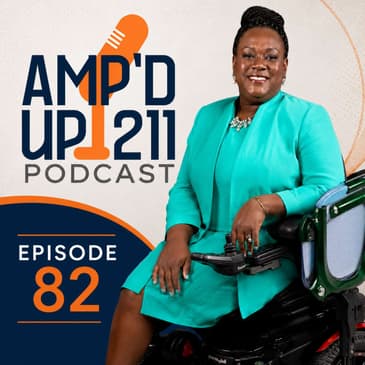
We all have a story that changes the course of our lives. For Dr. Jokima Hiller, that story wasn't simply about losing a limb, it was about discovering a new way to see herself, and ultimately, a new way to help others see disability.
When I sat down with Jokima, I expected to hear about her incredible accomplishments as an educator, entrepreneur, and hospitality leader. What I didn't expect was the remarkable story behind "Sabrina", the name of her prosthetic leg. What began as a way to cope with grief, phantom pain, and an uncertain future gradually became something much bigger: a symbol of hope, creativity, and resilience that has inspired books, children, families, and countless conversations about what it truly means to live with a disability.
In this episode, we talk about identity, purpose, and finding the courage to reinvent yourself after life takes an unexpected turn. We explore the power of humor, the importance of perspective, and why some of our greatest challenges often become the very thing that allows us to impact others. More than anything, this is a conversation about embracing who we are, not despite our differences, but because of them.
Jokima's story is thoughtful, inspiring, and deeply human. I believe you'll come away with a greater appreciation for the strength it takes to rebuild, the courage it takes to be vulnerable, and the incredible things that can happen when we choose purpose over circumstance.
The AMP'D UP211 Podcast exists to change the way the world views limb loss and disability by sharing authentic conversations with remarkable people who refuse to let adversity define them. Every episode goes beyond the diagnosis to uncover the person, the purpose, and the journey, reminding us that while every story is different, hope, resilience, and possibility are experiences we all share.
[00:00:00] From award-winning hospitality educator to entrepreneur, author, amputee advocate, and the creative mind behind the superhero named Sabrina, this week's guest has turned adversity into purpose in one of the most unique ways we've ever heard.
[00:00:15] Dr. Jokima Hiller joins us to talk about identity, reinvention, resilience, and how a prosthetic leg became the inspiration for storytelling, healing, and helping others see disability in a completely different light. This is the AMP'D UP211 Podcast, and this conversation starts right now.
[00:00:43] Hey everyone, this is Rick Bonkowski. Welcome to the AMPD UP211 Podcast. I'm very, very excited to introduce you to Dr. Jokima Hiller. She's here coming to us from? Valparaiso, Indiana. There you go. Valparaiso, Indiana. And I had the pleasure of meeting Jokima recently through the...
[00:01:07] I gotta make sure I get this right, because I know that I'm gonna get in big trouble if I say this wrong. Yes. The Amputee Support Group of Northwest Indiana. Did I get that correct? Yeah, you know. That's correct. Exactly. Which we are both part of. And I wanna give a big shout out to John, obviously, who's the founder of the group. Yes. He'll know who we're talking about when we mention him.
[00:01:37] And with that out of the way, Jokima, I wanted to just say to you, thank you so much for being here, for being willing to share your story. And especially sharing the excitement of your latest book, which I know we're gonna get into. Yes, we are going to talk about Sabrina. We're gonna get into Sabrina, her story, how she became this superhero, as you call her, which I love.
[00:02:04] But first, one of the things I want you to dive into with me is who Jokima was before amputation. Because so often, when I meet professional people, like yourself, I happen to be part of that group where life is just cranking along. And we're achieving, we're doing great things, we're reaching the pinnacles of our career. And then, whoa, something big happens.
[00:02:34] And what we thought was a particular trajectory, let's call it, suddenly goes into a completely different space. So, in your words, I want to describe sort of where were you at, at that time? And, you know, what had you been working for, working towards, and how you managed such a big life change. So I'll turn it over to you.
[00:03:03] Sure, thank you. First of all, I'm very honored to be here. Thank you for sharing your platform with me. I do not take this lightly. So thank you very much. Let's see. I always knew that I wanted to go into the hotel industry, the hospitality industry. I am an army brat. My dad served over 30 years in the army. And so we traveled extensively growing up.
[00:03:34] And I remember staying in a hotel, coming back at the end of the day and going, Mom, you didn't make us make the bed. Who did that? Not understanding that there was an entire department called the housekeeping department. Or we would go down for breakfast in the morning and then we would leave and I'd go, Oh, Daddy, we going to jail. You didn't pay.
[00:03:58] Not understanding that there were hotels specifically where breakfast was included in the raid. So at a very early age, I could articulate that I wanted to do something career wise in the hotel industry. It was magic. Things would happen and I would not have any idea how they occurred.
[00:04:19] And so I continued, had an opportunity to work at a Radisson Hotel in Merrillville, Indiana. And I was hooked, never looked back. And so I have a bachelor's in restaurant, hotel, institutional, and tourism management from Purdue University Northwest.
[00:04:42] I always tell people I'm a home girl from the Northwest, Indiana, born and raised in Gary, Indiana. And so by the time my amputation had occurred, I had done some fabulous things. I traveled all over the world as a traveling trainer for a global hotel company.
[00:05:03] I had relocated from Gary, Indiana to Indianapolis, where I also had transitioned from managing hotels to education. And then from there, I relocated to Springfield, Missouri, to take on a teaching position at Missouri State University. And then I started working on my doctorate in hospitality management.
[00:05:31] I truly was committed. But what happened was, I, when I was working in hotels, was a workaholic. You know, I was putting in over 100 hours a week. I was very committed to the industry and I had blinders on.
[00:05:50] When I transitioned into education, I kind of settled, you know, got involved in networking activities and really kind of took a deep breath. But then when I moved, I didn't know anyone. And so I once again became a workaholic.
[00:06:10] And honestly, one a year after being there, I looked up my calendar and I realized I had been ill, sick for about two and a half months. And, you know, just was working so hard, I didn't really realize how long I had had some specific symptoms. So I went to the doctor. She prescribed some medication for me.
[00:06:39] And took the medication, didn't ask any questions, had seen this doctor for a year for other things. And I began to have some side effects. Called back out to the doctor. And she said, if I was that sick, that I couldn't wait and come back in the next day, that I should go to the emergency room. I went to the emergency room that night. And several months later, I left minus a leg.
[00:07:10] And so my advice these days that I always share with my students is go, do, be right now. Because you never know what the future holds. You know, if I had not have been to Paris, if I had not have been to Hong Kong, if I had not have, you know, traveled and seen the world, I can imagine that my story would have been completely different.
[00:07:37] I would have been quite the bitter new amputee. Yeah, having missed out on those things. When they, when you went to the doctor, and I want to echo a little bit of what you said in terms of how work can take over. And yes, we tend to run on autopilot, even if we're very high performing.
[00:07:59] And I see a lot of this, even in the people that I work alongside, where you just reach that sort of elevated space where you just 60, 65, 70 hours a week. It just becomes status quo. That's just part of what you do. For sure. And it tends to create a dynamic where everything else just doesn't matter anymore.
[00:08:22] Whether that's things like going to the doctor, or eating right, or having good work life balance, or getting the right kind of sleep. You know, simple things like laughing enough, and living in a space of gratitude enough. You're just so driven and focused. What was the original suspicion when you went to the doctor? What were they telling you?
[00:08:47] And then how did things quickly spiral to a point where we're talking about amputation? Sure. Well, I will be very forthcoming. I grew up always having issues with my monthly menstrual cycle. And I was always told it was because I didn't have any children that it was irregular.
[00:09:16] And once I had a child, you know, things would all work out. Well, here I was in the height of my career teaching. This was my second career of teaching. And I moved to Springfield, Missouri, so that I could focus on getting my doctorate. I was so connected in Indianapolis that I just really couldn't focus. I wasn't a good student. So I made a very concerted effort to move to a place where I knew no one.
[00:09:45] And if I was not working on my schoolwork, I was teaching. And I had been on my cycle for two and a half months. And I literally, I can remember the day like yesterday. I was sitting at my kitchen table. I hadn't unpacked anything really because, you know, I'm a workaholic immediately once I get there. And I had been there a year. And I looked up at the calendar that I had. I did have that on the wall.
[00:10:13] And I flipped it. And I'm like, oh, wait a minute. I've been on my cycle for two and a half months. Something is wrong. Yeah, sure. So when I went to the doctor, she prescribed an estrogen type of medication. I still have the bottle today. It's called Estradiol. And the way she explained it is that it was supposed to slow the cycle to a stop.
[00:10:37] And that it was aggressive because I remember I took two of the medications each day for several days. And then it would wean off to where I would take one per day. Well, I didn't make it to the one per day. By that third, fourth, you know, fifth day, I couldn't put my finger on it. I just knew that I felt even worse. Yeah.
[00:11:03] So when I called out there and I spoke to the doctor's nurse, she said, well, what what symptoms? What are the side effects you're having? And I had already texted my sister that I felt like I was dying. I couldn't tell you, you know, if something hurt. I just I felt really bad. So the nurse said, well, if the doctor says if you can't wait to come back into the office the next day, you should go straight to the emergency room.
[00:11:31] If that's how bad you feel. And so show you how much of a workaholic and how I was just letting the world pass me by. I asked the nurse, I said, well, where is the emergency room? And she says, well, we're affiliated with such and such hospital. And I said, OK, thank you.
[00:11:51] So once I got myself together, got down to my vehicle and put into the GPS the name of the hospital, I realized it was right down the street. I had been passing it every single day to work. You never knew it was there. Big old hospital. Yeah. Didn't even notice it. Yeah.
[00:12:10] And so once I got there to the hospital and they started taking my vitals and everything, realized that I had had black blood clots that had formed in my leg from the medication. And so I tell people, what does it feel like? It feels like death, like you're dying. Yeah. Yeah.
[00:12:31] And I don't remember the conversation when the doctor said, we can't save your right leg with the blood clots have eaten away in the muscles in your legs. We're going to have to amputate. I don't remember any of that. I just remember being in the hospital, being in a lot of pain, having my sister and my aunt take over my business tasks because I couldn't function.
[00:13:01] I was so medicated because of the pain and then being sent home without a leg. Yeah. And a wheelchair. Yeah. Yeah. It was almost like I was in a twilight zone. Well, sure. And I don't know if that was God really protecting me from those moments, you know, those horrible hearing someone say, we're going to have to amputate your leg.
[00:13:28] Or if it was me already kind of zoning, you know, out of what was going on. It's interesting because I think sometimes it's a combination of both. It might be something psychological or, or let's say chemical in our minds that sort of manage stress and trauma. So, so many stories I hear are similar to yours. And, and someone might say, yeah, I was in a, an accident riding my motorcycle.
[00:13:56] And I looked down and my body was here. My leg was over there and it just didn't register almost, almost like you're describing like a surreal kind of moment. Sure. And they'll say, you know, I don't know if that was spiritual. I don't know if that was just my body's way of protecting me from the feelings that I was having.
[00:14:18] And once the sort of the dust settles, all the hurry, hurry, all these things are happening, calms down. And then there's that moment when you're home, time has passed. Yeah. Yeah. And now we're going to deal with this.
[00:14:39] Um, do you feel that in terms of challenges in those moments when you're now sort of receiving that clear signal that something is gone? My life is about to change. Do you feel like that was more of a psychological battle or more of a physical battle for you? It was both.
[00:15:09] Uh, what I didn't tell you was before amputation and all of that traveling I did, I was what I would call the best aunt in the world, not just to my own nephews and niece, but to everyone's children. So if, you know, I got the call that said so-and-so is not feeling well and they're in Alaska.
[00:15:35] I used my frequent flyer miles and I traveled to Alaska to check on that child. You know, if someone is in school and college in Texas and their parents can't get to them. I, you know, drove down or I went to go and see about that child. So I was extremely active in caring for others. And then to be home and need others to care for you.
[00:16:04] It was probably the worst thing that, that could have happened to me. Um, and I remember that first day back when my family was, was there at home and, uh, I went to sleep and I was awakened because they had prepared lunch. And I got up and forgotten that I didn't have a leg and I fell to the floor.
[00:16:32] And I just remember weeping saying, how could I forget something so monumental already? Yeah. Something else though, that made me laugh was in that same day. I, you know, said, Hey family, you know, everybody come around. Guess what? You do know I'm still on my menstrual cycle, right? Right. So the core issue was never even resolved.
[00:17:02] Uh, so, you know, I always tell ladies, if I'm ever, you know, talking to women out there, we have got to be on our P's and Q's of taking care of ourselves. I, and that's really my life story. I've taken care of everyone all over the world. And I never took care of myself. Yeah. And I, I think what you're describing, I feel for myself too.
[00:17:28] It's an issue of identity because you were a huge support system for so much of your family, extended family, you know, nieces, people that were close to you. You know, you know, Jokima was the one that showed up. Sure. She was the one that was present. Mm-hmm. Mm-hmm. And suddenly you're sidelined. And there's this huge sort of connection that gets cut off. And now, how do you approach that?
[00:17:57] But then there's a flip side to that, which I think makes it more complex, is that you were very much a thriving, overachieving, professional person. And I think that's the one that I probably pressed into most was, who am I now? Oh, yeah.
[00:18:19] And so much of that identity was built around leading, teaching, corporate climbing, networking, traveling. And then you sort of start to roll through all those sort of check boxes. And I sit back and thought, well, I can't check any of these boxes anymore. Mm-hmm. How am I going to do any of these things? How do you do any of these things?
[00:18:49] Because there's so many unanswered questions when we come to this, right? Absolutely. Because we don't know what that adaptation piece looks like. All we know is that something is missing, and now it is affecting every single aspect of our life. Every single aspect of your life. Yeah, it's really extraordinary. You know, I sit on, even today, and it's been, you know, over 10 years now.
[00:19:18] But every day when I wake up and I, you know, swing the one leg to the side of the bed and I sit there to get my day started, I go through the grieving process every morning to wait. And I'm going to say, that was one leg that went to the floor. Oh, I forgot. You know, I am a one leg, you know, amputee.
[00:19:47] And I have to make peace with that before I transition into my wheelchair to get my day started. Yeah. And so, you know, we talk about healing. And I don't know that I ever will. It's not going to grow back. It can't be replaced, even with a fantastic prosthesis. It's true.
[00:20:07] And so, to have to start from such a deficit every morning, you know, people say, well, how do you then show up in front of a class of 40 students and you've got a smile on your face? And I have to say that, you know, part of me goes, yeah, how do I do that? I don't know. And then it leads me to, you know, it's got to be, it's got to be God's grace. Yeah. And I'm glad that you find strength in that regard.
[00:20:37] Yeah. It's magical. Because I don't know, other than it's got to be his grace. But I agree in terms of the way you described it. When you're grieving, and I appreciate you being so transparent about it, grieving every morning, you know, recognizing this is the situation. You're right. It's not coming back. It's gone.
[00:21:04] And I hear that theme a lot in terms of, it's similar to grieving the loss of a person, where you say, this pain never goes away. It doesn't. That person's not coming back. They're gone. And that void will remain.
[00:21:26] And where I think we find strength and the ability to move forward in our lives, go teach a class of 40 students, is how we learn to cope with those feelings of loss. Yeah. Because as we move forward, and we adapt, we build new connections, we create new normals.
[00:21:51] And hopefully, although that loss remains, just like the loss of a loved one, we do start to recognize some of the light in our life. And I always, you know, will tell a newer amputee, the feelings you're having now, they're going to evolve. They're going to change.
[00:22:15] And most often, if your support systems are right, and you're in a good productive space, you will probably develop a newer normal, one that you didn't expect would be, let's call it your new identity.
[00:22:32] And I think it's so important to recognize that movement and that progress, because this is a perfect segue into some of the creativity and some of the beautiful, you know, narratives and stories.
[00:22:51] And just, in my opinion, incredibly inspiring path that you've taken, you know, with this endeavor into, you know, Sabrina, these books, and all the things that you're doing that are just extraordinary. And I'm a creative myself.
[00:23:14] So when I see someone taking all that energy, right, trauma, pain, loss, and it becoming something truly beautiful, then I think, well, none of these awesome, great, cool things would have happened if Jokima didn't lose her leg. Exactly. For sure. For sure.
[00:23:40] I don't think we're denying the sadness, right, of our tragedy by celebrating the goodness that came from it. It doesn't minimize that loss. It doesn't say that it was a good thing necessarily. It recognizes it, regards it, and honors it. But it does it in a way that gives people hope, and it gives them the ability to say, you know what? Life is good. Everything will be okay.
[00:24:10] And we find new pathways. So, and I know you've spoken about this in group, and I really want to share this with our audience. Talk to me about when you recognized, and I love this story, when you recognized that your prosthesis had a name. All right.
[00:24:34] Well, when I was still in the hospital as a new amputee, I am very fortunate to have been visited by a peer, amputee peer, who also was an amputee, and she was also an educator. And she came walking in with gym shoes on. And if she had not have had on shorts, you would not have known that she was an amputee.
[00:25:02] And she gave me some advice. She said, after you get home, you're going to have a multitude of doctor's visits, physical therapy visits. And she says, name your prosthesis. And she said, so that they have to call your prosthesis by name.
[00:25:25] And she said, so instead of them saying, make sure you are wearing your prosthetic device, or we need to make sure that, you know, we tweak, or everything is okay with your prosthesis. They'll call it by name. And so you, too, will have names. And that stayed with me. So we fast forward. I get home. I get fitted for my first prosthesis. I come home with it.
[00:25:52] And at the time, my cousin was there. And she has a daughter who is my goddaughter, my cousin and goddaughter. And she was about six years old. And nobody really, other than my mother, could embrace my, what you call stump, your residual limb.
[00:26:17] But I noticed that when I had on my prosthesis, people were a little bit more comfortable coming around me. So my goddaughter came up to me. And I said, oh, you know what? I'm supposed to name my new leg. Kaylin, could you name her? Do you, what should we call her? And she was sassy, as people say I was when I was a little girl. She put her hand on her hip.
[00:26:44] And she goes, and everybody, my nickname is Jodi. And everybody calls me Auntie Jodi. She says, Auntie Jodi, she looks like a Sabrina. And I said, a Sabrina? And I'm thinking, where you get Sabrina from? We don't have anybody in our family named Sabrina. Is that a witch? Is she good? Or is she bad? Tell us about her. And she says, oh, she just looks like a Sabrina. And I said, okay. And it stuck.
[00:27:12] It stuck so well that sometimes when I would go to a doctor's appointment and I did not have Sabrina with me, they would say, well, where's Sabrina? And I'm like, I'm here to get my blood drawn. What about me? But the telltale sign was I had started to get back to going to church. And I would wear Sabrina and I was using a walker.
[00:27:42] And this particular day, I'll never forget because I got there early. I never wanted to be in the way. I never wanted to call attention to me. And so I got to church. I chose an aisle seat. I took my walker. I put it inside of the aisle. And I waited for church to begin. And all of a sudden, I heard this lady from all the way over on the other side of the church screaming, Sabrina!
[00:28:11] Sabrina! And she was out of breath. She was literally running across the church. And I thought, well, we do have another Sabrina at church. She's got to be talking about her, right? No. She comes and she leans over and looks at my leg. And she goes, whoo! I just, I needed to check on Sabrina this morning. Make sure she was all right and to see what shoe she had on today. Yeah.
[00:28:41] You all right over there, Sabrina? And I was like, lady, do I, I don't even know you. Yeah, Sabrina was a rock star. And she was born. Yeah. That, you know, she had had the name. But that day, I realized I'm on to something. That Sabrina could have a character. She's got fans.
[00:29:08] And I just remember thinking to myself, maybe now this is my new purpose. You know, I had gotten so used to being known as the queen of hospitality, which is my background in hotel management. I had gotten used to being Auntie Jodi, you know, the world's best aunt. And I didn't want to lose those titles.
[00:29:36] And so I really hadn't embraced being an amputee, hadn't really embraced Sabrina. But that day, I thought, well, maybe that's why I feel lost, is because maybe I'm not the world's aunt, best aunt anymore. You know, maybe that's not my purpose. Maybe I'm not the queen of hospitality anymore. Maybe that's not really what my purpose is now.
[00:30:03] Maybe it has to do something with this girl, Sabrina, that's attached to me. And I just remember, you know, I would post on Facebook, Sabrina says. And it would be me literally channeling what I was feeling or, you know, how I thought about things. And just the feedback, the interaction.
[00:30:33] She, you know, I posted her photo on Instagram my first week that I joined Instagram. And I'm like, wait a minute. I had like one follower on Instagram. Now I've got a hundred because of Sabrina. Yeah. And I thought maybe this is I got to do something with Sabrina. She's she's it.
[00:30:56] I mean, it sounds like Sabrina was a component of so many things in healing and coping. In humor, in identity, in it's just this sort of force that I guess created a lot of connective
[00:31:18] tissue for you in that Sabrina created the change and the recognition of, well, I can move on. I'm accepting this. And I think a lot of amputees do reach that point, hopefully sooner than later, which is, OK, this isn't growing back. This isn't changing.
[00:31:49] How much power do I really have in this situation? And very often when I speak to people like yourself, we will talk about the idea. And I've spoken about this before of day one. And day one, it's it's not the day that you found out you were going to lose a limb. It's not the day of your surgery.
[00:32:15] It's not the day that they handed you a prosthesis. Day one is the day when you said. It's not coming back and it's time to live. And absolutely. Thank goodness for Sabrina. Along with that as well, Rick was no one's coming to rescue me. Yep. Like I had rescued other people.
[00:32:43] It went along with that that realization that I needed to get my independence back because the family, friends, the world, they're not willing to give that up for me. You know, they're not going to come and take care of me. They're not going to come and, you know, make things better. No one's writing a check. You know, nobody's coming to save me.
[00:33:11] No one's coming to save me. And so at that point, I realized I had to do it for myself. Yeah. Yeah. And I think this is a really good moment to pause and examine that because I do believe that those are powerful words for a lot of reasons. And I know there's amputees listening to this right now that are in that space and they're looking around and they're waiting for someone to come and save them.
[00:33:40] Oh, yeah. And the advice I have to give them as hard and as tough as it sounds is nobody's coming. Nobody. Nobody. You are on your own. And I will. It's important for me to give credit to both my mom's sister, Evelyn, and to my younger sister who became my big sister, my sister Jocelyn.
[00:34:08] Both Evelyn and Jocelyn came the eight-hour drive to Springfield, Missouri and helped me, you know, to my new normal. But even having them there, there were certain things that they couldn't do for me. Right. And so the goal was always going to be independence, which is why I love when people realize,
[00:34:36] well, it's your right leg that is amputated. How did you get here today? Or my students will give the realization, I saw you pull up in that van. How did you drive? How does that work? Well, my sister and my aunt took me to this open parking lot. There was nothing there. They put me behind the wheel and they got out. They were like, you need to figure this out. Yeah. We got to go. Yeah.
[00:35:06] And you don't need to know how to drive back. You don't need to be in the car when you're doing it, but you need to figure it out. Exactly. You know? And I was like, you guys aren't going to be in here with me. Yeah. We'll be over there. They went and sat on the side of the road. Yeah. No, it was too funny. So I drive with my left foot. But these were all moments where I had in the back of my mind, they're going to go. Yeah. Yeah. I drive with my left foot as well. And it's just going to be me. No, I agree with that. And it's just going to be me.
[00:35:34] And I think the support systems are critical. I think the encouragement, the humor that family and friends can bring. Yes. You know, the thoughtfulness and the kindness and all of those things are so critically important. And please, family and friends, don't stop doing that. Because anyone that's dealing with a disability or a chronic illness, we need help. Of course. We need a leg up. No pun intended. Yes.
[00:36:00] But when it all boils down to the yes or no questions, am I going to thrive in this space? Am I going to work? Am I going to have purpose? Am I going to write books? Things like that. No one is coming for you. No one is going to fix that for you.
[00:36:26] No one is going to get you, put you in that space that forces you to make those deliberate choices about living again. And that's when the really, really hard work starts. And we have to be willing to do that. No matter what it looks like, whether I'm in a prosthesis, whether I'm crutching, whether I'm rolling, whether I'm crawling, okay?
[00:36:54] I am going to navigate life. I'm going to figure it out. And it's different for everyone. Completely different. Absolutely. And when I meet people like yourself and see what you're doing with your life now, you know, how many years later, that's when I realize that this is someone who has made a very, very serious and deliberate choice to live again. And that doesn't mean that there aren't tough days.
[00:37:23] That doesn't mean that there isn't a moment of sadness. I go through it as well, where I think, I look down and I say, this is really bad. This is really bad. Yeah. This is not fun. My mom is no longer with us, but one of the toughest conversations that I had was I was still in Springfield, Missouri. And then this time I'm by myself and my mom was beginning to get sick.
[00:37:52] And so we talked and she made the comment. She said, you were my first to walk. Meaning of her children, I walked at the youngest age. Yeah. And she said, and you have traveled extensively. You have danced. I was a ballerina. I was a tap dancer.
[00:38:21] And even in my adult life, I was a ball, took ballroom dance lessons. And she says, I don't know why God took of all things the thing that made you really you with your dancing and everything. Yeah. And we cried. And I said, yeah, that was my exercise.
[00:38:46] That was, you know, my getaway from being a workaholic was I could turn on music and I could dance. And I don't have that now. And so she said, hold on. I need you to hold on. Because I was at that moment where I was like, of all things, my leg. You know, why not a finger? Yeah.
[00:39:14] You know, why not maybe the baby toe? You know, but my whole, I don't have a knee. My whole leg. Why of all things that? And she just told me to hold on. Better is coming. And then for her to pass.
[00:39:35] And shortly after that, for me to dance at my wedding reception, you know, I knew that that was her telling me that I needed to figure out how to get back to dancing. Yeah. The good things are coming. Yep. Yeah. That brought me to you. Hang in there. That I would figure it out. Yeah. I would figure it out. How to do the one thing that really brought me joy.
[00:40:02] It was a great gift that she gave you before her passing. Yeah, absolutely. So I think that's a wonderful story. Thanks for sharing it. I want to talk a little bit about your creative energy that you put into the books. How does that come together for you? You know, I know you've just released, you know, your second book. Walk me through that process as far as, you know, the design, the stories, you know, the ideas behind it.
[00:40:32] Well, at this point, I was still in Springfield, Missouri. And I had returned back to work. I only took one semester off. But I had challenged everyone around me, my prosthetists, physical therapists.
[00:40:49] I said, you know, I have been told that that is my calling is teaching, you know, lodging management, teaching people, students how to operate hotels.
[00:41:05] I cannot go back into the classroom in a wheelchair because a part of my teaching ability is my ability to stand, walk up and down the aisles, look into the faces of my students, connect with them, to be on field trips, you know, touch and see and smell the different hotel products that are out there. I want to walk back into my classroom.
[00:41:32] And so in the design of Sabrina getting me back, you know, on my feet, I did walk back that next semester into my classroom. But with it came some criticism. I had a fellow teacher, colleague, and I remember one day she looked at my feet and she says, you know what?
[00:41:57] Why is it every time I see you, you and Sabrina have on a new pair of shoes? And I thought she witnessed my struggle to get back into the classroom, having visited me in the hospital, you know, having been there and, you know, saw me struggle to use a cane to walk to my class.
[00:42:20] And for her to witness that and have dwindled it all down to what I felt was being petty about me spending money on shoes, she didn't know the story behind how we are taught how to go up and down stairs. You know, you have to make sure that your foot is flesh, you know, to the back of that step when you go up because you got to be stable.
[00:42:44] And then coming down, you got to kick your heel, making sure it's flesh to the back of that step, that you're stable when you make that step. I wound up having so many frayed shoes, holes, you know, until a couple of months will go by and I'm like, oh my goodness, Sabrina, look at your shoe. Let's go shoe shopping, you know, and I wasn't a big shopper. You're burning your shoes.
[00:43:12] I turned into a shopper of shoes because they were always being damaged. And here I am standing in front of students. I didn't want, you know, and we were required to wear suits to teach. I didn't want to have on, you know, shoes with holes in them. And so at that same time, I met with a colleague who had heard about my story.
[00:43:38] And we were there on campus at the cafeteria. And we were discussing and she was telling me what she had heard about me and that I was just so inspirational and everything. And I said, you know, I still don't know what my purpose is. You know, I feel like God chose me for this. I don't know why. But I'm just twisting in the wind. You know, I'm no longer looked at as an expert in hotels. You know, I'm no longer the aunt that everybody calls.
[00:44:09] What, who am I? What am I supposed to do with Sabrina? You know, and she goes, oh, I can see a coloring book. And she was so excited about it. And it took me a year to make that happen. And I thought in the back of my head, I'm like, well, now we do like shoes now because of having to get in the habit of buying them. Yeah.
[00:44:34] You know, and that process in and of itself for Sabrina and I was a huge challenge because it was so difficult to put a shoe on her foot. When I would go shoe shopping, I would have to carry her in with me and sit her on my lap and change the shoe because it could fit me, but it might not fit her and vice versa. So I thought, what do I do about that?
[00:44:59] Developing a character for Sabrina and putting it together with a coloring book. And before I knew it, I had a story in my mind about Sabrina and her new shoe. So that was the first story. It was important for me that it not just be a coloring book that would attract children, but it needed to have a story. Yeah, a real story. And so I told the story of why she had a new shoe. Yeah.
[00:45:29] The importance of it. And also, I envisioned in my mind that, you know, grandparents and parents would sit down like my mom used to do in the middle of the living room floor with her legs crossed. And she would read to us. And so that's what I imagined is that they would read the story to their children and then they would give them the book to color the page.
[00:45:56] And so it was a way to bring together parents, grandparents and children along with a story for them to read and color. But in the underlying purpose was to show them something that was different. Someone that was different who still did something that everybody else does, which is purchase shoes. So that was the first one.
[00:46:21] And I have to tell you, I've got three hotel books that, you know, on sale from Amazon, Barnes and Noble, you know, the whole nine yards. I've done the speaker circuit with the books. But when Sabrina and her new shoe came out, I was selling them out the back of my head. Everybody wanted one.
[00:46:47] I had book signings where, you know, I would get down to the last book and go, but wait, I don't have one for myself. And someone would say, well, now you don't have any because I want to buy that one. I would sell out. Yeah. And so it just really has been wonderful to see yet again a whole new group of fans embrace Sabrina. And by the way, she would be very upset if I didn't tell you her full name.
[00:47:15] It's Sabrina Latrice hyphen Louise Hiller. So Latrice is actually my middle name. And then Louise is my aunt's middle name that came and really stayed with me for a while until, you know, I became truly independent. Wow. Yeah. You'll only hear that here. Sabrina's full name. I said, you'll only hear that here. Sabrina Latrice Louise. That's it.
[00:47:42] You've got to, you've got to recognize she's, she's pretty special. So, and then what sparked you to go and revisit Sabrina as a superhero? Well, her fans were like, that was it. I mean, she's not going to do anything else. Yeah. And so I started thinking, what can I do though, to make her sustainable?
[00:48:10] Because now I'm thinking, what, what, what do I talk about now? You know, now what am I going to do with Sabrina? And actually my physical therapist here in Northwest Indiana, one day we were just talking and I said, maybe need to reconnect with that sassy little girl that people say that I was.
[00:48:35] Dancing and bopping all around, you know, always in green, which is my favorite color and twirling in my, you know, green dress. I need to reconnect with that sassy little girl because life had gotten difficult for me, you know, trying to still work to the standard that I had set for myself.
[00:48:59] And, you know, I dealt with phantom pain and I dealt with physical pain in my limb from, from a fall. And I just was really down. And so I remember asking my physical therapist, I said, what if I turn my leg, Sabrina, into a little girl? And he goes, you know, I want you to do what makes you happy.
[00:49:25] And I thought that would make me happy to see me in a book, you know, that, that little girl in a book. So I thought, let's transform my leg, Sabrina, into a little girl with a prosthesis. And then that gives her more room, more space to grow. Sure. You know, what if she becomes a teenager and gets her permit, needs to drive?
[00:49:53] You know, there, there would be more for me to develop with her story. So we, we move away from Sabrina being the, the prosthesis. And now she's the little me, mini me, Sabrina Latrice Louise Hiller. She's a 10 year old little girl who has a prosthesis,
[00:50:14] but she still is focused on shoes in that she's delivering shoes to people who need them. Yeah. So see, she's a superhero. And I don't know about, you know, other little girls out there in the world or women, period, who wouldn't want to go and buy shoes for people. I mean, what, is that a job? I want that job. Yeah, I think that's a... But she hears the call.
[00:50:43] She hears the call that, you know, the grandmother who's waiting for the children, her grandchildren in the winter at the bus stop needs a new pair of boots. And she goes to her workshop, gets a pair of boots and delivers them to the grandparent. And my brother is, older brother had challenged me many years ago when I first became an amputee.
[00:51:10] He would buy me socks for Sabrina and they would have, you know, different words and sayings on them. And he said, you know, just don't put her in a cape. And I thought, a cape? Oh, the superhero needs a cape. Oh, for sure. So she has a very vibrant cape. She flies around the world and delivers shoes.
[00:51:35] And so in my mind, this is part one of a five-part series to where we're going to go back and tell how Sabrina morphed from a prosthesis to a little girl. You know, she's got some room. We're going to show her growing up, maybe, you know, to a young lady and kind of giving her more of who I was. Yeah. You know, but she's also an amputee navigating the world. So. I think that's beautiful.
[00:52:05] And where for so the audience can enjoy these books, where do you recommend sending people if they want to purchase? Sure. They can purchase exclusively from Amazon dot com. Go into the search key. And if you type in Sabrina, the superhero, she's the first thing that pops up. Okay. That's amazing.
[00:52:30] You can look underneath my name, although this series is going to have my married name because I have been so encouraged by my husband. So my last name is Lewis for this book series. So you can type in Jokema Hiller Lewis and it will pop up as well. Yeah, that's wonderful. And these books are truly fantastic. You are nice enough to actually give me the first book that you did.
[00:53:00] And I've yet to see superhero. I'm definitely going to get my hands on it. Yeah, I'm definitely going to get my hands on it. I would recommend to everyone, you know, check it out. You know, embrace Jokema's story. She's really an extraordinary person in the community. And it's been such a pleasure to get to know you.
[00:53:24] And again, looking forward to, you know, seeing you in support group and continuing, you know, this journey that we're both on and doing great things in the community and supporting and being part of, you know, that light that people need in this particular space. So, yeah, I really thank you for being here. That's going to wrap it up for us. My name is Rick Bonkowski.
[00:53:52] This is the The AMP'D UP211 Podcast. And I want to wish everyone health and happiness. We'll see you next time.