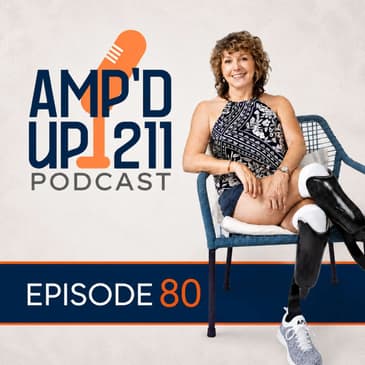
Some stories change you while you’re listening to them. This is one of those episodes.
In Episode 80 of AMP’D UP211, I sit down with author, amputee, and sepsis survivor Katy Grainger for an incredibly honest conversation about trauma, survival, identity, and rebuilding a life after everything changes. Many people know Katy’s story from the medical event that led to the loss of both of her legs and fingers, but this conversation goes much deeper. We talk about the emotional aftermath, the process of writing her powerful new memoir Finding Solid Footing: Thriving Beyond the Unimaginable, and what it was like to revisit some of the darkest moments of her life to help others heal through her words.
This episode is not just about limb loss. It’s about purpose, resilience, fear, reinvention, and the difficult work of finding yourself again after life takes a direction you never saw coming. Katy speaks with incredible vulnerability about grief, recovery, motherhood, faith, and the emotional reconstruction that happens long after the physical healing begins. If you’ve ever faced adversity, struggled with change, or wondered how people find the strength to move forward after devastating circumstances, this conversation will stay with you.
AMP’D UP211 exists to tell authentic stories from the amputee and disability community while breaking down stereotypes and showing the humanity behind these journeys. Whether you are an amputee, a caregiver, someone navigating trauma, or simply looking for perspective and inspiration, Episode 80 with Katy Grainger is a conversation you do not want to miss.
[00:00:00] There are moments in life that change everything. Not gradually, not over time, but in an instant. A small infection, a normal day, and within hours everything begins to unravel. You may remember today's guest, Katy Grainger. You've heard parts of her story before. The fight, the survival, and the unimaginable road that led to life as an amputee. But today we're going deeper. This isn't just about what happened, it's about what came after.
[00:00:26] What it takes to go back into your darkest moments, to relive them, right them, and then somehow turn that pain into purpose. This is the AMP'D UP211 Podcast where we explore resilience, identity, and what it really means to rebuild your life. And today, Katy Grainger is back with a story that might just change the way you see your own.
[00:00:54] Hey everyone, welcome back to the AMPD UP211 Podcast. We have a very special guest today. We are revisiting... Katy Grainger. Katy, how are you today? Katy Grainger. I am doing great, thanks. How are you doing? I'm doing great. And I am really excited to let our audience know about your book, Finding Solid Footing. This is a very, very big deal. If you don't know Katy, shame on you.
[00:01:19] However, she has been quite a force in the limb loss, limb difference communities as well as the sepsis community, as she is a survivor of sepsis. And I'm sure this interview is going to reveal a lot of your backstory. So if you did miss our first episode with Katy, I don't even know how long ago that was.
[00:01:48] It was in August. I just was looking at it. It was in August. It was in August. So August last year. Yeah, so I got my book finished within the year of that date. So we got to come in a little quicker. Oh my gosh. Then you probably would have invited me back. But I've got some fun, exciting things to talk about. Good for you. So I'm sure this conversation is going to, you know, certainly develop a lot of recall in terms of how you landed here and you being a survivor.
[00:02:12] Sure. I think the thing that I want to talk about a bit as well, when I think about the idea of writing a book after what you've been through, I think what comes to mind is what does that journey feel like?
[00:02:29] And what I mean by that is what kind of emotions, what kind of memories, because so often when we go through a trauma and we rebuild and we navigate and then we get back to that new normal, sometimes we sort of leave that in the rear view and we say, okay, I'm good. Like that's over. Yeah, for sure. That's in the past. For sure.
[00:02:55] And then I think Katy sits down and says, now I'm going to revisit all that and I'm going to write about it in detail. Take me through that process. And what I mean is the good, the bad, the ugly. What is that like?
[00:03:20] Okay. Now, quick question. Do you want me just to give a quick rundown of what happened just for anyone who maybe didn't see before? We're going to let that happen through osmosis. Okay. Okay, great. All right. We'll start then with me surviving septic shock. It was unexpected. I was in my early 50s a few years back.
[00:03:43] And it ended up that it got so severe that I nearly lost my life, but I lost both my lower legs and seven fingertips. So I'll give you that preview of the story. And it was such a huge life change that not only do we sometimes like to put it in our rear view mirror, let me get that right, but we also like to bypass a lot of the healing.
[00:04:05] Yeah. So when you ask about the journey of the book writing, it was a lot of the continuation of my healing. And I was just thinking when you were talking about an example I have is that I see people on social media because I'm on there now a lot. And I share my story on TikTok, but I didn't start sharing it until four years into my recovery because I was just like, I can't even, I don't even know how to process this and what to say.
[00:04:31] And I shared it with my friends and family on Facebook group. But other than that, I was just, and I shared it a little bit publicly for Sepsis Alliance because I joined their board, but I didn't go deep. I just said, these are the medical things that happened. It really sucked. Move on.
[00:04:48] And somewhere about the three to four year mark of my recovery, my family actually kind of took me aside and said, you know, you're doing all these great things for Sepsis Alliance. You're going to all these events for Amputee Coalition. You're making all these friends in the community. You're up and about and you're smiling and you seem happy.
[00:05:10] But we just want to be a reality check that we don't think you've processed. And we want you back like fully. And we can tell that there's things that you're not wanting to deal with. And you think that we don't know, but we know. And it was such a powerful moment for me to be called out like that because it was almost like during my early recovery, I was in denial that I was going to lose my legs.
[00:05:38] And that was very effective and very important. And it was just a couple weeks before I was able to admit that I knew I was going to lose my feet. And my family allowed me that time and it was really important in my healing. But this drug on, like I say, many years. And I was just bypassing a lot of the emotional healing. And even in writing the book in my early days, I started probably six years ago in writing workshops.
[00:06:04] I would tell a lot about the story, but then people, the feedback I would get in my writing groups was kind of, what did that feel like? And how was it going through that? And how did your family react? And these deeper questions that I'm like, oh, I don't want to talk about that. I don't want to think about that yet. But so that wake-up call was huge for me. And I'd already written quite a bit of the book, maybe half of it by then, and half of the stories at least that went into it and the stories that got cut out of it as well.
[00:06:34] But in going back, I was able to add a lot more depth because I did start seeing someone to get some help with my healing. And I just started really peeling back my own layers of defensiveness, I think, and denial and really started getting in there. And I used my writing as part of the healing process. So I went back into some of those chapters that I'd written earlier and I started saying, gosh, what was it like when I woke up and saw my fingertips?
[00:06:59] And realized that they were black from the very beginning. I had DIC, which is a secondary condition that can happen with sepsis. It happens in about 10% of people with septic shock. And I got lucky and I got that. And so it caused bleeding in my capillaries at my fingers, starting with my fingertips and my toes, but then going back into my hands and feet.
[00:07:22] And then I survived all that, which is fabulous. But it did cause the loss of the fingertips and then eventually my full feet. So in the spirit of review, because I agree that some of that backstory is important and wanting to sort of weave that into the now.
[00:07:43] Because what you're saying is by writing the book, having to recall, having to recount and knowing, okay, from what I remember about your story is things simply starting as a, what seemed like a very superficial wound. Right. Correct.
[00:08:03] And understanding that what escalated from there was very rapid, very quick, literally life-changing almost in a moment. And looking at that, writing about it, but then like you're saying, this isn't just a chronology. This isn't like step one, step two, step three.
[00:08:29] This is, here's what happened. This is what I was thinking in that moment. And here's where it took me in terms of my deeper feelings. And so much of that, I would agree with you, is a therapy in that now you're zooming out a bit, but at times sort of zooming in like really, really tight and saying, yeah, what was I thinking in that moment?
[00:08:58] How did that make me feel? And what were the consequences of that? And how can this serve as a roadmap, as a guide, as a cautionary tale to say, here's something that can happen.
[00:09:13] And I want people to understand not only the urgency of that and how important it is from a medical standpoint, but also if you've suffered a trauma, and we can even step outside of sepsis. If you've, if you've, if you've suffered a trauma, here's how. Medical or otherwise. Yeah. Yeah. Emotional, whatever it is, whatever that disability is or whatever that trauma is, you can survive. Because I'm here.
[00:09:44] And I'm living to tell. And I'm putting it, you know, on the page so that people can understand and make those connections and feel that there's a place to put all of that worry or all of those feelings. So, um, I appreciate you being so transparent about, well, yeah, it was, you know, a lot to sort of work through that.
[00:10:09] And you said that, um, you did some like workshopping and you were sort of assembling over time. Like, what would you say is the period of time between you started developing some of those ideas and let's say today? Um, so I, um, this happened in 2018 and, um, in, at the, in September and I lost, I got my first prosthetic legs three months later at the beginning of 2019.
[00:10:37] At one year later, I was asked to be on the board of sepsis Alliance. So I was very privately healing at that point and was just learning to walk and learning to drive and getting on a bike and seeing if I could balance. And, you know, just seeing what I could do, just getting on my feet and getting familiar with this new body. And, um, and then I was invited onto the board of directors of sepsis Alliance. And a year after that, so the, the end of 2020, um, I was invited to give a keynote speech.
[00:11:05] So it took me about two years before I started kind of sharing the story and putting, and when I did the keynote speech, I had to sit down and sort of say, what was the series of events that brought me to where I am? And I was speaking about it kind of on a medical perspective, but then I also wanted to add some personal notes about it so that other sepsis survivors and their families could relate to it. And, um, and people in the amputee community. Um, so it was about two years before I really started. Well, that's not entirely true. I did, I did a writer's workshop in there.
[00:11:34] So about 18 months after, and so it's almost been eight years. It'll be eight years in September. So, um, it was about six solid years before that I have been writing the book. And it started in workshops just with, um, giving, uh, writing prompts. And we would write for like an hour. We'd write for 45 minutes or an hour and a half depending. And I would just brain dump whatever ideas I had. And it was always about sepsis. It was always about this experience because at that point in time, it's all,
[00:12:01] I felt like, I mean, that was my whole life, you know, it was just like this thing that had happened to me. And, um, over time I started writing a little bit about other things, but by the time I was capable of thinking beyond sepsis, I realized this is a book and I want this to be a book. So I did workshops over the years. And I also did, um, during COVID, we started doing these really cool online, um, monologue performances where like six to 10 people from the workshops would write. And then we'd get online and we'd perform our monologue.
[00:12:29] And so I, I started realizing after a couple years of that, that, um, that these were chapters or, or a story within a chapter. And many of them are, are in the book and, and became a part of the book. And it was just this great way that I could just piece by piece write it. And it's, you know, if you read the book, you know, that like one of my first survival tools was tiny steps was, it was too overwhelming to think about my future. That was like impossible.
[00:12:58] I couldn't, and I mean, I couldn't even think to the end of the day because I was having difficulty breathing when I first woke up from the coma that I was in. And I was having, you know, just difficulty just with everything and cognitively I was not well. And, and so I just would think, what is the next thing I need to do? And I just started just moving myself forward just in these tiny steps. And I used that throughout the first, um, really three, I would say three months was a huge thing.
[00:13:23] Literally just like, okay, as soon as I'm done with this interview, I'm going to put away the stuff on the table and I'm going to organize my things to start getting my book online to get published. You know, I mean, I would just say this, I'm going to do that little step and it's going to take me five minutes and I'm going to do that step and it'll take five minutes. And then over time I've spread those distances out, you know, but that just sort of got me through that time that was so, that was so difficult.
[00:13:45] Yeah. And I think that, um, I personally see writing as a form of therapy and so often, um, being able to articulate your thoughts is one thing, but when you're forced to really compose something and there's an editing process and, you know, you're sort of rereading, proofreading, you know, I didn't quite say that the way I thought it should be, or, um,
[00:14:15] you know, I'm, I'm, I'm, I'm trying to make this point or I'm trying to create this momentum in this particular section or piece. And I think so much of that, it's like sort of medicine for ourselves and processing through a lot of those feelings.
[00:14:37] And I think the end result is we're never necessarily done. Okay. We're, we're, we're never truly baked in any of this. It's, it's this evolution. Where am I at in the now?
[00:14:55] And in this point in time, exactly. Like where am I at in, in my progress, in my pursuit of, and I think this is such a milestone in this moment for you.
[00:15:08] Yeah, it is. It's, it's, it's, uh, you know, this, this, this huge, you know, kind of, uh, mixed bag, this, this huge sort of, you know, achievement of all of these experiences, all these things that have happened, especially in the community itself.
[00:15:27] Because knowing what you know now, let's say, then you did, you know, when you went through this and had your amputations and were just trying to navigate life again, knowing what you know, know now and what the community requires of us. I think you even mentioned that before we started taping, um, you know, what, what are we representing in this space? Yeah.
[00:15:55] And I always go back to the word serving. We, we have to serve. And what are we bringing to this? You know, what does our light look like in this sort of community? And this is going to be a tremendous, uh, you know, piece of work for people to engage and learn a lot from. Uh, and I'm sure, uh, you're going to get lots of, you know, support, more following.
[00:16:27] And what would be the thing you would say to someone who's just discovering you now, what would be the thing you would say to them as far as this is what I want you to take away from this book? Um, I think, you know, I mean, a lot of people say this, I've heard it said many times about books, but I kind of wrote the book that I wish I had when it happened to me.
[00:16:49] And I will say there were books out there and, um, there, there were some books out there, but there wasn't, I didn't find a lot on social media. I didn't find a lot of people in the real world. Um, so I, I think from the book, I want you to understand that you're not alone and that there are a lot of us who have been through what you've been through or are going through something similar. Your, your situation may not be limb loss from sepsis. It probably won't be.
[00:17:17] Um, and I hope that's, you know, I mean, it's, that's a tiny portion of the people that will buy the book, but, um, but it, it will be some type of loss. And I encourage you, you know, you found me hopefully finding my book and finding this podcast and, and finding these two people within the limb loss community, but keep reaching and keep searching because, you know, find out who do we follow online?
[00:17:41] Who are we talking to? Um, you know, what other podcasts are out there? What events are there that you might go to in person? Because I've made some of the best friends over the last few years. I still go every year that I can to the amputee coalition conference. And, um, there's other groups that have conferences and it's something that I do personally for myself. When I go, I end up setting up a table for sepsis alliance because I want to share information about that, but that's not why I'm there. I'm there for me.
[00:18:07] And, um, and it's just to see this community and it, I feel like it is growing. I feel like it's definitely grown online. Um, but I've mentioned there were books. So Amy Purdy was sort of the person that I found in the hospital. My kids introduced me and Amy is a Paralympian. She was on dancing with the stars. She's an all around fabulous woman.
[00:18:25] And she lost her lower legs from meningitis and sepsis when she was 19. And, and, um, in my early days of following her, I remember seeing a post that said today's my birthday and I've officially lived over half my life with these legs. And, and now it's been longer for her. She's in her forties. And, um, she, um, had a great book that told her story and it was definitely, I didn't, I didn't ever set them side by side, but just her telling her story definitely inspired me to tell mine.
[00:18:55] And honestly, one thing is I hope I'm inspiring someone else to start exploring their story personally for healing. And then also considering maybe taking some writing workshops and just journaling or doing something to, to work through it because whatever you've been through, whatever thing that you found unimaginable,
[00:19:11] unimaginable, which is from my title, you know, thriving beyond the unimaginable, whatever that is for you or might be for you. Um, writing is a great way to work through it. And it can be something that no one else will ever see, which is what mine started as. And it might develop over time that you start writing and you realize, wow, these three little pieces kind of go together. And that's sort of the first chapter of what, what happened, you know, and, and you start, I mean, over time for me, it just evolved, but, um, I hope that, you know, it can be an inspiration to others to think about doing that for themselves.
[00:19:41] Cause it was a part of my healing. Yeah. And, and, uh, Amy Purdy, uh, huge, you know, presence in the community. Um, you know, I follow her as well and, uh, you know, it'd be a dream come true to meet her someday, but I want to talk a little bit about the conference too. And that dynamic, because I always think of, I guess the fact that everywhere I go,
[00:20:11] generally I'm the only amputee in the room, you know, if I go to the grocery store, um, I'm the one, you know, I get on a plane and I'm the one. And that becomes sort of the common thread in our lives. Yeah.
[00:20:29] We're just different. And it, it, it, it tends to be an exercise in humility and just kind of being comfortable in your skin and, and, and, you know, trying to, uh, adapt to, uh, what I see as a little bit of a social challenge.
[00:20:48] And the one thing that's pretty extraordinary about the conferences, the conventions, amputee coalition limb, limb, limb preservation foundation, you know, wherever you're going, I know that there keeps sprouting up, you know, new events, more events, empowerment events, things like that. Mm-hmm.
[00:21:09] Wherever you are, there's nothing more, um, sort of inspiring and empowering is that when you're in a space and you look around and it's amputees everywhere. Yeah. It's pretty cool. It's amazing. It, it feels so validating and you feel seen and understood. And it's a feeling that a lot of us haven't had, you know, in our, we don't get that in our everyday lives. We, we feel seen, but in a very different way.
[00:21:38] We feel like, Oh, yep. I'm the one who's standing out, you know, and yep. I, you know, I mean, it's not, it's not bad. I'm not, I, I appreciate when people approach me and sometimes they'll say things like, Oh, good for you. You're doing so great. Yeah. Sometimes it'll be a little kid saying, you know, why does that lady have robot legs? That was when I got last week, which was awesome. And I love, I love those moments just to educate a little bit about sepsis. It always gives me an opportunity to tell people to look out for the signs and symptoms. Sure.
[00:22:03] And it, um, and it gives me a chance to show kids that bodies can be different, but people are the same. And, um, but yeah, the conferences make us feel seen, understood, heard everything there. You want to go to every workshop because they all apply. Yeah. I can relate to all of these things and difficulty with insurance and, and, um, how it's changed the intimacy in your personal life, you know, or just, I mean, there's a million different topics that pop up and you're like, these are all important to me.
[00:22:32] You know, how to get out there and start sharing your story. I mean, they'll have topics like that. And, and, um, like I say, I mean, I, I do always encourage that with people and it starts just with yourself, grab a notebook and start writing down some of your feelings and some of the stuff that's happened. And who knows where it's going to go. I mentioned, I just quick thing. I mentioned baby steps and that's what I was just going to say. That's why it took me six years. I never set an end date for this. In fact, right now the launch is scheduled for the 5th of May.
[00:22:57] And I still have a few days to change that because I've got a couple edits that are going on in the book that may not make it. And it might end up the 12th. And I have had that flexibility the whole time because I knew that the book was not, I didn't ever want this to be, I'm self-publishing. I didn't ever want it to be something I did for anyone else.
[00:23:14] I'm doing it for myself. I'm doing it for my family and I'm doing it for these communities to have this resource. And I feel like I just represent, and you know this about me, I represent just a lady, just a person. I'm 60 years old. I, I have a hard time saying that and admitting that, but we were talking about at the beginning of the podcast. It's just the reality. And I'm happy that I get to be 60 years old.
[00:23:38] And, and, and, you know, I just, this book was going to happen when it happened. The story was going to get there when it got there. And like you mentioned before, it was, it's, it was the perfect book three months ago when I sort of solidified it. And I've done some edits on it and, and I still have to keep reminding myself, it's never going to be a perfect book forever. It, I, there's, I'm like, oh, this story, I should have mentioned that. Or someone reads it and they're like, oh, I was surprised you didn't mention it. I'm like, ah, dang it, I cut that out. Or, you know, and, and I go back and look at it.
[00:24:07] But, you know, it's, it's a great exercise in just being enough. I was going to say like, uh, doesn't that mean, you know, a second book? I mean, doesn't that mean that we can, you know, circle back to this idea? And I know I always, I honestly, I mean, up until I'm getting to the point where it's literally out of my hands now and I'm down to the last, like, you know, QR code that's going in the book and just a two like tiny changes that are happening.
[00:24:35] Um, all of a sudden my brain just feels like I just, this chunk of space just freed up and I'm like, oh, I could write about, you know? So yeah, it definitely crosses my mind. I will say, um, that Amy Purdy came out with a second book and, um, it came out a week ago. And so if anyone's interested in seeing the next steps in her journey, she really goes through steps on how to get through something hard.
[00:24:58] I talk about them in my book and I really tried to have the chapters build around that, but I feel like her book is a great follow-up to like what I have to say. And based on, um, uh, other things that happen after, I mean, she had her amputations 20 years ago, but then she had to have reamputation and a lot of surgeries. She almost lost another leg and she's gone through a lot of healing. And really with that wisdom that I will have in 10 years, she was able to look at the situation and really come up with some things that got her through.
[00:25:28] So, um, I'm going to plug her book a little bit too, because she really is fabulous. And, and the difference in us is that I think people see her as, you know, they're like, oh, anyone that could do the Paralympics and be on Dancing with the Stars, they're not me. Um, and I, I think that when they see me, they say, okay, I can relate to this. But I think both types of, um, both types of stories are so important.
[00:25:49] I mean, it's important that we have aspirational goals, you know, and it's important that we also realize that even for an ordinary person that like myself, that was just, you know, kids had gone off to college and I was minding my own business, trying to think what I was going to do with the next third of my life when all this happened, you know, but I found this strength that I believe we all have in us. And it's, you know, I talk about it in the book, but it's, it's what you do with that, that matters. And you're, you're, you're not going to heal without action. And my kids called me out on that.
[00:26:18] When I was here, I was out in public talking about, you know, it's so important to heal and have a positive attitude and do all these little things. And my kids call me out and I'm like, uh, we would like to say, maybe that's not fully you yet, you know, and, and it's, it's publicly, it's enough, but is it privately? And we all want to be healed fully and I'm, I'm never going to be healed fully, but it's good enough. Just like, you know, the book, it's good enough in the moment. I'm where I need to be right now.
[00:26:42] And I think that so much of, you know, what people see isn't necessarily always the real story. It's the parts that people don't see where the work is really being done. And you were talking about, you know, not being in a hurry, pacing this out, letting it happen in, in more of an organic way.
[00:27:04] And I really respect that because so much of the healing process and so much of the forward momentum that we create through these tools, whether that's attending a conference, whether that's just simply, simply jotting down your musings in a phone or on a pad or something. And, and, and I'm in the same camp of, yeah, writing is, is very much a big part of my therapy.
[00:27:34] And I feel like it's, um, it's served me in a way that not only allows me to reflect on what I've been through, allow me to reflect on how deep it really goes, you know, how it's really baked in to who I am now.
[00:27:52] But can also eventually, um, serve to others that might say, oh yeah, that thing you said, whether that's on the podcast, whether that's even like a simple, you know, sort of inconsequential social media post where I'm sure you get this, where they say, oh, when you said that Katie, like, oh, that really, that really resonated with me. Mm-hmm. I'm glad you said that.
[00:28:20] Or the one I love is, yeah, you put into words the way that I feel and I didn't know how to articulate that. And the words that you said, it was like, those were my words. And I think, yeah, that's powerful stuff. So getting into those spaces with other amputees and being in those environments, because I'm such a fan, you know, people like yourself and other people,
[00:28:48] in the community, getting to see people in person really makes it all kind of make sense in a way. Yes. Because I love what you said when you, when you said, um, we're just people. We're just people. Yeah. That's it. Yeah. You know? Yeah. Just flesh and bone. We're all the same. We're just people. Yep. And, you know, I get really excited because I think, oh my gosh, you know, I've been following, you know, Jenny Thomas for like,
[00:29:18] you know, five years and, oh my gosh, I get to interview her. Oh my gosh. I get to meet her. Oh my gosh. Oh my gosh. Yeah. And I just think that that's when the magic kind of happens and we feel validated and we feel like we're part of something that's much bigger than ourselves. Yeah. And I like the way that that feels that it sort of starts to become a movement at that point.
[00:29:43] And that's when we can start to feel like we're building communities and so much of the world right now, you know, whether it's divided or, you know, people tend to sort of draw a line and take a side, whatever it is. Um, socially, culturally, politically, whatever it is. Mm-hmm. Yeah.
[00:30:04] I, I, I, I want there to be more systems in place that identify how we're the same, how we are more similar than different. Because once you realize that a lot of the other sort of fringe opinion, it kind of fades away because. Yeah, it does.
[00:30:29] I, I have deep, deep friendships with amputees now that I know are not aligned with me on other topics. In fact, they're completely opposite of my own personal beliefs. And this podcast is not for that, so I'm not going to get into that.
[00:30:48] However, what I do appreciate and what I am very proud of is that I can love them and celebrate them and feel connected to them just as much as someone who I am aligned with in those other regards. Because again, we're more same than different and we're just people.
[00:31:10] So, I think that's what is exciting about those, you know, conventions and when we get to look at each other's gear and hardware and be like, oh, that's cool. What do you got? Oh, I got this. And oh, yeah, that's great. And we're connecting on all those different levels. I want you to talk a little bit more about the Sepsis Alliance and, you know, its initiatives.
[00:31:36] And, you know, what do you see in the coming months or the next year as far as creating awareness in that space? So, Sepsis Alliance is the largest organization in the United States that is solely focused on sepsis, prevention, treatment, education. We don't actually, we're a nonprofit. I say we because I'm on the board. We don't put funding into things.
[00:32:06] We don't have money ourselves. We get money through contributions. And I will just put a plug that you can donate to them at sepsis.org. And they have incredible online resources that helped my family before I was awake from the ICU when they started realizing, oh, my gosh, we know my mom has sepsis. So, they started immediately looking online and getting reading all about that. And then they even had information about amputations as well. And so, they were able to get information about that. But the first thing on their mind was saving my life.
[00:32:35] So, they were a huge resource. Then when I woke up, my family was like, here's this resource. Start learning online about it and what your future might be like and the things down the road. So, there's a lot of resources online for individuals and for the medical field. We're tied in now with people who are doing research, trying to develop new products that will help better save lives. The mission of the organization is to save lives in suffering from sepsis in a nutshell.
[00:33:05] And, you know, the vision, which is sort of, you know, if in the perfect world, there would be no more sepsis. I don't think we're ever going to see that because as long as there's infections, some of the people are going to end up getting sepsis. And just to clarify, sepsis is not an infection. Sepsis is your body's overwhelming reaction to an infection. So, you know, all the infections that you've had in your lifetime aren't necessarily going to lead there.
[00:33:31] But then like me, at some point you might get one that your body just for whatever reason, we don't know why yet. And that's why we're so interested in research and funding for those things. Some people get triggered. It's more common in the elderly, older people at the end of life and people at the beginning of life. So very young children before their immune systems are fully developed and when they're more fragile and elderly people. And kind of similar reasons, you know, just that immune response. But it does happen in completely healthy people like myself.
[00:34:01] Let's talk about early warning signs. Give us some bullet points on, and again, in the spirit of review and what you went through and people understanding your backstory. Walk us through that a little bit. Okay. So with me, I had, and I hear this a lot, flu-like symptoms. So I had an infection on my thumb and I started feeling maybe like I was a little under the weather. And it started kind of with a gut feeling.
[00:34:29] And that just, I'm not right. I've been on a trip and I'm just like, I'm just going to sleep today because no one, my husband was gone. And so I'm just going to hang out and sleep. That's sort of how it began. So just like a general sleepiness, which is sometimes how we begin getting sick, right? And then it turns out, I don't remember the weekend, but I sent someone a text saying I had thrown up. 36 hours later when I called a friend for help, I told her I was not peeing anymore, which is a very bad sign.
[00:34:59] That's a sign of organ failure. Your organs are starting to shut down. And I, because I don't have memories and I don't think I was thinking clearly. I had inflammation in my body, which is really common with sepsis. And so I wasn't thinking clearly. But I can give you a little more idea with an acronym, TIME, T-I-M-E. Your temperature can be high, but it can also be low. And with a high temperature, you know, like a fever, you might get shivering. You feel cold. Your extremities might be cold.
[00:35:26] If that's happening, keep an eye on any signs of pins and needles or pain because that can be that secondary condition that I had. And that's very, very serious. You need help immediately. And you kind of want to look for, you know, a couple different symptoms and that they seem to be getting worse. I is for infection. It always happens with some type of infection. Mine was just that little thing on my finger. But sometimes you don't know you have an infection. So I just always encourage people when they start feeling sick, just keep it in the back of your head that you now know sepsis is a thing.
[00:35:55] And, I mean, it's one thing to know on a medical drama that sepsis might kill you. It's another thing to realize you might live the rest of your life as a multiple amputee. And many of the sepsis amputees that I know are quad amputees where they're literally missing from the – they're missing their hands and their feet. So they're – and so at least a portion of their hands or all of their hands and even up into their arms. So it can become really, really serious. So it's worth – now that you've heard me speak, it's worth, you know, really keeping it at the back of your mind.
[00:36:24] So time, temperature high, low. I for infection. M is mental decline, which I mentioned. And E is that gut feeling I had at the very beginning of feeling extremely ill. But that gut feeling hit a high mark 36 hours after this all started in my body. I woke up in the morning at the crack of dawn and I texted a friend a very garbled text that basically said, can you take me to the hospital? I've never been so sick. And she rushed down to my house, got me, had to help me in the car, got me to the hospital.
[00:36:54] And even called on the way because I was crying saying my hands and feet were on fire. And so she just at this point was like, wow, this is not the flu. And I was also having difficulty. She found me kind of unconscious on my bed. But when she started saying my name loud, I woke up and she got – anyways, I was very clear that it was serious. So she called ahead and got me there very rapidly and got me the help I needed. I encourage people to call an ambulance if you're that sick. Like my situation, I was in a rural area and there were reasons that we didn't do that.
[00:37:23] And I think she got me there as quickly as I would have in an ambulance. Yeah, it's – I have to take a breath when you – I know. I have to take a breath when you recall all that because it's such a rapid decline. It's – It is. It's like, wow. That's – It was 36 hours for me from realizing that this cut looked weird and getting some antibiotic ointment at a walk-in clinic
[00:37:52] and then 36 hours later calling and basically saying, I feel like I'm dying. I will say too, another thing I like to tell people now that I've really studied this and really talked to people and I've had a million questions online, they're like, but that still kind of sounds like the flu. You know? And so a flu with an infection, that's a problem. And the infection can be viral. It can – or it can be like strep throat or a urinary tract infection or pneumonia.
[00:38:20] I mean, so those are all kind of bacterial, but it could also be COVID. In fact, most of the people who died from COVID died because they were that little percentage that ended up getting sepsis from that infection. And so you want to keep an eye out for that, but vital signs are vital. That's the other thing to remember. If you're having difficulty breathing, you're breathing rapidly, you're feeling dizzy when you stand up. I mean, it might be a low blood pressure, also serious and worth getting checked out by a doctor,
[00:38:47] but it could also be that your brain is not getting enough oxygen because your lungs aren't functioning well or your circulation isn't functioning well. So vital signs are vital. It's not okay to not be peeing. And I told someone that the day before I called for help. And so, I mean, if someone says something like that to you, let them know that that's a sign of organ shutdown and that's very, very serious. Yeah. If you hear that, you've got to go into, you know, for alarm fire, you're in trouble.
[00:39:17] Really, really bad things are happening right now. And we may not know exactly what it is, but that is a major warning sign that we need to get you care right away. And it may not be sepsis, but it still might be something serious. So it's like, it's worth mentioning when you go in and saying, I'm concerned about sepsis and put that on their radar. And that way they can, and sepsis kind of in these situations is sort of, they're looking to rule it out,
[00:39:45] but they rule it out by looking for a lot of other things. And so at least when you put it on their radar that sepsis is your concern, they can get blood drawn and get that going quickly. It takes a little while to get lab work back so that they can see the results, but there are indicators in your blood when sepsis is happening. Yeah, that's all really great information. I appreciate you rolling us through that. I want to go back to the book.
[00:40:08] What would you say is something about the book that you're most proud of? Ooh, good question. Well, I'm going to say as a writer and as a storyteller, which is something I now identify as, and that's really fun to have that new kind of side to myself. I'm really proud that I was able to bring in some outside stories that didn't really pertain
[00:40:37] to the event itself. And specifically, I start the book off at the beginning of my, I was an empty nester. My youngest daughter was entering her junior year of college when I got sick. But at the beginning of her sophomore year, as she went off for her sophomore year, I went to Greece with a group of women that I'd never met before. I knew one person on the trip and I went on just a self-discovery trip.
[00:41:01] And that led me into realizing that I needed to sort of loosen my hold on my daughters and start reflecting my energy that I've been putting on them so heavily for the prior 20 years of my life. I needed to start reflecting that back on me and my husband. And it really was a changing point in my life. And then I got sick a year later, so it kind of got caught up in all that. But it was really cool to be able to tie that in and then tie a couple trips on the journey
[00:41:31] in that had this Greek theme. Tie in a trip to see that daughter in Italy and have some insights about how I had changed and how she had changed. And then near the end of the book, to have a trip back to Greece and what that was. And it was just really cool to be able to do that as a storyteller and realize, wow, not only do I have this sepsis thing that I can do, but I know how to weave a story now.
[00:42:00] And I know how to... Every chapter, another thing I'm proud of, every chapter kind of ends with the cliffhanger. And it was clear that there were these events that were happening as it escalated and it became more critical in the hospital. And then I realized I'm going to lose my limbs and then it's just sort of like, how am I adapting and how am I going on with my life? And it was really fun to sort of weave all these together and into a story. I will add one more thing.
[00:42:27] I'm really proud that at the end of the book and the book process, I probably had, I don't know, maybe three quarters of it written and done. I realized as an amputee, I don't type. And it's really difficult to get the text to speech to work. And I might've said this when we asked. Why can't you type, Katie? What are you talking about? I know. In fairness, I can type for the people out there who are saying, but your fingers look pretty good. You probably type a little bit. I can type a little bit, but it's a lot of, it's hunting and pecking because, and my brain
[00:42:57] still thinks those fingers are longer than they are. So I'll go for the U and I hit the J. You know, it's still kind of funny how my brain remembers all the years that I was doing it differently. Right. But I ended up hiring my writing coach to be my ghost writer. And she ended up writing a couple of the chapters by interviewing me. And they were the ones near that late part of my healing. And then she really helped me weave the stories together. So it was just, it was fun doing it creatively with other people.
[00:43:25] And that's one of the lessons I learned through this is that, you know, we aren't meant to go through life alone and we find people who compliment us and we're meant to engage with others and, and function with others. It can just lead so much more fullness to our lives. And I feel like I found that not only in my healing journey, which is all about the support I got, but also in this writing journey. And it's led me to a book that I'm really proud of.
[00:43:52] And I can honestly say, um, this book is, it's, it's, um, it's much more literary than a, a typical patient story. Um, I, I really did get a lot of professional help and a lot of professional editing, um, from friends in the writing world and the storytelling world and the acting world, um, who really made it something that I think is going to be enjoyable for anybody to read. And I'm super proud of that. So it sounds like maybe a screenplay is next.
[00:44:22] Yeah, I have all the rights. Cause I didn't want, I can you, I just, I couldn't imagine giving anyone access to this. And I didn't even want to look into what that meant legally giving someone else my story, you know? And, and by the way, my story, and I mean, there are people watching this. No, my story is not unique. Um, my telling of the story is my, is unique, you know, but a lot of people been through what I've been through and come out the other side really well. Um, I have some specific things that, that, that make mine unique, of course, as everyone's story does.
[00:44:51] But, um, but it, it tells a really, uh, I think for anyone who's gone through something, it's going to be familiar. I think you're going to find things like you were talking about earlier where someone will say, wow, you put that into words. Or I say that all the time to people and here I read you writing it and I feel seen and I feel understood and I feel validated. And, um, that is just a powerful feeling in a healing journey or in a sepsis or amputee journey. It's just, you know, we're, um, not that feeling of not being alone.
[00:45:21] Have you always felt like a creative at heart? Gosh, you know, um, no, I haven't. I mean, I, I, I was a, when in my business, when I was younger, I kind of went into, um, just kind of random stuff. I went into the insurance industry and, and I, I did writing, I, I, but I wrote stuff like quarterly reports and just like, I, you know, I thought it was kind of creative that I could take this boring, this boring, um, speak about, you know, numbers and, and put
[00:45:49] it into words and say, this is why these numbers were that way. Um, I started painting about 15 years ago and I started realizing, oh, there's someone in here that wants to be heard. Someone's trying to get out. I started doing, someone's trying to get out. Someone's trying to get out. And I was like, but I don't have time for that. I got to get to soccer practice. I'm, I'm team mom and I gotta, I'm planning graduation parties. And, you know, so that, I mean, it explains my loss when my kids went away is, is, um,
[00:46:15] I definitely put most of my energy into them and I don't regret that at all, but I, I, there's a part of me that it was really excited to get out. I think it's why older women are kind of, there's a lot of stories of older women recreating themselves. I think we get to this place when we're, we're done raising children or we're done with the career arc that we've wanted to have, whatever it was that we did that filled our younger years. And boy, we're wise and we're, we're creative and, and there's just this energy that comes out.
[00:46:42] So getting in these groups of women, well, I guess the first trip was the trip to Greece, you know, before I, before all this happened and, and, and having all these women that they were seeking the same thing I was, which is just some purpose in their lives and some understanding of what really mattered. And, you know, you, whether a couple of them were like really big business people and they had really fancy titles. And I was a little bit like, Ooh, you guys are somebody. And, and, and they, they just were like, yeah, we're just like, we're all the same.
[00:47:09] We're just, we're just women that want to try and figure out what's next, you know? And, and, um, just, I think that's really where the creativity really started going. And just this realization that, you know, gosh, older women, we've got, we've got energy and we've got stuff that we still want to do. And, um, I can't believe that I have a story that I look now and I go, well, I can't believe I did this. Like I recreated myself and I didn't sepsis did and amputations did I, but I took that.
[00:47:38] I'm going to call it an opportunity. I took that opportunity for change that was presented to me with no option. It was, you have to do this or you're going to be miserable. You have to embrace it and move forward. Or the alternative is really horrible. I didn't want that. And, and I've, I've just taken the opportunities as they've come and I've made the most of them. And I look now and I go, I am a totally different person than I was before this began. And, um, and I've found this new, new thing in myself, this creativity.
[00:48:07] And so, yeah, so I do identify as a creative now, but I didn't bad. That's interesting because I always think of it in terms of, okay, what did you do with it? Or the idea of, well, okay, that happened. What are you going to do now? Yeah.
[00:48:27] Well, that's, I think that's the question that gets placed at our feet when life pulls the rug out from under you, you know, and is, okay, you didn't see that coming. Now what are you going to do? And, you know, it's, it's, it's, I mean, it's been written in many different ways, but it's what you do with that question and how you answer it. That will be your destiny and be what happens in your life.
[00:48:53] And, you know, in this community, you see so many versions. You see some good, some bad, some not. I mean, we, you and I both are very fortunate that we are not in constant pain from neuropathy or nerve damage or that we don't have a part of our body that we're still struggling to repair, that we're trying to hang on to because maybe that bone will get better, even though it just causes me excruciating pain every day.
[00:49:22] I mean, so, I mean, there's people that are dealing with things that are far worse than what I've been through. And, and so I don't claim to say mine is the only route, you know, and that mine is the only outcome. But you do have choices throughout your day of just sort of how you make the best of the moments in it and what you do to alleviate the pain as best you can and focus on the things that matter and figure out what those are.
[00:49:48] So it's time for, it's time for introspection and time to really figure out what are you going to do? Yeah. How old are your kids? 30 and 28. Any grandkids? I think she did turn 28. Yes. You know I have one, don't you? You know. I have a grandson and he's, he's the last chapter in my book. He's, he's the greatest thing that, you know, since my kids. And I, I'm so grateful to be here. Yeah. To be in life with him.
[00:50:17] And I'm so grateful that I have, you know, future grandkids ahead of me. And I just, I can't imagine missing this part of my life. And I'm just, you know, so grateful I survived and that I get to be here to experience that with him. So I know that there's change ahead. I mean, I know I'm going to be spending the next few years. I want to get speaking more and out in the world more and see where this book takes me. And then I want to slow down and be the grandma I want to be. Yeah. And be with them.
[00:50:47] I miss him. I've been gone two days. I can almost tell you how many hours I've been gone from him. I miss him so much. Wow. That's awesome. Yeah. That, that energy in life is so incredible. I mean, it's creation, you know? I mean, it's just like, it's no big secret that when things are created and babies are the epitome of that, you know, puppies and babies and whatever it is. No, I get it. I get it. And, you know, I think it's really beautiful that you press into that and you realize how fortunate you are.
[00:51:14] And I'm going to go a step further because I've spoken to this. I've spoken about this with my own daughter who's turned 30 in October. And I think about legacy. Yeah. What, not that I'm selling short the now and all the beautiful joy and things that I'm experiencing, but what is it that I'm leaving?
[00:51:44] What remains when I'm no longer here? Am I just a photo on the mantle or will my daughter and furthermore, my granddaughter, Emma, or your grandson, what will they say about me? And what will they have to reference in that regard?
[00:52:13] Because when you talk about, you know, life's work, the writing you're doing now, you're talking about, you know, getting out there more speaking and you're ready very much. Hey, by the way, just so you know, you're ready very much, you know, a thing and out there. So. Oh, thank you. You've seen me. You've seen me out there. Oh, yeah.
[00:52:35] I mean, you were probably one of the earliest digital creators that I was like, oh, wow, she's really interesting. She's going for it, whether she has makeup on or not. Just very authentic, very real, very just practical. And I have a message. And here's the things you need to think about. And here are the challenges. Here are the victories.
[00:53:00] You know, your social media presence definitely grabbed me immediately because something that I very much search for is authenticity. Is this a real person? Yeah. Or are they a lot more worried about the camera angle or this or that or creating the perfect, you know, video or whatever?
[00:53:21] Um, so when I think about legacy, I, I say to myself, yeah, what, what, what am I leaving behind that will provide, um, you know, a grandchild with a narrative about who I was? And, you know, I mean, that's, I mean, that's, I mean, that's, that's the stuff right there.
[00:53:49] You know, like, yeah, here's my grandma. This is who, this is who she was. Yeah. And being able to pass that on, let's say to another generation and to know that this is what we come from. We come from strength. We come from resilience. We come from, uh, amazing, amazing storytelling.
[00:54:14] We come from a depth of life experience struggle. And we champion that, right? And I think when younger people are, uh, struggling with identity, whatever that is, uh, you know, culturally, sexually, whatever the issue is where they're, they're, they're soul searching.
[00:54:40] Those kinds of touch points are usually what they gravitate towards. Well, what am I part of? Well, I'm part of this. This is my heritage. And I think that that is really important to recognize, especially in this moment, because you're here to think about it and enjoy it.
[00:55:06] And I think it enriches, you know, those relationships. And my, uh, my girlfriend, Sarah, was noticing that my, my granddaughter, Emma was, um, you know, had certain people she was, you know, following on YouTube. You know, all. How old is she? Oh, she's seven. So all, all very well monitored by mom, you know, all the filters on.
[00:55:34] So don't send me the hate mail about letting my kid on YouTube. Yeah. Don't, don't give him a hard time. Don't let her on YouTube. Um, no, very, very curated, uh, content. But, um, Sarah had said, um, you know, grandpa has, uh, a channel. And she got the strange, Sarah describes it great. She goes, she got the most, the strangest look on her face. Like what? What'd you think?
[00:56:03] What are you talking about, Sarah? Grandpa? What? That old guy? Exactly. Sarah says, um, yeah. He reinvented the internet. Yeah, right. I wish. I mean, I probably wouldn't be here right now if I had reinvented the internet. But anyway. If you actually had invented the internet. Yeah, she, she exposed her to some of the content and, and, um, she said, uh. What'd she think? She was really impressed.
[00:56:34] It was. That's fabulous. It was as if she had this whole other kind of version of me that she was introduced to. Right. Like she was meeting that, that person for the first time. Yeah. Yeah. Like he operates in the same space that I do. Because when you're seven, I mean, you look at your grandfather and you know that's some old. They're a million, we're a million years old. This guy doesn't relate to me.
[00:57:03] He's just, I love him, but he's an old guy. And, and she said, wow, it was really interesting to see this sort of shift in the way that she was perceiving you. And she was asking all kinds of really cute questions. Like, well, um, does he have like followers and, and do like people like watch and. Does anyone watch it? Exactly. Does that. Well, he has a few little, he has a few little friends that log in on occasion.
[00:57:32] Does any, she goes, does anyone watch this stuff? That's awesome. And I think the takeaway was, um, these are components of what we leave behind, even if it is in the digital space. Yeah. These are the things that we want to be, um, not necessarily only remembered for, but what, what was our mission and what were the, what was the, um, endeavors? What were the pursuits?
[00:58:01] What was the excellence that we were chasing in our lives? And did our, our life's work no matter what it was creatively business, whatever you do and you pursue excellence. Um, what does that represent? And that gives, I think future generations, such a clearer picture as to what they came from. And in a lot of ways, it's cool to think, well, maybe that will inspire someone that I never
[00:58:30] get to meet, but has my DNA. I think that's really interesting to ponder. And I don't know if enough people really think about that because we're, we're so focused in like the now relationship. Right. And we're not, which is great. Which is great. Which is great. I mean, that's a good, that's a good turn. We have to be present. And that we are, we are being present more than I think. We have to be there for our family or friends, but then it becomes, okay, what am I leaving behind? Yeah.
[00:59:00] And I am so excited about hearing about what happens here forward for you in this book, in how it's received, where it finds itself, where you find yourself in lieu of that.
[00:59:19] And I definitely want to revisit at some point and have you on again and talk about that. And I'm very proud to know you and to be part of that energy. And of course, very much appreciate your friendship, your guidance, and everything that you represent
[00:59:46] in the big picture sense, but just who you are as a person. So, you know, thank you. Thank you so much for, you know, allowing me, you know, to be connected to you in that way and be able to share all of this. The feelings are mutual. With the audience. It was so, yeah, it was so great meeting you, by the way. I just shook my whole world. There was not an earthquake that was me hitting my computer.
[01:00:12] But it was so great meeting you and being in person with you and Ginny and getting to have, you know, this digital world collide out in the real world. And so for those who haven't had that opportunity to see people they've seen online, we are real. And our online friends are real, you know? So this is a great place to be. And in a lot of ways, we're just kind of average and normal. We're very average and normal. I will say that. Ginny's a little spectacular when you meet her, but she's very average and normal.
[01:00:40] She's just a person. And same with Amy Purdy, you know, this woman that I'd seen as a hero. I met her on a couple occasions and she is just a fabulous, wonderful person. And just to, you know, put out, you know, a plug for you. The book, Finding Solid Footing. Please, please look into this. We don't know the exact release date, but... That's right.
[01:01:09] You're the first audience that I've dared to say. It might be the 12th. Yeah, but here's the thing. You got to remember... This won't be out before this. This won't be out until probably... Yeah, perfect. So you should be able to find it on Amazon. And it does have a subtitle. It's Finding Solid Footing. And we kind of put the subtitle down a little bit. And I kind of... Finding Solid Footing says it all. But it's about thriving beyond the unimaginable. Whatever that is for you. Oh, I love that. And then you'll specifically hear what it is, what it was for me. And I...
[01:01:39] Yeah, I'm so excited for it to come out. And I really do believe it's a readable, good book. It's beyond just... I think it's a good memoir. You know, I mean, I think it's... And again, I can say that because I really did get a lot of help making it better than what it would have been. And I joked that I feel like I wrote a book with my favorite college professor who would read ink all my stuff. You know, and we did about 10 rewrites. You know, in school, you write something once and you rewrite it once.
[01:02:07] But I mean, this has been rewritten 10 times, you know. And with that person over and over saying it still could be better. It still could be better. Nicely, you know. Or like, what about this idea? Or I thought of a synonym for this. And I just think it just makes a difference. And I'm privileged and honored and excited that I got to do it that way. And got to put this much love into it. But yeah. So thank you for the plug. And I hope people find me on my socials. I'm on Facebook as Katie Granger.
[01:02:36] G-R-A-I-N-G-E-R. And also K-A-T-Y. But I'm also on there. I think that possibly the best way to look me up is as Katie Sepsis Amputee. All one word. Because that's kind of my... I don't know. They give you a name. And then they give you what you call yourself. You get all these things. But I hope you'll have links on there that people can click and follow. Yeah. We'll definitely promote it.
[01:03:03] And we will definitely provide either those hashtags or the specific places to click in order to get directly to your content. Thank you so much for doing this. And I am just... Thank you so much. Yeah. And like I say, it's so mutual. What you're doing is incredible. And you and I have talked a lot about the fact that it's such a privilege that we both get to be...
[01:03:31] Have people that are listening and that we get to be out there. And I hope that we're just all inspiring all of you to come and do more, be creative, and do more of what we're doing. And get on a podcast and share your story because you go through stuff and you've got a story to tell. And there's a million outlets for it. Write a little article and put it in a local magazine or tell your newspaper. Whatever. It's so important.
[01:03:58] And you're going to impact other people by letting them know that they're not alone. Yeah. Just reach out. I agree. And it is very much a privilege to be in this type of space and being able to experience this kind of energy. Katie Granger, thank you so much. You're the best. Thank you so much, Rick. Always wonderful seeing you. My name is Rick Bonkowski. This is the Amped Up to 11 podcast and I want to wish everyone health and happiness.
[01:04:28] We'll see you next time.