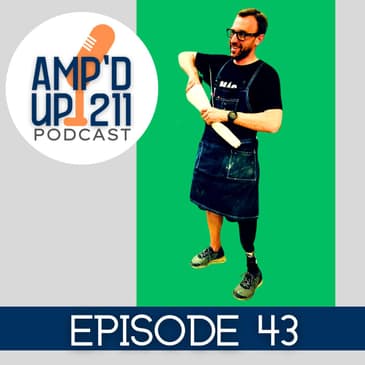
We are proud to present Executive Director and Co-Founder of ROMP, (The Range of Motion Project), Mr David Krupa! David has facilitated the provision of custom-made prosthetic devices to over 4,500 of the Western hemisphere’s most vulnerable individuals through a delivery model emphasizing high-quality clinical care, local investment; and advocacy. An amputee and prosthetist, he believes mobility and health are critical components in an individual’s pursuit of life’s many aspirations. When not busy working, Krupa spends his time outdoors. His passions include climbing; every year since 2015, he has been leading teams of adaptive climbers to the summits of glacier-covered volcanoes in Ecuador to raise awareness and funding for the ROMP mission. The AMP'D UP211 Video Podcast is hosted by Rick Bontkowski, a right-below-knee amputee.
[00:00:00] Today on the AMPD UP211 Podcast, Executive Director and co-founder of ROMP, the Range
[00:00:06] of Motion Project, Mr. David Krupa.
[00:00:10] David has facilitated the provision of custom made prosthetic devices to over 4,500 of
[00:00:17] the Western Hemisphere's most vulnerable individuals through a delivery model emphasizing
[00:00:22] high quality clinical care, local investment, and advocacy.
[00:00:26] An amputee and prosthetist, he believes mobility and health are critical components in an individual's
[00:00:33] pursuit of life's many aspirations.
[00:00:36] When not working, Krupa spends his time outdoors.
[00:00:40] His passions include climbing.
[00:00:42] Every year since 2015, he has been leading teams of adaptive climbers to the summits
[00:00:48] of glacier covered volcanoes in Ecuador in order to raise awareness and funding
[00:00:53] for the ROMP mission.
[00:00:55] Please welcome to the podcast, David Krupa.
[00:01:06] Mr. David Krupa, how are you?
[00:01:08] Good to see you today, sir.
[00:01:11] I am well.
[00:01:12] How are you, Rick?
[00:01:13] Good to see you.
[00:01:14] Nice to meet you.
[00:01:15] Oh my gosh.
[00:01:16] So nice to meet you.
[00:01:17] And I was reading something the other day because I was doing some show prep on
[00:01:21] you and researching you interesting gentlemen.
[00:01:26] And you are from the Chicagoland area, correct?
[00:01:30] That is correct.
[00:01:32] Where?
[00:01:33] Where exactly?
[00:01:34] So I exactly, precisely, I grew up in a western suburb of Forest Park, Illinois.
[00:01:43] Overbite Air?
[00:01:44] Right on the overbite air.
[00:01:45] Yep.
[00:01:46] That's west side.
[00:01:47] We're the last stop on the CTA blue line.
[00:01:51] So kind of, you know, as close to the city as you can be with not really being
[00:01:56] in it.
[00:01:57] Yeah.
[00:01:58] They said small town.
[00:01:59] What was it?
[00:02:00] Big town access, small town charm, I believe.
[00:02:02] That was the motto at that time of Forest Park, Illinois.
[00:02:06] I was not aware of that tagline.
[00:02:09] That is pretty choice little mixture of words there to describe Forest Park.
[00:02:14] I am somewhat familiar with Forest Park because I come from the construction
[00:02:19] industry and I recall having clients in some of those areas around there.
[00:02:25] I actually grew up in the northwest suburbs like Palatine kind of area, not too
[00:02:31] far from like Schomburg.
[00:02:33] And Schomburg.
[00:02:37] I was actually born in Humboldt Park, but my parents were pretty quick to
[00:02:44] hustle us out of the city and get us into more of a suburban life.
[00:02:49] You actually went to Northwestern, correct?
[00:02:53] I studied prosthetics at Northwestern University.
[00:02:56] That's right.
[00:02:57] Very cool.
[00:02:58] Very cool.
[00:03:00] Given that you've been an amputee most of your life, was that a natural sort
[00:03:07] of progression or evolution that I think I want to be a prostitutes?
[00:03:16] Yes and no.
[00:03:18] I grew up using a prosthetic leg pretty much my entire life from the time I was
[00:03:25] about 18 months old.
[00:03:30] I used to go to the Shriners Children's Hospital there on the northwest side of
[00:03:36] Chicago and had really great access to prosthetic care.
[00:03:40] But honestly, I didn't think about prosthetics as a profession until I was
[00:03:48] getting close to graduating from undergrad university.
[00:03:51] I was considering medical school and that whole track and was getting a new
[00:03:58] I was at the University of Illinois and I was back in town and I was working
[00:04:04] with my prosthetists up there.
[00:04:07] And I remember asking my prosthetists, like, hey, I've been coming here
[00:04:13] for years, I hear the noises in the back, I smell all the chemicals, but I
[00:04:18] never actually have really seen what you do or how you do it.
[00:04:23] And could you take me back there and kind of walk me through it?
[00:04:27] Tell me what goes into this?
[00:04:28] What did you have to study?
[00:04:30] What happened next?
[00:04:31] You know, I'm kind of at this point in my life.
[00:04:32] So yeah, of course, I mean, being around it my entire life, most of the
[00:04:37] time just kind of took it for granted that I would be able to walk,
[00:04:40] that I have a good prosthesis.
[00:04:42] I suffered the moments when I was in pain and I struggled and I had to be
[00:04:46] out of my leg.
[00:04:49] And certainly very much appreciated the work that my prosthetists did
[00:04:55] growing up, but also I appreciated them as people.
[00:04:58] I always liked going to the prosthetists for the most part, you know, I
[00:05:03] enjoyed the experience.
[00:05:04] They were always so kind to me.
[00:05:06] So yeah, I think of course, naturally it led to that because of the
[00:05:11] exposure, but it wasn't something that I was thinking about, you know,
[00:05:14] from the time I was like 12 when someone's like, what do you want to
[00:05:18] do when you grow up?
[00:05:18] I kind of went through all the other things in my imagination and
[00:05:21] then got to that.
[00:05:23] Yeah, it's interesting because when I think about someone like yourself
[00:05:27] and being an amputee most of your life and landing in that space of
[00:05:33] being a prosthetist, I always wonder because I see prosthetics as such
[00:05:40] a mechanical thing.
[00:05:41] Like there's a lot of engineering behind it and there's sort of that
[00:05:45] critical thinking process that goes into the fabrication of these
[00:05:49] devices.
[00:05:50] And I'm like, you know, it's interesting because you really need, and you
[00:05:55] were talking about the medical track, you really need sort of this kind
[00:05:59] of engineering kind of mind where you kind of see things as, you
[00:06:07] know, components that work in harmony, so to speak.
[00:06:12] And I don't know if prosthetists are born from that or conversely, are
[00:06:19] they born from the medical, let's say thinking of I want to care for
[00:06:25] people.
[00:06:26] I want to give them the ability to walk again, to perform again,
[00:06:33] to thrive again.
[00:06:35] But when I think about your journey, especially in reading, you
[00:06:39] know, about ROMP, your mission statement, you know, where you
[00:06:46] have woven all of these various initiatives into what this organization
[00:06:52] does.
[00:06:54] I mean, it's sort of mind blowing because there's so much to it,
[00:06:57] right?
[00:06:58] There's the prosthetic piece giving people those adaptive devices,
[00:07:05] some of which have never even probably seen a prosthetic like in
[00:07:09] person before.
[00:07:12] But there's also this huge advocacy piece for populations that don't
[00:07:23] have these resources, that these things are not available to them.
[00:07:28] But then kind of comes this blanket of inclusivity and diversity and
[00:07:36] all of these other sort of like socio-cultural, economic, it's really
[00:07:43] this sort of, you know, potpourri of a lot of good is how I see it.
[00:07:51] It's just this big sort of momentous kind of ball of, hey man, we're
[00:07:58] just doing some really, really amazing things for some people that
[00:08:03] are struggling in this space.
[00:08:06] And I want to jump ahead just a little bit and, you know, I'm kind of
[00:08:12] breaking my outline here.
[00:08:15] But I want to talk, just because I'm hyper curious, I want to talk
[00:08:22] about the 10th anniversary climb that you're looking at right now.
[00:08:29] And that to me was the thing that sort of jumped off the page and made
[00:08:37] me feel compelled to reach out to your organization.
[00:08:40] I think I saw a teaser somewhere on socials just sort of explaining,
[00:08:48] hey, this is what we're doing over here.
[00:08:51] And I was like, oh shit, like this is something I need to focus in on
[00:08:57] because there's something really, really extraordinary happening with
[00:09:02] these people right now.
[00:09:04] And why don't you walk through not only the history behind, you know,
[00:09:12] these fundraising climbs that you're doing, but also, you know, sort of
[00:09:17] what the initiatives are in that and where you see that going.
[00:09:21] Obviously you're a climber yourself, but explain it in a way that the
[00:09:25] audience can sort of digest it.
[00:09:27] All right.
[00:09:31] Well, first I want to commend your use of the word popery in an
[00:09:36] interview and a podcast conversation.
[00:09:39] That be a first actually.
[00:09:41] I listened to a lot of podcasts, maybe not the right ones to hear
[00:09:46] popery a lot.
[00:09:47] I'm sure there are anyways.
[00:09:48] Yeah, I think you're opening up a lot of facets to the
[00:09:53] conversation.
[00:09:54] And I think at the core of it all, for me, this has always been about
[00:09:59] healing.
[00:10:00] And I think you can approach healing from so many different angles,
[00:10:06] including the engineering angle, including the medical angle,
[00:10:09] the psychological angle, the socio-cultural angle that you
[00:10:13] mentioned, the economic angle, the health justice angle.
[00:10:17] At the end of the day, everything that I personally have been
[00:10:22] trying to do with my life is contribute to the healing of people
[00:10:28] like me, people living with limb loss, limb difference, and have been
[00:10:33] able to find ways to do that through my direct work with my hands
[00:10:37] as a professional, as a prosthetist, through the work of our
[00:10:41] organization, Romp, the Range of Motion Project, and through
[00:10:46] Romp, utilizing a variety of operations and programs and
[00:10:52] interventions on country levels in Latin America, specifically in
[00:10:56] Guatemala and Ecuador.
[00:10:59] And then also through events like Climbing for Romp, which you
[00:11:02] just mentioned, and we are this year celebrating the 10th
[00:11:06] anniversary of this event, which again, going back to this
[00:11:11] concept of healing was initially created to bring people who use
[00:11:21] prostheses, climbing, hiking into the outdoors as a way to heal,
[00:11:29] as a way to improve health, to increase strength, to learn new
[00:11:35] skills, to experience the great outdoors, to work as a team,
[00:11:40] to learn resilience through climbing, hiking, reaching to new heights,
[00:11:49] and to elevate the need for the global need for prosthetic care,
[00:11:56] which is what Romp as an organization specifically is trying
[00:12:00] to change, the fact that there are about 37 million people
[00:12:05] globally who don't have access to prosthetic care.
[00:12:08] So to elevate what's possible with prosthetic rehabilitation,
[00:12:14] with physical rehabilitation, with teamwork, with all the
[00:12:18] things that can be done on a mountain so that someone can reach
[00:12:23] that physical summit of the mountain as a way to demonstrate
[00:12:27] the power of mobility, the power of access to prosthetic care
[00:12:31] and rehabilitation for everyone.
[00:12:33] And to ask that question, what's your mountain?
[00:12:38] What is ultimately your challenge that you're facing?
[00:12:40] We all throughout our lives will face a variety of them
[00:12:44] and to work towards achieving it, overcoming it, reaching it,
[00:12:50] whatever it may be.
[00:12:52] So this 10th year, we've been doing this for many years now,
[00:12:55] we use this particular event Climbing for Romp as a fundraiser,
[00:12:59] as an awareness raiser to teach people about the mission of Romp,
[00:13:07] to ensure access to high quality prosthetic care for underserved
[00:13:11] people, improving their mobility and independence,
[00:13:14] to invite people to climb with us around the world
[00:13:17] and specifically a sort of handpicked group of people
[00:13:21] to climb every year with us in Ecuador, to climb these
[00:13:24] huge volcanoes that we have down here.
[00:13:27] And so do it with the intention to pay forward mobility
[00:13:33] for others who don't have access to prosthetic care today.
[00:13:37] So talking about those climbs, I would think given that
[00:13:42] you've been doing it a decade, I would imagine that your memory
[00:13:48] has got to be chock full of just phenomenal experiences
[00:13:53] to see people in that space achieving those great things,
[00:14:01] showing strength, resilience, pushing those boundaries.
[00:14:06] Right?
[00:14:06] And I know for myself as an amputee in my seventh year,
[00:14:13] it always starts with that teeny tiny goal.
[00:14:17] And you're a prosthetist so you see that evolution
[00:14:22] in real time, that teeny tiny goal of,
[00:14:26] I just want to walk.
[00:14:28] I just want to walk.
[00:14:29] I want to be able to walk.
[00:14:31] And then something happens when you have the proper care,
[00:14:36] when you have the right support system,
[00:14:39] when you have a prosthetist like David Rodder,
[00:14:44] we'll talk about him, that provides you with that type of care.
[00:14:53] Suddenly possibilities start to open up
[00:14:57] and then it becomes something else.
[00:15:00] Maybe it's, I want to ride a bike.
[00:15:03] Maybe it's, I want to go on a hike.
[00:15:07] Then it becomes, maybe I want to walk a 5K.
[00:15:12] And I will talk to amputees frequently that'll say,
[00:15:19] you know, I ran half a marathon last weekend.
[00:15:25] How on earth did I get here?
[00:15:28] Like, I am just blown away that somehow I got into this space
[00:15:34] and knowing and accepting that so much of what happens for an amputee,
[00:15:42] anyone with a limb loss or a limb difference,
[00:15:45] that you have to engage a process.
[00:15:50] That it's incremental.
[00:15:52] It takes time.
[00:15:53] It takes time.
[00:15:54] It's a process.
[00:15:56] And as long as you commit yourself to that journey,
[00:16:00] you're going to get somewhere.
[00:16:03] We'd all love that you throw a leg on and,
[00:16:09] you know, hey, look at me go.
[00:16:10] I can do anything.
[00:16:12] That doesn't happen.
[00:16:14] It's very much a, you know,
[00:16:17] crawl before you walk, you know,
[00:16:19] walk before you run kind of situation.
[00:16:22] And I would imagine for yourself,
[00:16:26] seeing people accomplish things that maybe they had no idea they could do.
[00:16:35] But to feed on the energy,
[00:16:38] that vibration that you're creating with this type,
[00:16:43] you know, of climb, this type of event,
[00:16:47] it sort of compels people to go to that place.
[00:16:51] I mean, what's something that stands out in your memory?
[00:16:54] Where you're like, oh my gosh,
[00:16:55] that was such an affirmation type moment for me.
[00:17:02] Sure.
[00:17:02] Well, you know, there's this cynical philosophy
[00:17:06] that people can't change,
[00:17:08] that people don't change.
[00:17:10] And in this world of prosthetics and in my experience,
[00:17:16] I see people changing every single day.
[00:17:19] Just as you talked about incrementally,
[00:17:22] little by little.
[00:17:24] And certainly have had so many experiences on the mountain
[00:17:27] where I've been witness to incredible growth and transformation.
[00:17:32] And just like funny things too.
[00:17:35] Something that jumps out to me is with one of our first climbers
[00:17:40] who's from Ecuador,
[00:17:42] one of Romps patients at the time.
[00:17:46] He's from a very tropical sort of low altitude,
[00:17:50] low elevation part of Ecuador.
[00:17:53] And never in his life had he touched or seen snow.
[00:17:59] And just like watching his eyes and his energy
[00:18:04] light up like a little boy on the mountain.
[00:18:10] That, you know, how that doesn't change you,
[00:18:13] I don't know if that doesn't,
[00:18:14] like what will, right?
[00:18:16] Yeah, exactly.
[00:18:17] And so, you know, watching year after year,
[00:18:21] people reaching new heights,
[00:18:23] breaking down in tears of both joy
[00:18:26] and sometimes of real suffering and pain.
[00:18:30] Discovering a strength within them that they didn't know existed.
[00:18:35] I have another memory that comes to mind.
[00:18:38] Well, it's sort of a memory spread out over time
[00:18:40] because it's very akin to what you just said,
[00:18:43] which is with one of my dear friends and patients,
[00:18:48] Cathy, early on in her rehabilitation,
[00:18:53] she was happy to walk a 5K.
[00:18:55] And I remember walking it with her.
[00:18:58] And then years later, we were standing on top
[00:19:01] of a 19,300 foot summit in Ecuador called Apoxy.
[00:19:07] And the very next weekend,
[00:19:08] the two of us ran the Chicago Marathon together.
[00:19:11] And so, being exposed to that year after year
[00:19:16] and facilitating that through climbing for ROMP,
[00:19:20] it's a reminder to me that if people can change,
[00:19:24] systems can too.
[00:19:27] And so that's really, I kind of,
[00:19:29] I draw a lot of energy from going into the mountain
[00:19:32] with people because it reminds me that our work
[00:19:36] is having an impact and it's transformed
[00:19:39] and it's transformative.
[00:19:41] And that impact, if we're changing individual lives,
[00:19:44] if we're helping to create access for one person,
[00:19:48] that access can fan out into a systems level change
[00:19:54] to where universal access can eventually become possible.
[00:19:58] Why is that not the case today?
[00:20:00] Why can't every person living with limb loss
[00:20:03] access a prosthesis and go out and do that 5K
[00:20:08] or hike to the top of that hill behind their house?
[00:20:12] So yeah, I've got just an endless amount of memories
[00:20:17] and a decent amount of them have actually been captured
[00:20:20] in video and some of the great content
[00:20:22] that ROMP has produced.
[00:20:23] So if anyone's listening to this
[00:20:25] and ends up going to some of our channels
[00:20:27] or just digs around on our website,
[00:20:30] you can find some really, really beautiful pieces,
[00:20:33] short stories and films of some of these stories.
[00:20:37] And I hope that they do serve as inspiration
[00:20:39] and I'm glad to hear that it does
[00:20:41] to some degree for you as well.
[00:20:42] Like that's the idea here is like if we can inspire someone
[00:20:46] or remind them that transformation is possible,
[00:20:50] it comes with effort without a doubt.
[00:20:52] But that's I think a well applied use of life.
[00:20:59] Very much so.
[00:21:00] And I'm a big believer.
[00:21:03] What resonates for me is that whole ripple effect
[00:21:07] when we're placing our energies in the right place
[00:21:11] and it tends to resonate amongst communities
[00:21:16] and those ripples get larger and larger and larger
[00:21:20] and then suddenly they reach the highest of places,
[00:21:23] those decision-making places that say,
[00:21:26] well now wait a minute, like this is really important.
[00:21:30] And it's just the power of community.
[00:21:33] It's the power of organizations like ROMP
[00:21:36] that say this will not stand.
[00:21:39] Like people need these things to live.
[00:21:43] This isn't just a matter of you need it to walk.
[00:21:46] No, no, no.
[00:21:47] You need this to live.
[00:21:50] It's like oxygen.
[00:21:52] Without it, we don't have life.
[00:21:55] And I am very inspired watching some of the content
[00:22:00] you have on your channels, these video blogs,
[00:22:04] these mini docs that you put together.
[00:22:08] They're really, really amazing.
[00:22:10] I would tell anyone listening to the podcast,
[00:22:15] check out that content because it's moving stuff.
[00:22:20] This organization is doing fantastic things
[00:22:23] for people that are desperate for change
[00:22:29] and to be given the liberation of movement
[00:22:35] and to be able to go to these mountainous places.
[00:22:39] And some of it is very thrilling and obviously cinematic.
[00:22:44] And it's just, all of it is very kinetic for me.
[00:22:48] It's like, wow, there's a lot going on here.
[00:22:52] And that's really what compelled me initially
[00:22:56] to reach out to your organization was the 10th anniversary climb.
[00:23:03] I want to circle back a little bit
[00:23:07] and talk about you personally a little bit more.
[00:23:14] Coming from Chicagoland, my hometown as well,
[00:23:19] and growing up in a suburb of Chicago,
[00:23:25] being an amputee from a very early age,
[00:23:31] I'm trying to remember exactly when you lost
[00:23:34] a portion of your limb.
[00:23:35] Do you remember a time when you had your foot or no?
[00:23:39] I don't remember a time.
[00:23:40] I was about a year and a half old when they amputated my foot.
[00:23:45] I would guess the only fuzzy memories you have
[00:23:47] are derivative just from pictures or something like that,
[00:23:51] like a baby photo or something.
[00:23:55] So growing up amputee is something that always fascinates me
[00:24:00] because relatively speaking in my seventh year,
[00:24:06] I still consider myself very new to all of this.
[00:24:09] The podcast has been serving my curiosities in this journey
[00:24:15] of wanting to understand on a deeper level what all this means.
[00:24:19] Of course, trying to get stories, content into the community space,
[00:24:26] my own little personal ripple to the effect that's going on to say,
[00:24:32] okay, we're all in this community.
[00:24:35] It is our duty to serve and to bring these stories forward.
[00:24:40] It's very important.
[00:24:43] My phone's going off.
[00:24:44] Holy cow.
[00:24:45] We're gonna need to edit that out, Brian.
[00:24:50] So that's really important to me.
[00:24:54] And I want to talk about you as a kid.
[00:24:58] And you had mentioned previously that it sounds like
[00:25:04] you had generally a very positive experience as a child amputee.
[00:25:11] You speak of your care in an endearing kind of way.
[00:25:18] And do you recall ever feeling like this is hard or this is a struggle
[00:25:26] or why am I different or were there any of those emotional sets
[00:25:31] or was your support system so strong that it never really entered your orbit?
[00:25:38] Oh, yeah.
[00:25:40] Yeah, for sure.
[00:25:44] I don't know how old I was probably between 10 and 12, I would say.
[00:25:48] I definitely wrestled with a lot of why questions.
[00:25:57] Why did this happen to me?
[00:25:59] Why am I different?
[00:26:01] I started to notice that difference more.
[00:26:04] I started to feel sometimes physically inferior,
[00:26:09] and it was something I tended to swallow and handle, but it hurt.
[00:26:15] It hurt to come in last doing the laps, jogging around the blacktop
[00:26:22] for one of those little fundraisers you do where every lap
[00:26:26] you'd get 50 cents or something like that.
[00:26:28] Yeah, you did a trackathon.
[00:26:30] Yeah, exactly.
[00:26:35] It was tough to not feel as capable as my friends and people around me.
[00:26:44] And certainly I had those moments of questioning and frustration,
[00:26:50] but I'd say that generally speaking for a variety of reasons
[00:26:56] both peer support as well as family support and professional support
[00:27:04] and having access to really, really good care.
[00:27:10] I was able to handle a lot of that stuff.
[00:27:12] And specifically I can recall a time when I was probably 13, 14,
[00:27:20] we used to have these things called all school picnics in our town.
[00:27:26] And all the schools would be at the public park
[00:27:31] where there's the pool and there's the soccer fields
[00:27:34] and the basketball courts and all that stuff.
[00:27:37] And there was this group of kind of mean kids from another school
[00:27:44] that I don't even know how they managed to do this,
[00:27:47] but they stole my leg from me during the picnic.
[00:27:56] This sounds like part of a movie.
[00:27:59] Oh man, and it was a huge joke for them.
[00:28:03] This was so funny.
[00:28:05] And I was just mortified.
[00:28:09] My friends, my classmates just rallied to my support
[00:28:17] and just surrounded this group of kids and took my leg back.
[00:28:21] And that group of classmates was extremely multicultural,
[00:28:30] multi-ethnic, multi-religious.
[00:28:33] I was very blessed.
[00:28:34] I didn't realize that this was not the way it was for everyone.
[00:28:37] But my grade school experience was extremely diverse
[00:28:45] in this very small class of 25, 26 kids.
[00:28:49] And so here they all were coming back to me with my leg,
[00:28:55] pat me on the shoulders, telling me that everything's fine,
[00:28:58] not to worry, that they wouldn't let that happen again.
[00:29:01] Those are very reassuring as don't let that get to you, whatever.
[00:29:08] I think that that did something to me internally.
[00:29:13] This idea of community, this idea of looking out for one another.
[00:29:23] I think I grew up with a lot of those teachings as well.
[00:29:26] But some of those lived experience,
[00:29:30] for all the times that I was down,
[00:29:32] for all the times that I was in pain,
[00:29:33] for all the times that I was frustrated about being a person
[00:29:35] that was different than others,
[00:29:38] I think just really quickly I found some form of support.
[00:29:43] And certainly within the home.
[00:29:45] But even from peers, from teachers, from coaches
[00:29:49] who decided to take me under their wing and say,
[00:29:52] hey, you want to do this sport,
[00:29:55] I'll work with you directly and let's learn how to wrestle
[00:29:58] and use your disability to your advantage.
[00:30:00] And let's take off your prosthesis and figure out a way to...
[00:30:03] Just a lot of little things like that
[00:30:05] that I think added up over time to a sum total of possibility.
[00:30:13] What is available to you if you open your mind,
[00:30:16] if you think positively, if you cultivate resilience.
[00:30:23] So yeah, I think I was given a lot of the tools,
[00:30:26] I was taught a lot of those tools
[00:30:28] to figure out how to navigate through the tough spots
[00:30:31] because who's not going to come up against tough spots,
[00:30:34] especially going through that change of adolescence
[00:30:38] where you're starting to wonder,
[00:30:40] are girls going to be interested in me?
[00:30:42] Am I going to have friends?
[00:30:43] I'm going to a new school.
[00:30:44] Like, are people going to ostracize me?
[00:30:46] Are they going to make fun of me?
[00:30:48] Someone else is going to steal my leg.
[00:30:52] Adolescence is so difficult already
[00:30:56] with having all your limbs.
[00:30:58] It's painful.
[00:31:00] And I was painfully shy as a kid
[00:31:03] and incredibly insecure as a kid.
[00:31:06] And everything, any look that didn't seem quite right at me
[00:31:12] or any tone that came out of someone's mouth
[00:31:17] that made me think, what does that mean?
[00:31:21] Would just crush me and I would internalize it.
[00:31:25] And then I try to wrap my brain around the thought of,
[00:31:29] well, what if I was an amputee during those times
[00:31:34] or those years?
[00:31:36] And I want to quickly circle back to something you said
[00:31:39] about being exposed to a very diverse sort of group
[00:31:47] of classmates and people
[00:31:50] and having this exposure to that diverse environment
[00:31:58] culturally, religiously, which is a beautiful concept to me.
[00:32:04] And I sort of immediately go to sort of that connection point
[00:32:10] in that you sort of live in that now
[00:32:16] and so much of what you represent in the world
[00:32:22] and looking at your organization, your staff,
[00:32:28] the people that you surround yourself with,
[00:32:32] the people that you serve in these countries.
[00:32:37] This seems to be sort of a theme in your life
[00:32:43] that you sort of bring that to the table.
[00:32:48] You bring these people of different backgrounds
[00:32:52] and cultures and perspectives
[00:32:56] and you focus on the mission.
[00:32:59] Because I was talking to someone the other day
[00:33:02] about the eclipse and everyone has their opinion
[00:33:09] on whether it was important or it was unimportant
[00:33:12] or all the phobias about, did you get the glasses?
[00:33:17] No, I wore my sunglasses.
[00:33:18] Oh, you're going to go blind.
[00:33:19] So there's all these various sort of lenses
[00:33:24] that people are looking through with the solar eclipse.
[00:33:29] And someone had asked me, what are your thoughts?
[00:33:34] And I said, you know, I felt like it was such a beautiful moment
[00:33:40] because amongst all of the sort of disagreement
[00:33:47] and sort of tribal attitudes that exist in our culture now,
[00:33:54] everybody came together.
[00:33:56] Hmm.
[00:33:57] Everybody stopped for a moment, looked in the sky
[00:34:01] and we all shared a moment.
[00:34:04] I go, when was the last time that we all just came together
[00:34:09] and shared something and said, hey, that's really cool.
[00:34:14] Right?
[00:34:15] And I thought, hey, here's a crazy thought.
[00:34:19] We are capable of this.
[00:34:22] We are capable of coming together.
[00:34:26] Wow. Imagine that, especially in an election year in this country.
[00:34:29] Imagine that, right?
[00:34:31] We came together.
[00:34:32] So I think about your organization in somewhat of the same spirit
[00:34:38] of people coming together and serving a cause
[00:34:43] that they see as bigger than themselves
[00:34:47] and they want to be part of that.
[00:34:49] So, you know, in researching, you know, Romp
[00:34:54] and thinking about all the things that you're doing, of course,
[00:34:59] it touched me.
[00:35:00] And, you know, I'm like, well, wait a minute.
[00:35:02] Like, how do you get to go on this climb?
[00:35:06] And, you know, what's the screening process?
[00:35:09] And, you know, maybe if I train for this thing
[00:35:12] and I'm lucky enough, maybe I could do this someday.
[00:35:16] And it sort of, in my own little personal space,
[00:35:21] it's sort of even without you even saying a word we hadn't met yet,
[00:35:28] it opened a door.
[00:35:30] It created a possibility.
[00:35:32] It created the potential for growth.
[00:35:37] Maybe I worked out a little bit harder at the gym.
[00:35:41] Maybe I pushed myself a little bit harder.
[00:35:44] I went a few more miles on my bike that weekend
[00:35:48] simply because you get in that headspace of
[00:35:53] I know I can do better.
[00:35:55] I know I can be better.
[00:35:56] I know I can serve this community better, right?
[00:36:00] And I feel like those affirmations have to be on repeat
[00:36:04] where you go, okay, there's a reason that I'm meeting you.
[00:36:09] There's a reason that we're talking today
[00:36:12] and it's to serve something that's bigger than us
[00:36:15] and to provide that energy that so many people in this community
[00:36:21] are starving for, that are desperate for.
[00:36:25] So I do appreciate you being transparent about your childhood
[00:36:32] and sort of the pitfalls of growing up amputee.
[00:36:36] And it's a beautiful story when you think about it.
[00:36:39] It's definitely something that when you guys do the full documentary
[00:36:45] I definitely want to watch and see that whole kind of lifetime of
[00:36:52] the humble beginnings of growing up as an amputee
[00:36:56] and going to Northwestern and becoming a prostitutes
[00:37:00] and finding that calling to serve people in these underprivileged
[00:37:09] places in the world and giving them the gift of mobility again is remarkable to me.
[00:37:20] What would you say outside of the climb
[00:37:24] and some of the other things that your organization is working on?
[00:37:29] What would be the things that you would want to highlight today
[00:37:31] and let the audience know about?
[00:37:35] Sure. Well, certainly I think the work that we do is really the highlight of what Romp is about.
[00:37:45] You mentioned a few core values there.
[00:37:47] You're talking about community.
[00:37:49] The fact that what we're doing with climbing is somehow empowering you
[00:37:53] to think or opening doors as you said.
[00:37:57] Ultimately, the work that we're doing
[00:38:01] it centers around the human dignity of all of us.
[00:38:05] Each and every single person kind of recognizing their value
[00:38:09] in this time and place.
[00:38:11] We're all the same species.
[00:38:12] There are a lot of different things that we do and ways that we think,
[00:38:15] but ultimately the work that Romp does is really what I'd highlight.
[00:38:21] We use climbing, we use this event this year to again advocate for
[00:38:26] and to kind of scream from the mountaintops like let's change this.
[00:38:29] Let's do something about this.
[00:38:30] We're sending rockets to space.
[00:38:33] We have artificial intelligence and we can't figure out how to put
[00:38:36] millions and millions of prosthetic limbs on people that need it the world over.
[00:38:39] It's kind of absurd, but ultimately we're doing all this stuff.
[00:38:44] We're making this noise.
[00:38:45] We're trying to raise money and raise awareness so that we can do the work.
[00:38:49] The work that Romp has been doing for almost 20 years now
[00:38:52] is something that I'm just so proud of.
[00:38:55] I'm proud of the team.
[00:38:57] You mentioned our incredibly diverse staff.
[00:39:01] Most of our team is in Latin America and Guatemala and Ecuador
[00:39:05] and we have just some of the absolute best professionals,
[00:39:09] many of them women that are making change in their communities
[00:39:12] and bringing the highest quality prosthetic care,
[00:39:15] physical therapy, psychological support, nutritional guidance,
[00:39:20] community level work to people who need it the most,
[00:39:23] the poorest of the poor.
[00:39:25] 95% of the patients that we serve are living on $6.85 a day or less.
[00:39:33] We are serving people in the remote corners of Guatemala
[00:39:36] in indigenous communities in the Amazon of Ecuador,
[00:39:41] from the highlands to the coast,
[00:39:43] bringing incredibly advanced technology to them.
[00:39:49] And we're able to do that because we recycle prosthetic waste nationally in the US,
[00:39:57] running maybe one of the largest prosthetic recycling networks in the US.
[00:40:02] So anyone that's listening that has even just a piece of a prosthetic limb
[00:40:06] that they're no longer using, we will take it.
[00:40:09] Oh, that's a really good point.
[00:40:11] Yeah, I was not aware of that.
[00:40:13] So anyone out there that's got an old foot,
[00:40:16] got an old socket, any kind of loose parts, anything of that nature,
[00:40:21] you harvest that and then you actually turn that around.
[00:40:26] We harvest that.
[00:40:27] That's a great word.
[00:40:27] Absolutely, yeah, we do harvest it.
[00:40:30] We collect it.
[00:40:31] We quality control it.
[00:40:32] We toss the junk.
[00:40:34] We break it down into the most usable parts
[00:40:37] and we package it up and ship it out to our clinicians
[00:40:42] where it's needed for specific cases.
[00:40:44] This is allowing us to put a wide variety of technologies on our patients
[00:40:49] according to their needs,
[00:40:51] very much in the way that you would expect to be treated by,
[00:40:54] you mentioned David Rodder,
[00:40:57] anyone listening expects that of their prosthetic care.
[00:41:00] I need this device to work for me,
[00:41:02] for my activities, for my goals, for my work.
[00:41:06] And the people that we serve quite often
[00:41:09] are the vast majority of them are very healthy.
[00:41:14] Otherwise, they've suffered a traumatic amputation.
[00:41:17] They're usually of working age or of school age
[00:41:22] and have very few other issues going on
[00:41:25] to limit their health and mobility.
[00:41:28] And so the prosthetic device, when crafted appropriately
[00:41:32] of the technology that they can make use of,
[00:41:35] we've helped people run within the first hour of their fitting
[00:41:39] and go back to work and go back to construction
[00:41:42] and farm again and walk five miles to school
[00:41:46] back and forth every day.
[00:41:48] So I'm extremely proud of the actual programs
[00:41:51] that ROMP carries out.
[00:41:52] Ultimately, our mission to ensure access,
[00:41:55] a huge aspect of ensuring access for us
[00:42:01] is actually providing care.
[00:42:02] And creating ecosystems within currently Guatemala
[00:42:06] and Ecuador where high quality care is happening,
[00:42:10] where professionals from both countries,
[00:42:13] from the region can work with patients,
[00:42:16] can learn evidence-based practice,
[00:42:20] evidence-based practice,
[00:42:21] can learn from the best professors, colleagues,
[00:42:28] teachers, can improve their skills
[00:42:31] that can focus on delivering loving and quality care
[00:42:37] to each and every single patient.
[00:42:39] And that is really, I think, part of our long-term vision
[00:42:44] of sustainability and change comes at that level
[00:42:48] of providing actual care.
[00:42:50] So I think there's been a variety of innovations
[00:42:52] that we've been able to do as an organization
[00:42:56] from data collection and measuring the impact
[00:42:59] of our work and tracking meticulously each and every case
[00:43:03] and doing it in a way that I think really stands on par
[00:43:06] with some of the best medical systems in the world
[00:43:11] to getting down and dirty in the community.
[00:43:14] I mean, we are in the communities,
[00:43:16] we're working in the homes, we're doing home care,
[00:43:19] we're visiting our patients from the time
[00:43:21] that they have an amputation
[00:43:23] to through their pre-prosthetic coaching
[00:43:27] and physical therapy and psychological therapy
[00:43:31] to getting a prosthesis, to learning how to use it,
[00:43:34] to getting back to work,
[00:43:35] to learning how to use the health system around them,
[00:43:38] to learn how to use public transportation,
[00:43:39] to learn how to open up bank accounts
[00:43:41] and start small businesses,
[00:43:43] to prepare for a job interview and get back to work.
[00:43:47] Our patients are more mobile, they're more employed,
[00:43:50] they're less depressed.
[00:43:52] That's ultimately, I think what I hope anyone listening
[00:43:57] can walk away with is that we can go to the mountains,
[00:44:01] we can inspire and empower people
[00:44:03] to dig deep within themselves,
[00:44:05] to change, to transform,
[00:44:07] to reach for new summits, to reach for new heights.
[00:44:10] But ultimately, we're trying to do it in a way
[00:44:14] that is ensuring some sort of sustainable
[00:44:16] and lasting improvement in health systems
[00:44:20] in underserved parts of currently the Americas.
[00:44:24] What do you, what gravitated you specifically
[00:44:29] in your journey to Ecuador?
[00:44:37] Like what was it that occurred,
[00:44:41] that put you in a trajectory to go to those locations?
[00:44:47] I mean, what was the series of events?
[00:44:49] Was it something that you had just an opportunity
[00:44:54] to go there and serve those communities or what was it?
[00:44:59] Has anyone ever offered you like a free dinner coupon
[00:45:03] at a restaurant?
[00:45:04] Oh, for sure.
[00:45:06] Did you go?
[00:45:07] Yeah.
[00:45:09] Well, so early on in the first couple months of ROMP
[00:45:15] back in 2005, my employer introduced me
[00:45:19] to an organization, their home office
[00:45:24] is up in Northwest Indiana.
[00:45:26] And in conversations with their executive director,
[00:45:29] she basically said, hey,
[00:45:31] if you want to provide prosthetic care,
[00:45:32] I've got a brand new facility that we're about to open up.
[00:45:36] I have some empty space.
[00:45:38] If you want, you can put a prosthetics lab
[00:45:41] and facility in that space.
[00:45:43] I said, where is it?
[00:45:44] She said, it's in Guatemala.
[00:45:46] Okay.
[00:45:47] So it was really a serendipitous opportunity,
[00:45:52] I think as an organization when we first started
[00:45:56] with the desire to help,
[00:45:59] we understood then and we understood now
[00:46:01] that there's a need everywhere.
[00:46:03] But we followed an opening.
[00:46:06] We followed this path that basically opened up
[00:46:10] an opportunity came our way to have this collaboration
[00:46:13] on the ground, to have infrastructure,
[00:46:15] to have local knowledge,
[00:46:19] to have this red carpet rolled out, if you will.
[00:46:23] And ever since then that's been our model,
[00:46:25] which has been wherever we're going to grow,
[00:46:28] we need to grow with partnerships,
[00:46:30] we need to grow with others.
[00:46:32] We need to look for those open doors.
[00:46:34] We need to look for that fertile soil
[00:46:36] where the need exists,
[00:46:37] but the opportunity exists as well,
[00:46:40] that intersection.
[00:46:42] And so that's kind of how we jumped from Guatemala
[00:46:45] to Ecuador, similar.
[00:46:47] I had some relationships and some friendships
[00:46:50] and some other things that were aligning.
[00:46:52] And as we look towards the next few years
[00:46:55] wanting to expand beyond Guatemala and Ecuador
[00:46:59] and kind of putting our feelers out there
[00:47:00] and investigating and doing some site visits
[00:47:04] and going to different countries in the region,
[00:47:08] it's very much we are keeping our mind open to that,
[00:47:16] to the types of partnerships,
[00:47:17] to the type of local ownership and desire that exists.
[00:47:21] Because in order to sustain Romp,
[00:47:24] Romp is not about me,
[00:47:26] it's not about that we started in Chicago,
[00:47:29] it's not about that we're in Ecuador,
[00:47:31] it's ultimately about the community around it
[00:47:34] that wants to prop it up, keep it up,
[00:47:36] and help it thrive.
[00:47:38] That community is, we find it on the mountains
[00:47:41] with our climbers and with the people
[00:47:43] that donate to them and support them
[00:47:45] and cheer for them.
[00:47:46] But we also find it locally
[00:47:48] with all of the healthcare professionals,
[00:47:51] the doctors, the nurses, the physicians,
[00:47:53] or the physical therapists,
[00:47:55] the donors, the community organizations,
[00:48:00] the other foundations in the area,
[00:48:01] the schools, the universities, et cetera,
[00:48:04] that want this to exist
[00:48:05] because they're also sick and tired
[00:48:08] of seeing dozens and hundreds
[00:48:11] of people with amputation every year
[00:48:13] out on the street, begging at the stoplight,
[00:48:17] hobbling around on crutches,
[00:48:20] sticking around at home,
[00:48:21] the kids that aren't going to school,
[00:48:23] their neighbors' daughter
[00:48:26] who's grown up just never leaving her house.
[00:48:30] It's just people are getting fed up with it
[00:48:33] as we should because the human right
[00:48:35] to access mobility and this type of technology
[00:48:38] to participate in the world is something
[00:48:42] that it just seems that more
[00:48:45] and more people are able to rally around.
[00:48:49] And so if we find those connections,
[00:48:51] that's how ultimately we ended up
[00:48:52] in Ecuador and Guatemala.
[00:48:54] And then kind of over the years
[00:48:55] it's become strategically reasonable
[00:48:59] for us to kind of maintain our presence
[00:49:03] in the Western hemisphere.
[00:49:04] We have a lot of understanding
[00:49:06] of the Latin American culture.
[00:49:09] We have bilingual workforce.
[00:49:12] We're kind of on the same time zones.
[00:49:14] You know, there's some logistics,
[00:49:16] ease of doing business.
[00:49:18] So for now, you know,
[00:49:20] knowing that there's a huge demand
[00:49:21] in this part of the world
[00:49:23] and a big need to kind of continue
[00:49:25] building those bridges throughout
[00:49:27] the Americas and look for future
[00:49:30] opportunities for growth
[00:49:31] throughout the Americas is at least
[00:49:33] what we see on the horizon.
[00:49:35] Yeah, it's a fantastic organization,
[00:49:38] Endeavor.
[00:49:38] What a phenomenal legacy
[00:49:43] that you've created for yourself.
[00:49:51] You mentioned David Roder,
[00:49:52] my prostitutes right here
[00:49:54] and in Joliet, Illinois.
[00:49:57] Had you guys worked together?
[00:49:58] Was that the connection?
[00:49:59] Like somehow your paths crossed
[00:50:01] at some point?
[00:50:02] So I was a resident years ago
[00:50:08] and I worked in the same company
[00:50:10] that David Roder was working at.
[00:50:11] He was one of my mentors at the time
[00:50:15] and the other co-founder of Romp,
[00:50:17] Eric Neufeld and I,
[00:50:18] we were residents together
[00:50:19] and as we started to come up
[00:50:22] with the idea of Romp,
[00:50:25] David Roder was always there
[00:50:28] as a mentor,
[00:50:31] as sort of a spiritual
[00:50:34] and moral guide in a certain sense.
[00:50:36] I think really helping us to believe
[00:50:39] in the possibility that
[00:50:40] this could be done
[00:50:43] and has always since pretty much
[00:50:45] the beginnings of Romp served,
[00:50:47] has served on our volunteer
[00:50:49] clinical programs.
[00:50:50] This is a way that
[00:50:52] prostitutes in the U.S.
[00:50:54] but also kind of anyone
[00:50:55] can be a part of it
[00:50:55] to get involved with Romp
[00:50:57] in the patient service care,
[00:51:00] which is something
[00:51:02] that he was doing from 2005 on.
[00:51:05] You know every single year
[00:51:07] without fail he'd come down
[00:51:08] to Guatemala and volunteer
[00:51:11] as a prostitutes
[00:51:13] and make some of the most
[00:51:14] incredible devices,
[00:51:16] provide some of the most
[00:51:18] loving care to our patients
[00:51:20] and has always been sort of
[00:51:21] like this honorary co-founder
[00:51:24] of the organization,
[00:51:25] coaxing us on financially supporting,
[00:51:28] sending his staff,
[00:51:30] sending probably thousands of pounds
[00:51:33] of prosthetic components every year
[00:51:36] to the organization
[00:51:37] and really just kind of
[00:51:42] when things have gotten tough,
[00:51:44] when doubts have come on strong,
[00:51:46] when it's just like
[00:51:47] how are we going to keep this up?
[00:51:48] How are we going to keep this growing?
[00:51:50] Just kind of always bringing it back
[00:51:53] to the fundamentals
[00:51:54] of what Romp is about
[00:51:55] and just reminding me personally
[00:51:58] as a friend, as a mentor,
[00:52:01] that this just keep doing it.
[00:52:02] Just keep doing it
[00:52:04] and yeah just a great guy.
[00:52:06] He's taught me a ton
[00:52:07] about prosthetic care itself,
[00:52:09] you know about design,
[00:52:10] upper extremity prosthetics.
[00:52:11] We've done so many crazy things
[00:52:14] in both Guatemala and Ecuador,
[00:52:17] you know really complex
[00:52:19] amputation cases
[00:52:20] where he's come in
[00:52:21] and has not only provided care
[00:52:23] but has also provided a lot of teaching
[00:52:25] to our local prosthetists,
[00:52:27] sharing his knowledge,
[00:52:28] sharing his wisdom.
[00:52:30] Just such a generous guy
[00:52:32] and I'm glad that he happens
[00:52:35] to be a little nexus of connection
[00:52:38] between you and me
[00:52:39] because he's such a great human being,
[00:52:42] good friend.
[00:52:43] Yeah I have to echo that.
[00:52:46] I have been with David
[00:52:49] for about three years now
[00:52:52] and you know coming to him
[00:52:55] and when you say you know loving care,
[00:52:58] I've never had the kind of care
[00:53:03] in my amputee journey
[00:53:04] that would even come close
[00:53:07] to the level of just
[00:53:09] you know kindness
[00:53:10] and empathy
[00:53:11] and just you know
[00:53:14] really wanting to be
[00:53:16] very patient focused
[00:53:19] and not process focused
[00:53:21] because so much of my experiences
[00:53:23] when I became an amputee
[00:53:26] I thought okay this is a
[00:53:28] kind of a one leg fits all
[00:53:29] kind of concept isn't it
[00:53:31] and then I realized
[00:53:34] that I needed to keep working towards
[00:53:40] advocating for myself,
[00:53:41] speaking up more,
[00:53:43] trying harder,
[00:53:44] definitely owning
[00:53:48] a lot of the responsibility
[00:53:49] and saying you know
[00:53:52] you're gonna have to
[00:53:53] become much more fit,
[00:53:56] you're gonna have to take
[00:53:57] better care of yourself.
[00:53:58] None of this works
[00:54:00] until you start
[00:54:01] doing the work on yourself
[00:54:03] and start owning your piece
[00:54:06] in this puzzle
[00:54:07] and once I sort of fully engaged
[00:54:11] I ended up in an adjustable socket
[00:54:14] for a few years
[00:54:16] which was good for me
[00:54:17] because my residual limb
[00:54:19] was going through a lot
[00:54:21] of sweeping changes
[00:54:23] especially as my fitness level
[00:54:24] was increasing
[00:54:26] and you know I'd have
[00:54:28] a tremendous amount
[00:54:31] of shrinkage
[00:54:32] throughout the day
[00:54:33] so there was all kinds
[00:54:34] of challenges
[00:54:36] but once I came to David
[00:54:37] I kind of plateaued
[00:54:39] and he said
[00:54:43] you know you're ready
[00:54:44] for a rigid socket now
[00:54:46] like your limb is in
[00:54:48] pretty good shape
[00:54:50] we're gonna give it a shot
[00:54:53] and I have to say that
[00:54:56] the way I feel now
[00:54:57] in my prosthesis
[00:54:59] it's the most comfortable
[00:55:00] I've ever felt
[00:55:01] to be able to
[00:55:04] movement was never tough
[00:55:06] movement was never tough for me
[00:55:08] moving around
[00:55:09] was always pretty easy
[00:55:11] because I felt like
[00:55:14] my limb enjoyed the movement
[00:55:15] it enjoyed being in the socket
[00:55:17] as long as the side
[00:55:18] as long as there was movement involved
[00:55:21] I was walking
[00:55:22] or doing some level of activity
[00:55:25] I was fine
[00:55:26] it was the moment
[00:55:28] I would stop
[00:55:29] and sit
[00:55:31] that's when
[00:55:32] I would really struggle
[00:55:34] whether I was in a car
[00:55:36] whether I was at my desk at work
[00:55:38] whether I was in a movie
[00:55:40] I just couldn't sit
[00:55:42] with a prosthesis on
[00:55:44] so the fact that I can
[00:55:47] you know work at my desk
[00:55:49] for you know 8-10 hours straight
[00:55:53] and not even
[00:55:54] some days even realize
[00:55:55] I'm wearing a prosthesis
[00:55:57] it feels almost like
[00:55:59] a miracle to me
[00:56:00] that it's just
[00:56:02] a natural extension of myself now
[00:56:04] and it's been just such an absolute pleasure
[00:56:10] to deal with him
[00:56:11] so yeah it's a cool connection point
[00:56:14] so I was excited to explore that a little bit
[00:56:19] you know I'm excited
[00:56:22] to stay tuned so to speak
[00:56:24] to see what's going to be happening in the future
[00:56:28] I'll definitely be tuning in to see
[00:56:31] how this 10th anniversary climate
[00:56:34] goes how things develop
[00:56:37] you know on your path
[00:56:39] on the path
[00:56:40] of the range of motion project
[00:56:43] and I would encourage
[00:56:45] all of our listeners
[00:56:46] to really check it out
[00:56:48] and see the good that you're doing
[00:56:50] in the world
[00:56:51] and try to find
[00:56:54] where maybe you can support
[00:56:56] and you know bring
[00:56:59] all of our efforts
[00:57:00] to what you're trying to accomplish
[00:57:01] as an organization
[00:57:03] is there anything you'd like to say
[00:57:07] to the audience to close today?
[00:57:11] Yes absolutely
[00:57:13] I see behind you
[00:57:15] there's this little
[00:57:16] there's this cool banner
[00:57:17] Amped Up podcast
[00:57:19] if you have all the silhouette images
[00:57:21] of people hiking
[00:57:23] and running
[00:57:23] and playing soccer
[00:57:25] and in wheelchairs
[00:57:26] and this May
[00:57:30] I invite all of you listeners
[00:57:34] everyone here that's tuned in
[00:57:37] to join
[00:57:39] ROMP's Mobility May campaign
[00:57:44] you can find out about it
[00:57:45] on our on our channels
[00:57:47] at rompglobal
[00:57:49] most of our channels there
[00:57:50] www.rompglobal.org
[00:57:53] and we want to as a community
[00:57:56] move 60,000 miles
[00:57:59] miles are
[00:58:02] 10 minutes of exercise
[00:58:03] or literally a mile moved
[00:58:05] walking in a wheelchair
[00:58:07] running whatever biking
[00:58:09] hiking
[00:58:11] join Mobility May
[00:58:13] move with us
[00:58:14] if you're inspired to
[00:58:16] to find some people to pledge
[00:58:19] some money to your to your miles
[00:58:21] to your to your efforts
[00:58:23] thank you because that money's
[00:58:24] going straight to helping us
[00:58:25] provide prosthetic care
[00:58:27] and ensure access
[00:58:28] for for quality prosthetic care
[00:58:31] throughout the Americas
[00:58:32] but it's a you know
[00:58:34] really really fun
[00:58:35] we're looking to have
[00:58:36] at least 500 people
[00:58:37] signed up this year
[00:58:39] I think probably
[00:58:40] I understand through your community
[00:58:42] you've got way more than 500
[00:58:44] so congratulations Rick
[00:58:45] for building a really awesome
[00:58:47] platform and having
[00:58:49] yeah just having this
[00:58:50] this information available
[00:58:52] and a good conversation available
[00:58:54] so yeah join
[00:58:55] join Mobility May
[00:58:56] with ROMP this year
[00:58:58] and and from there
[00:58:59] yeah you'll learn more about
[00:59:01] all the other things we do
[00:59:03] we also have a lot of opportunities
[00:59:04] for for health care professionals
[00:59:06] clinical opportunities
[00:59:07] and of course
[00:59:08] if you're ever going to get rid
[00:59:09] of something
[00:59:10] or you're not using it anymore
[00:59:12] we can recycle it
[00:59:13] we can take all that prosthetic
[00:59:15] quote unquote waste
[00:59:17] and put it back to
[00:59:18] put it back to use
[00:59:19] so let's increase our
[00:59:21] our carbon fiber footprint
[00:59:23] as we we recycle
[00:59:24] prosthetic waste in the world
[00:59:27] so that that would be it my friend
[00:59:29] David Krupa thank you so much
[00:59:31] I appreciate that way to go
[00:59:33] way to wrap it up
[00:59:34] this is the Amped Up 211 podcast
[00:59:36] my name is Rick Bonkowski
[00:59:38] I want to wish everyone
[00:59:39] health and happiness
[00:59:40] and we'll see you next time