
Some people tell stories.
Others live them.
And then there are people like Stuart St Paul… who have done both.
From working in high-risk stunt environments… to directing award-winning films… to building a career around storytelling, Stuart has lived a life that most people only see on screen. But what makes this conversation different isn’t just where he’s been… it’s where his work has taken him now.
In his latest project, Strictly Human, Stuart steps into a space that hits close to home for this community. The story centers around an amputee navigating identity, technology, and what it means to remain human in a world that’s constantly evolving. It’s not a personal story from lived limb loss… but it is a perspective. And that perspective opens the door to a bigger conversation.
What does it mean to tell a story about a community you’re not part of?
What responsibility comes with that?
And what happens when the line between human and machine starts to blur?
This episode goes beyond film, beyond writing, and into something deeper. It’s about reinvention, resilience, and the power of storytelling to shape how people understand adversity and identity.
If you’re new here, this is AMP’D UP211, a podcast built around real conversations with people navigating life after limb loss, trauma, and the unexpected turns that come with it. No scripts, no filters… just honest dialogue and perspectives that matter.
This one is different. It’s thoughtful, it’s a little provocative, and it might just change the way you think about the stories we tell, and who gets to tell them.
-Rick Bontkowski
[00:00:00] Some people live one life, and some people live many. Today's guest has done just that. From training with the BBC to stepping into a world of high-risk stunts to becoming an award-winning director, Stuart St Paul has spent a lifetime telling stories from the inside of the action. But everything changed after a devastating on-set explosion. And in that moment, the story shifted.
[00:00:23] What followed wasn't just recovery, it was reinvention. A new chapter built through writing, creativity, and a deeper exploration of what it really means to be human. Now, through his latest work, he's stepping into a different kind of story. One that touches the amputee community, identity, and the line between man and machine. This is a conversation about resilience, storytelling, and the power to rewrite your life. This is Amped Up 211.
[00:00:58] Hey everyone, this is Rick Bontkowski. Welcome to the The AMP'D UP211 Podcast Podcast. I have the pleasure of having Mr. Stuart St Paul with us today. Coming to us from London, correct? I am, yeah. And I hope I'm not too much of a phony, because I'm not an amputee, although I've suffered some big injuries.
[00:01:19] Oh my gosh, that is not what intrigued me about you. When we had that first interaction via email, I thought, man, what a great angle. What a great connection that we could engage and talk about the amputee experience, but through a very, very different lens. Oh yeah.
[00:02:15] Available on Amazon at the moment. I believe in Kindle version, paperback, soon to be hardcover as well. I don't know whether we've done that. I think there is an audio version of it, and I should get it up on Apple Books, but that's just me being lazy at the moment and having other things to do. No, I hear you. Yeah, but I just want to take a moment really quick, because I took this screenshot last night.
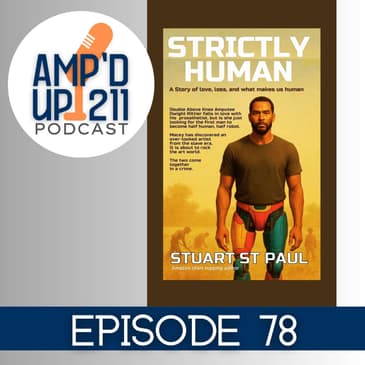
[00:02:44] And this is the cover art from Strictly Human. So if you're an amputee, and of course our show is for amputees, their families, things of that nature. The book, Strictly Human, a story of love, loss, and what makes us human. And then there's a descriptor, double above the knee amputee, Dwight. Is it Rittier? Am I saying that right?
[00:03:15] I can't remember what it is, is it? Dwight Rittier? No, Dwight Ritter. Yeah. Dwight Ritter. Okay, so let's start over. Double above the knee amputee, Dwight Ritter, falls in love with his prosthetist. Now, for any amputee, that's a boom, boom, boom. That's a very dramatic opener, right? Falls in love with... Doesn't happen. Well, not to me.
[00:03:47] But falls in love with his prosthetist. But is she just looking for the first man to become half human, half robot? Cue the music again, right? Yeah. It's excellent. I mean, you've got me, okay? Okay. If this was a log line for a movie, I'd be like, okay, I'm in. Let's go. Right. The biggest problem is it takes five to ten years to make a movie, and in that time, this could be real.
[00:04:16] And the movie would be, oh yeah. Right. No, I know what you mean. Macy has discovered an overlooked artist from the slave era. It is about to rock the art world. The two come together in a crime. Oh boy. There's even a crime involved. Yeah.
[00:04:36] I mean, that in itself has me wanting to immediately jump into, we've got to talk about strictly human. You know, I know you have a number of other books, which I would encourage people to seek out your writing. You know, crime thrillers. You know, all kinds of really interesting, kind of sexy, kind of cool, you know, themes.
[00:05:02] But, you know, this story in particular, I guess the first question I'd want to ask you is, you know, why a double amputee? How did that enter your consciousness? Do you know, lots of people ask how many things enter my consciousness?
[00:05:19] And I think I've heard you use the term futurist occasionally, where there are some people who literally do have the kind of brains that don't work kind of the way other people's do. And they're more asking what if or how or what could happen. And then you get into that Star Wars era or beyond. And all I was doing was going, OK, I've got this character.
[00:05:48] He's been with me now through. He joined silently and in the background in book two. And he's been from book three. And by the time he came to book eight and he's in a chair, but he's a great guy. He's repurposed his whole career into working in IT tech. And he's the main man. He's like the point guard of the whole of the agency. So Dwight Ritter is the most important person at CSCI, really.
[00:06:17] But I got bored with the fact that he hadn't moved himself on. He moved my company on and my book and the agency. So I had the other guys say to him, look, it's about time you got to see a prosthesis and started to walk again and got out of the chair. So they actually punished him to do that. And he did get up and walk. So once I'd done that, which was book eight and nine, he goes out on active duty again, effectively.
[00:06:47] In book 10, I just went, I want to do something really different. And you know what, let's be futuristic again. And what if instead of having, and I know a lot of limbs now are very automated, but what if we actually went real Boston robotics on it and said, let's have half man, half human? Yeah. What if? Yeah, very, very cool.
[00:07:13] And you're correct, because so much of this technology up until, let's say, the last like 20 years was very archaic. You know, it was all very post-World War II. And a lot of those sort of clunky, you know, not computer chip sort of driven, you know, prosthetics and processors, you know, knee microprocessors, things like that.
[00:07:41] They really weren't in any kind of real existence. They may have been in some kind of testing phases, but it wasn't something that was really, you know, a shelf item that your average amputee could access. But we are slowly but surely moving into what you're portraying in this particular piece, which is, you know, the half human, you know, half robot sort of concept.
[00:08:06] And again, you know, talking about, you know, great, you know, sort of reference in the Star Wars piece of, you know, when I was a kid and I saw Star Wars for the first time, seeing Luke lose his hand and then being given another one. And I think there's this moment in that scene where there's sort of this panel that's opened up in his wrist and they're sort of checking, you know, the function of his hand.
[00:08:35] And there's actually a robot performing that maintenance on him. So there's a droid involved. He's got this robotic hand. To me, that was so fascinating. Like, wow, what a cool idea of what the future holds.
[00:08:51] But then you fast forward and a lot of these things, whether you're talking about osseointegration, which is coming on very strong in the U.S. right now, and many of the manufacturers of prosthetics are employing a lot of these technologies now. So it's really just a matter of time before this concept where you have this sort of fusion of both, where just these limbs just become an extension of you.
[00:09:20] It's no longer like something that you don, but it's surgically part of your body. Well, I think the word even saying it's surgically part of your body in a way harks to the past because I think that integration is going to become so much easier that we're going to look at even today's stuff and go, wow, that was yesterday. Why? Because, for example, I did quite a lot of research.
[00:09:50] And remember, I'm an outsider. I'm literally going, OK, I've got a lot of friends who are amputees. I've got a lot of friends who are in chairs, a lot of stuntmen with injuries so that they are currently not walking. So, yeah, I have people that are currently in the zone as we know it. And I researched it and I was amazed by the intricacy of just knees for walking up and down stairs, how much they put into the microprocessors.
[00:10:18] So in the research, I started to look at actual robots and we haven't seen what they've got at the moment. And what they've got is is beyond scary. I mean, it can do any stand up and do backflips on the stop, you know, standing backflips and land where it stops.
[00:10:38] And I just thought, how about if we took the whole bottom half of that robot and gave it to Dwight, who is basically above the knee amputee on both legs. But the position I have to put to him is we need to remove what you've still got. We need to go straight up to your pelvis.
[00:11:00] And we are going to plate your pelvis and create a just sit a robot below it that does everything for you. And that kind of gives you all kinds of problems. Like, firstly, do I want the rest of me cut away? Secondly, how does it connect to my pelvis? And thirdly, does that mean I now have two brains? Yeah. I have my brain in my head and my robotic brain.
[00:11:30] Exactly. And all of it starts to get very deeply questionable. And in the book, what happens is, in a way, although this lovely lady who's a real biotech expert has fallen for him as a person, she is seeing him as a target, as a test person.
[00:11:58] And in a way, her excitement for her career potential is above her love potential. So if you look at the chart, her career potential is up here and her love potential is down here. So she's saying to him, look, why don't you try it? But she really wants to move herself on. She sees him because he's fit. He's engaged with walking, let's say, very late on in his amputee stage. He's very comfortable in a chair.
[00:12:28] So he had to learn to walk. In that case, he's strong enough to learn to be a robot or have a robot in his second half, in his bottom half. So she's seen him with this potential. Now, what the book does, which is really clever, is have him resist this because he doesn't want to lose his humanity, or so he thinks. He has in his head his own plimsoll line of where that is. So he's down at the bottom. I don't want to do it. She's at the top. I do want to do it.
[00:12:58] And then what starts to happen is he falls in love with her. She falls in love with him. She then decides you shouldn't be doing this because it is too risky. And I like you too much for that. But he's gone the other way. And he's now, I'm going to do this. This is my chance, spoiler alert, a daughter he's not seen since she first saw him as a blast victim and hasn't seen her since. A young girl, must be about 11 or 12 now.
[00:13:27] It's his first chance to be able to go back to her and say, look, hey, it's dad. I'm walking. I can jump. I can leap. I can do all of that. And he now wants to go forward and do this. But his biochemist, human prosthesis doesn't want him to do it now. So the book swings the other way. Yeah. The conflict sounds fascinating to me in terms of physical, mental.
[00:13:56] So much of your creativity and your imagination, you know, really intrigues me, which is, you know, why I feel that your story is so relevant.
[00:14:07] And I do believe that there's some connective tissue, obviously, between the earlier parts of your career, what you were exposed to, going through a trauma yourself, and then coming out on the other side of that and saying, well, I think writing is going to be part of my healing process. And it's going to allow me to keep exploring these creative spaces.
[00:14:33] So thank you for indulging me and allowing me to put that on the front end of the interview. Because if you were to read my notes right now, you'd be like, hey, mate, Rick, all that's at the end. It's at the end of your interview. And I was looking at this this morning, and I thought, eh, I think I'm just going to ask him right off the bat about Strictly Human coming to your bookstore.
[00:15:02] There was a song that used to haunt me when I was writing the character of Dwight. And I know, I've got friends who are amputees, as you'll expect. And their loss has not always just been the limbs. It's been family afterwards. And in my head, every time I wrote Dwight Ritter, I had in my head, Ruby, don't take your love to town, the Kenny Rogers song.
[00:15:29] It punished me all the time that he was losing his wife, that this guy lost his wife and has never seen his child since that day. So for me, this book was about getting that back as well. And that can mean so much because Dwight, now it could be more than human. And that's the future. Yeah, yeah. No, I think that's very thoughtful.
[00:15:57] And, you know, I would think having, you know, knowing people in your orbit that, you know, had limb loss or limb difference was certainly helpful. But I would think for someone like yourself coming into this space, there's always going to be that level of kind of like you kind of let it slip out, you know, in the beginning of the interview. Like, I feel like a phony.
[00:16:23] And what I would welcome out there in the community, encourage people to engage this experience, encourage people to learn about this experience. It's a very unique and very often extraordinary sort of journey that people who have to make these adaptations, these sort of recalibrations in their life.
[00:16:53] It speaks to a lot of creative forms, whether you're talking about film or you're talking about, you know, writing. You know, I find for myself, becoming an amputee sparked a ton of creative energy in me.
[00:17:11] And not that I didn't have some of those skills, but sort of going through a trauma or having to deal with that evolution of the human experience and going a completely different direction sort of gets you in that very reflective space. And I think if you allow those feelings in and you embrace them, it's really extraordinary what comes out of you when you've gone through something like that.
[00:17:38] And the backstory on you is super fascinating. I mean, you've lived a pretty incredible life. I am a huge, like, film fan, movie. I was a movie kid. I'm a movie adult. Film to me, it's sort of like the Holy Grail to me. It's like, it's what documents our history.
[00:18:07] It's such an important art form to me. And it's so accessible, which I really appreciate. But you becoming a stuntman, that just really, really gets my curiosity going. Because really, in truth, I've never met a stuntman before. And I'm always thinking, well, how does that come about?
[00:18:34] Because I know you train with the BBC, but it was like, okay, how did that transition into, you know, becoming a stuntman and finding career space? By doing that. Okay, I'm going to knock this one out of the park very quickly, because it's, I think this is kind of the boring part of my career. But I understand the fascination there. So I had a dream to be a radio presenter.
[00:19:00] And in England, back in the late 60s, we only had very conventional radio stations. And the pop radio stations were run by ships offshore called pirate radio stations. They're very big in Britain. They also had pirate radio stations in Israel, many other places. So my dream was to become a DJ on a pirate radio ship. Turn forward because of that.
[00:19:26] This is another thing about necessity as the mother of invention, which is kind of where you were hitting with if you have to approach your life from a new angle. Right? That's where you were earlier. Yeah. So I was 14, 15, wanted to be a DJ. I taught myself electronics. I built a radio desk at home. And I DJed to myself every night. So I was a geek of the first order.
[00:19:53] You know, I could have had a wardrobe full of anoraks. But I did have, I gave myself that radio tone. I gave myself a great show reel. I had everything I needed. So I pitched to BBC when I was only 17. And they picked me up and trained me in radio. It was obvious I wasn't going to get on the air because I wasn't a star. I was such a youngster.
[00:20:17] So after three years with them, and I must have been early 20s, I went off. I did a little time with one of the record companies, Capital Records. I stayed with them for a year. But then I joined two other radio stations during the breakfast show. So I did 10 years in radio. And my dream was to go back to Radio 1 to do the national breakfast show. Somebody else got it. And in those races, there's only ever one gold medal winner.
[00:20:45] But I was lucky because I was offered a great runner-up prize, which was a TV show that came out about a radio station. And they offered me the part as the radio DJ. So by default in 1980, I still was quite young, 22. I became an in-vision, on-television, DJ at a radio station, and also acting all of the other stuff I had to do around the part twice a week on a soap,
[00:21:14] which was going out in the UK. Oh, that's interesting. So I moved from radio to television. Well, it's just funny that you're trying to be a DJ and you ended up acting as a DJ. Absolutely. And I hated it. Hated it. Hated acting. Hated acting. And if you look at the logic of what you do, because you're a radio presenter, you'll get this straight away, is I opened the microphone every morning.
[00:21:39] And apart from the playlist of records, I could say what I wanted, ask what I wanted, and within broadcast rules, do what I wanted. But as an actor, they were all of a sudden, they were going to be, can you stand there and say that and say it this way? And that was so against my training. Yeah. It just didn't work for me. And then I looked at the way actors were pushed around. I'm going, I don't want to do this.
[00:22:09] I don't even want to work in television, really. I want to work in movies if I'm going to be an actor. And you go, but is that likely with the training I had, which wasn't in that direction? So I'd been an athlete. Okay. I'd fought for Britain nationally, three years running in judo. I was pretty good at taekwondo. I was a runner. I swam for my local district, played basketball for the district.
[00:22:37] So I did a number of sports to a high level. And a casting director once said to me, you know what, Stuart, you're wasting your time trying to be an actor. If you became a stuntman with your looks and your youth and your enthusiasm, you will get parts thrown at you. And I just went, what? Okay. I hadn't thought of that. And I trained and changed. And in 1981 became a stuntman.
[00:23:03] And I was still only 27, which was an old stuntman, but still quite young in career terms to make a change. Yeah. So that is exactly how it happened. And what's the craziest thing that ever happened to you as a stuntman? Well, I can list a lot of them and they're all different. And I know that one you're going to get around to at the end because at the end of my career, I suffered a blast injury. Yeah, I know that.
[00:23:32] And I was very ill and it required brain surgery. So that is something which you don't expect to hit you on a film set. But only too many people do get injured on film sets because the public forget it's a factory floor. It's where we make stuff. And if you're on a big war show where we do use explosives, we don't use live bullets. We shouldn't. And I know some people have suffered from that. So it does happen.
[00:24:01] But we certainly the explosions are live. And I can talk to you more about that in a minute if you wish. But it's dangerous and people get injured. Now, I wasn't even doing a stunt that day. I was the senior stunt person of the team. We were in Hungary. There was a Hungarian stunt coordinator on the floor managing the floor.
[00:24:23] I just sniffed something wasn't right this day, that it wasn't proceeding the way I had planned it with the production designers, the special effects and all the rest of the team. Something smelt wrong. I went on set and the most vulnerable cameraman who was nearest to where the incident was going to take place. And this was the beginning. It was the first of a series of 10 explosions.
[00:24:48] So this was the close-up of the real actors in the real truck, camera looking at the windscreen to see them. That's the key. To see them driving as they hit a roadblock. Oh, wow. So it's just a small explosion. All it needs to do is cover the windscreen. Very small. And then as the minute that goes, bosh, we edit, just like you edit sound and we edit pictures. We'll cut to something else much bigger as the camera moves along sideways.
[00:25:16] But we'll control that so that we've actually got the explosion just in front of lens between the lens and the camera. We do it with fire ones and all kinds of other little things. But we went into a traveling shot, traveling sequence, a car chase, then a big explosion at the end. I sniffed something was wrong. There was a lot of tension on set. I stood by the first camera and I said, look. And this is exactly how it worked out. We were beside the river.
[00:25:43] If you imagine beside the big old river, which has like got Romanesque walls all the way down the side. And this truck's going to hit roadworks. And I said to the cameraman, I'm not worried about the explosion. I've seen the test. It lasts. The amount of fuel in that explosion, liquid fuel, that's being lifted by a dry deck cord, lasts for 1.7 seconds. We've timed it on a number of tests. It only reached 10 feet in height.
[00:26:12] So it will cover your picture frame, your close-up of the windscreen, but it's safe. What I'm worried about is the barrel or any of the materials getting entangled in the wheel of the truck. And trust me, I will see that before anyone else. I will see that quicker than anyone else notices something's gone wrong. And if I see that and the truck is out of control, I will announce on my walkie-talkie brakes, stop the truck.
[00:26:41] But I will be first taking you away from your camera position and walking you behind this really thick stone wall that the truck can't penetrate. And what happened was the biggest explosion I've ever seen in my life. It was like a petrol station had been napalmed by a drop set of bombs going in a long line. There was more fuel, more explosives than anyone had ever imagined. And it came straight at me.
[00:27:11] So, yeah, that was pretty memorable in the way. But it wasn't a stunt. It was a special effect. Yeah, I mean, we can rank that as a crazy situation. So, after that blast, was it lights out for you waking up in a hospital? It wasn't lights out because I didn't know my head was on fire. I was covered in glue.
[00:27:38] I don't know what you'd call it there, but like sticky glue because that was being used to throw bits in the air. It should never have gone as far as it. I was 40 feet away, 40 feet away from a measured 10-foot explosion. So, my head had been covered in glue and it was on fire. And I didn't know it was on fire because you just don't.
[00:28:00] It's like when we do simple stunts, like a guy jumping through a window, someone else will check him because he will not or she will not know their cut from the glass. Their adrenaline is so high. And your body shuts off the pain for that second, even if you're going to get it later and you get all those phantom pains and horrible pains afterwards. For that moment, it's gone. So, you wouldn't know your cut. And I did not know I was on fire until somebody told me.
[00:28:30] Yeah. I was calling for help. There wasn't any coming. No firemen came. No ambulance came. So, I had to. I knew I'd be dead within seconds. I took both of my hands and I knew I had to squeeze the flame out by pushing the glue into my head, which is exactly what I did. All the oxygen away. I knew I'd got to get rid of the oxygen. I put the flame out. I was ready to run and jump into the river, which was near if I hadn't got it out. But I got the flame out.
[00:28:59] My hands were covered in fire and glue. I don't know if you can still see it, but the white skin on my hands is where it's never grown back properly. So, yeah, after that, I was taken quite slowly to hospital. You may ask why, but this is part of, and so many of your listeners that went through this or are going through this in the same way as therapy. After an accident.
[00:29:25] I've got severe PTSD and I'm having the usual problems with it. I'm being seen by a military PTSD counselor who, I have to say, was brilliant and saved my life. And I get a bit emotional when I talk about this sometimes. That's heavy. I'm having the therapy because I've turned into an angry person.
[00:29:53] But immediately after the accident, I didn't know I was injured. So I was taken to hospital. The reason I was taken slowly, okay, let me explain that. There's only one ambulance on a film set. It's there for safety. It's there in case something happens. But no one expects something as big as that to happen. And two multimillion dollar movie stars are in the truck. And they can't get him out of the truck. Now, I can't see this because I'm covered in flame and I'm on fire.
[00:30:23] The other two guys are in the truck. They can't get him out. The door's swollen. It's heated up. The metal's gone torsioned. And so they, even when they get me to the ambulance and I'm in so much pain now because my head's burning. They're pouring water on me, but I can feel the burn. There's no flame there. It's the heat. The ambulance can't go because they don't even know whether these two guys are alive in the truck. They don't know what state they're in.
[00:30:50] And it's not until they get the truck open and the two actors out, and luckily they were safe inside, that they then all of a sudden, quite ironically, put on the alarms and a blue flashing light and take me to hospital. And the rest is history. Within three months, I was getting quite cranky. I was not a nice person.
[00:31:12] And my wife had me, I don't know what the American word would be for it, but sectioned in the UK because my brain, I was just this, there was something wrong. I was evil. What they didn't know because they were treating me for PTSD. And again, I bet so many of your people have been through this. They hadn't noticed the medical problem.
[00:31:41] What happened was my blood pressure had gone so high during the fire that I had not burst blood vessels, but they had gone to the point where they were distorted. And in my brain, on the side of my brain, the blood vessel was varicused, to say, to use the right word. And the bulbous bits were hitting the nerve as my heartbeat. And it was giving me facial epilepsy and head pains.
[00:32:11] So I wasn't mad. And it wasn't all PTSD. I was genuinely in pain. Well, you suffered a serious brain injury. Yeah. And they said to me, look, we're going to put you on drugs. We know how to manage this now. We'll put you on... I knew it as tegratol, but there's a proper chemical name for it. And they said, what's going to happen with you now? And we know because you're now on a road. You're going somewhere.
[00:32:41] Is the pain... Your body will get used to this drug. So we'll start on one. You'll be on two. In the end, I was on 1,600 milligrams of tegratol a day, plus another drug, which was an A-list drug. Two horrible drugs that you have to take. And I was still fitting and falling to the floor with face fits. And at that point, they said, okay, drug regime over. You've had a year of drugs. We're beyond that now. We have to operate.
[00:33:11] And it was just one of those things where they didn't know whether I'd come around or not. But the funny thing is, out of that therapy where you have to write about your emotions and all of that written therapy and homework, and I did it religiously. Because I had a family, and both of my kids had just got married, and I wanted to see this family. So I did the homework. I did the punishment. And it was writing. And that's where the books came from. Because I was going to ask you, what was the turning point?
[00:33:41] And given that it was a connection for you in healing, that makes a lot of sense. And that's actually a common thread when I hear about people who either struggle with PTSD or become amputees through a traumatic event.
[00:34:01] It usually requires them to sort of redefine themselves, rediscover themselves, and then eventually fall in love with that version as they are. And it's really no longer about mourning the loss, let's say, of who you were. But it's more in the becoming piece. This is my starting point. I'm born today. And here are the things that I want to pursue in this lifetime.
[00:34:31] And once that engagement occurs and you sort of receive it, that's when someone like yourself writes all these books and has all these stories and all this creativity is just flowing.
[00:34:48] It's such a testament to our community because so often I'll speak to people who are newly amputees and they're entering this community and they're in that space of, who am I now? Like, I look in the mirror and I don't know who's looking back at me anymore.
[00:35:17] I don't recognize myself. And so much of what you're describing is that, you know, those first steps in saying, okay, well, this is helping me. This is healing me. Writing is filling the gaps and it's giving me purpose. And, you know, I think it's a beautiful part of your story. And I just appreciate that you're actually willing to share it.
[00:35:45] And, you know, given that one of your main characters is, you know, someone with limb loss, you know, has arrived us at that intersection, you know, of life. Yeah. And I think it's really, really interesting the way different people come to this community, whether it's through story, whether it's through a loved one, a partner.
[00:36:09] But I thought I read something and I could be wrong. You had something to do with one of the aliens movies or something like that? Yeah, I was the queen alien in James Cameron's Aliens. I was inside. I wasn't going to say that because I swear I read that somewhere. And I wasn't going to say that because if I was wrong, I would feel really stupid.
[00:36:36] Like, hey, Stuart, were you the queen alien in Aliens? I'll send you a picture you can put up. Can you please do that? Yeah, myself, there were two of us strapped back to back and our arms went out. So my two arms and his two arms made the four arms of the alien and our hands and wrists were the elbow joint of the alien. So they would give us like a stick with a floppy hand on real old fashioned filmmaking in our hand.
[00:37:06] And we would fight Sigourney Weaver or whoever we were fighting. It was normally Sigourney. And literally, I would have James Cameron in my earpiece. He would talk directly to me. And hold on one second, Stuart. Hey, sir. How are you? We're going to see you in a little while. OK. Oh, you're good. We're just right in the middle of one. Yeah, it's our next guest decided to. Am I going on too long?
[00:37:35] No, you're fine. No, we just have we have our next guest who's obviously very anxious. OK, well, I hope you can enjoy the story. I want to revisit this. Hold on a second. Let's back up. And I want you to start. I want you to start where you were describing you and the other stuntman in the outfit. This is like a total geek session for me because I'm a huge aliens fan.
[00:38:04] And this is very self-indulgent. Excuse me. Excuse my indulgence. I'll pick it up. I'll pick it up. So there would I was the Queen Alien. I'm inside the Queen Alien. And there's two of us inside the Queen Aliens. 1985. We didn't even think it was going to be a big or a special movie. It was just another job. And the two of us were strapped back to back. And my two arms and Malcolm's two arms were the forearms of the Queen Alien.
[00:38:33] And our arms were solid. Our wrist was the elbow joint of the monster. So effectively, we would have a broomstick with a floppy rubber glove on the end. And our wrists would make the arm move. And James Cameron would talk to us. We had earpieces. So I could speak to James. James could speak to us. He was really very definite on what he wanted this alien to look like. And we had a rapport.
[00:39:02] He understood us as his Queen Alien. And I could move my hands to what he asked. And I would be hitting Sigourney Weaver with these floppy latex hands on a broomstick by wriggling my wrist. I couldn't see anything. Couldn't really see her. But I could take his direction. We just, after three months, we got it. We were puppeteering for him. So recently, Malcolm and I got together. It was about a year ago. Malcolm does the Comic-Con circuit. Okay.
[00:39:31] And he signs autographs there. And he said, hi, Stuart. He said, if we could do a picture together, because it's never been done before. We'd never, ever done it. He said, you know, I'll be able to sign these at Comic-Con. So we got together. I'll send you the picture. In his garden. He was then 82 or 83, and I must have been 70, 71.
[00:39:53] And the two old men, back to back, showing exactly how the Queen Alien was, which is hilarious. I so appreciate you saying that, because I hear this, you know, with actors, with, you know, extras, stuntmen, different people that have worked on iconic films, which, you know, Aliens became this, like, huge hit and really, you know, set a course for, obviously, James Cameron.
[00:40:23] But when you say, well, we didn't know, like, what this was. You know, we're on set. It's a job. And they're putting you in this huge, you know, suit. And I would think you're going, like, what on earth is this? Like, what is this? What is going on? What are they on about? Yeah. What is this movie about exactly? Let me just pick you up on this, because there's, I tell you something here. We don't know what films were, and we don't know if they're going to be hits. Yeah.
[00:40:52] But you doing your show, you do not know who you're helping. Yeah, that's true. You really don't. And when I heard your show and did some, after you emailed and we started talking and I listened to your show, I just, I've got to do this show because this guy has no idea how many people he's helping. Oh, that's fair. And you don't. No, I appreciate that. Yeah.
[00:41:16] And the thing about it is, you know, I came to this sort of self-serving, you know, being a new amputee, I began following people and I really enjoyed their stories. I liked following them on social media and if they were kind enough to write an article somewhere or, you know, just a short journal piece or something, I was very fascinated
[00:41:41] with their perspectives and sort of how their lives were developing in their own little journeys as amputees. And, you know, it was one of those, gosh, it'd be really cool if I could directly speak to some of my heroes because these people were sort of emerging in my life. They were becoming significant to me and I wanted to meet them and have an exchange of ideas with them.
[00:42:09] And bearing in mind, I'm at the very beginning of my own, you know, experience as an amputee. So I have a lot of questions, you know, about, you know, adapting to amputee life and the technology, you know, that we've spoken about, you know, how does all this work? And I was just very fortunate that when I started reaching out to some of my people, my, you know, I had these little crushes on people.
[00:42:37] Gosh, Stuart, they were so kind. They were so receptive. It's magic, really. And I think as well, like you were saying about PTSD sufferers, people who are suffering from depression because something's happened to them. Yeah. It's so important. Listen, you're lucky if you get a great teacher. It's like being at school. If you get a great teacher, you're lucky. If you get one that's not so good, you have to find your own way through it. Yeah. But I had a great therapist.
[00:43:06] I mean, a super great therapist. And his job to me was, he said, listen, my job is to try and get whoever I'm seeing back into the world, back into the employment circle if I can. Yeah. But he said, that's not going to happen with you because of your age and your injuries are so severe. You're not going to be managing big disasters on film sets again. I get that. But he said, what we've got to do is make you remember the best of your life.
[00:43:35] So you asking me about aliens is exactly what he told me to do. He told me that I should go out and lecture or speak at functions about my time in the stunt industry. Yeah. Which is how I got on the cruise ships because they love it. I mean, I go on the cruise ships. I talk about aliens. I talk about Batman, Superman and all the tales behind there and some of the pictures I've got.
[00:44:02] And I mean, it allows me to see the better side of my career and not have it finish on the accident which ended it. Yeah. And that's so important. I think you're right. And I'm at an age now where so many of my friends are either retired or they're thinking about retirement. And some of them are, I guess, in this space of like, this is it. Like, this is my finish line.
[00:44:30] And I always say, well, what can you celebrate, first of all, from this huge body of work that you've done over decades? You know, what can you revisit that's very positive? And now that you're turning the page, so to speak, what's next? This is a very, very exciting moment. Because isn't life about sort of reinvention? I want to try this.
[00:44:59] And people tell me all the time, it's never too late, man. It's never too late. Go do something that you wanted to try when you were young. I mean, you have the opportunity now. You're wiser. Maybe you have some more resources that you didn't have when you were young. You know people, right? Because we all have a network. Once we get up in years, it's like, I know people. I can call people. I can get advice. I can, you know, utilize my Rolodex, so to speak.
[00:45:29] And I think that that's kind of the beauty of it, you know? And having gone through, you know, what you did in terms of being, you know, a trauma survivor and someone that's managed PTSD, what would be the advice, you know, that you would give someone today that was struggling with PTSD?
[00:45:57] I think you've definitely got to look back at the good times and the times that you had. But you've got to do that actually is not easy because you've got to find a way of sitting with the fact that they were in the past. And that's a barrier in itself. I did mine through writing. I wrote the book Cruise Ship Heist, which was my first book, and Kieran in it.
[00:46:25] If you imagine, the writing is straight out of therapy because in therapy you have to write in the first person, how it affects you, your emotions, what happened to you. So the first book is Kieran. He's just been thrown out of the army. We don't know why. And I think I didn't know that clearly why. When I first had the idea, but I gave him the reason that he was helping.
[00:46:49] His life became too much about helping the kids in Syria as opposed to why he'd been sent there as a member of the military. And he got thrown out of the military. So the book's written in the first person and it doesn't take my journey. Now, they wanted me to write a biography. I didn't want to do that. But I wrote somebody else's life, which was very close to mine. And I wrote it in that first person. So I brought all my feelings out through a book.
[00:47:18] It's a good way of doing it. Storytelling, a book. But you do have to find a way of moving forward. As you read Cruise Ship Heist, you can feel Kieran has got PTSD. You can feel there's stuff in his closet. You are dying. The military guys amongst you will be dying to know what is in his past.
[00:47:40] And I think for you to be able to hold back on some of it because it is personal to you, your injury is personal to you, but share what you're going through. For me, that was the way out of mine. So the first book, which is a rip-roaring page turner, is me coming out of therapy. And somehow you've got to figure out your way of doing it.
[00:48:06] Yeah, awesome how you were able to channel that energy in the way that you did. Taking something that was very significant in your life and then finding a way in a therapeutic way, but also in a very, very generous way to sort of give that to the world and say, this is how that feels. Because so much of good writing, it comes from the soul, I think.
[00:48:34] When you're really able to share the deepest parts of yourself, I think that's when you make the biggest connections with readers. I know that I tend to gravitate towards those types of stories, that type of writing. And I'll say, wow, you know, this really touched a lot of buttons with me. It really created a lot of connective, you know, sort of feelings.
[00:48:59] And I think that that's just very, very effective in healing in general. Because even if I write something, you know, if I do a blog post or something of that nature and someone will make a comment to me or they'll DM me and say, and they'll quote me and say that line right there. That really, really got me. That really, really helped me.
[00:49:28] That resonated with me. That was super important to me. And I'm really glad that you said that. Because I was struggling to find the words to describe how I was feeling. And sometimes it's a little strange because I think, well, yeah, I mean, I don't know if I really felt that way when I wrote it. But gosh, I'm so glad that you feel that way about it. Like, great.
[00:49:56] And I think that energy is so important, you know, between someone who's, you know, an artiste and someone who can love and appreciate it. So, no, I think that's wonderful. And what a great sentiment in terms of, you know, people that are out there struggling. If someone wants to follow you, where's the best place to do that, Stuart? I have a page on Facebook.
[00:50:26] They can find me there. Stuart's important. I'm pretty easy to find. You're all over the internet, by the way. Yeah, I'm everywhere. So, yeah. Stuart St. Paul. Yeah. Yeah. Fantastic author. Amazing career. I feel like we just kind of scratched the surface today. This was a very quick hour for me. So, of course, I'm going to be following and keeping up on your progress. Please don't be a stranger.
[00:50:56] I very much appreciate your time. I was just thinking the same term. Yeah. But we'll do this again sometime when I don't have to, we don't have to talk about the muddy stuff. The muddy stuff. Exactly. But thank you so much for, you know, representing this community in the way that you are. And I would recommend everyone get out there and check out Strictly Human by Stuart St. Paul.
[00:51:25] I'm Rick Bontkowski. This is the Amped Up to 11 podcast. And I want to wish everyone health and happiness. We'll see you next time.