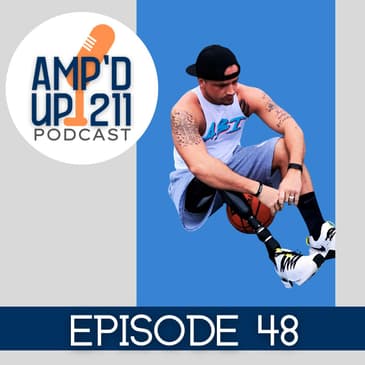
We are proud to present Scott Odom, a true testament to the power of resilience and determination. At just 14 years old, Scott faced a life-altering challenge when he lost his leg to cancer. Despite this daunting obstacle, he refused to let it define his future. Instead, Scott channeled his passion for basketball into a remarkable career as a professional amputee athlete. In this episode, Scott shares his personal experiences from the moment he learned about his amputation, through his rigorous recovery, to his triumphant return to the basketball court. We’ll explore his transition into adaptive sports, and the profound impact of his charity called ABI, Amputee Basketball Invigorated. Scott’s story is one of overcoming adversity, achieving greatness, and giving back to the community. The AMP'D UP211 Podcast is created and hosted by Rick Bontkowski, a right below-the-knee amputee.
[00:00:00] Now on the AMPD UP211 Podcast, Scott Odom, A true testament to the power of resilience and determination At just 14 years old, Scott faced a life-altering challenge when he lost his leg to cancer. Despite this daunting obstacle, he refused to let it define his future.
[00:00:17] Instead, Scott channeled his passion for basketball into a remarkable career as a professional amputee athlete. In this episode, Scott shares his personal experiences from the moment he learned about his amputation through his rigorous recovery to the triumphant return to the basketball court.
[00:00:35] We'll explore his transition into adaptive sports and a profound impact of his charity called amputee basketball and vigourated. Scott's story is one of overcoming adversity, achieving greatness and giving back to the community. Scott Odom, Welcome to the show, my man!
[00:01:00] Thank you and I appreciate it. Thanks for having me all. So good to see you, I so appreciate you being here in the morning. Of course we do. We're doing these early morning tapings now.
[00:01:10] We've got to make sure we get this out of the way before we get on with our day. So thank you very much. And I've spent probably the last three or four days with show prep on you. And it's extraordinary story.
[00:01:31] I mean, what you've done with your amputation and how you've transcended into some of the spaces that you have been in and now are currently. It's just phenomenal. And very inspirational for someone like myself, an amputee of going into my seventh year.
[00:01:56] I think about you specifically in regards to the age that you face the anputation 14 years old. I think of myself in that particular age, you know, I kind of felt I was pretty self-aware at that point. I mean, you're still a kid.
[00:02:20] But you're sort of getting into that young adult space and, you know, your developing dreams and developing those ideas about what you want to do and you're trying to be cool and, you know, all of that stuff right that goes at that particular age.
[00:02:42] And then the juggernaut arrives, right, cancer. What's going on, right? So if you could describe your 14 year old self at that time, what would be the narrative in that situation? How would you describe what you were processing as a 14 year old Scott Odom?
[00:03:09] Yeah, I mean, right before I got diagnosed like I was heavy in the sports. So like I that summer I just finished up in all stars and baseball about the transition into high school.
[00:03:23] And so I had like high school coaches and all this looking at us talking to us, you know, like, So there was talks about me possibly, you know, going pretty far and baseball because that was my sport that I excelled most of that was baseball.
[00:03:39] And then just just the stay active, like I was always involved in a sport. So soon as that ended, two days for high school starting and I was transitioning to high school as a freshman. Yeah, and at this time my knee was just really hurting a lot.
[00:03:57] But it's been hurting since I was 10, you know, it's been bothering me for that long. And I was so determined and so like, I knew what I wanted to do. Like I wanted to be a professional athlete. Like that was my dream.
[00:04:10] Like nobody was going to tell me that that just wasn't an option. That was the all I was focused on. And so going to the high school was like that next step of getting closer to that goal.
[00:04:21] Yeah, but I always had knee pain and you know, doctors would tell me it was just put ligaments growing too fast growing pain.
[00:04:29] So I was like, oh, I can go back playing. And then that I think was like the second to last game or the last game of all stars of baseball. My knee gave out on me and it was the first time whenever gave out.
[00:04:40] I hit it deep into center field, like left center. So I was running turning second to try to get a triple. And when I touched the back second on second base, my knee just buckled on my fell.
[00:04:54] And then in my mind, I'm like, man, I tore something or, you know, I'm done. Like so I was more upset about that that, you know, and my mom came to the dug out and I was like, yeah, we got to go to the doctor.
[00:05:05] I think I tore something. That was in my mind. And so through the MRI, you know, he said he saw a cloud around my knee didn't really like. So he wanted to have it more I'd done.
[00:05:20] So in my mind, you know, 14, it's not a big deal. I'll have surgery, I'll milk it, you know, be out a little bit and then I'll go back, at least for baseball season. You know, I can miss football. I wasn't a big kid.
[00:05:33] So football was just doing it just to do it honestly. He's the reactive. And then during that time from the MRI to the results, like I was still on two a days and football practice,
[00:05:47] I couldn't run full speed because the pain was so bad, but I didn't say anything. I just kind of pushed through it. Yeah, you tough to coaches. The coaches knew me from baseball and all that. So they knew I could run faster than what I was.
[00:06:01] So they thought I wasn't given in my all. So they were making me run more like almost, you know, I'm thinking I wasn't thinking I was just kind of playing around.
[00:06:11] Finally, what's on my mind? I had tears of my eyes at that time. I was like, my knee is just killing me. Like I can't do it. And so first day of high school, I have like two classes and then I come out on my second period.
[00:06:26] And I see my mom down the hallway and I'm like, what is she like, I was more embarrassed. Like, what was my mom doing at high school? Why are you here? Like you said the cool kid and that's like our worst nightmare at that age.
[00:06:40] Like why is my, that's one world collide, right? Your parents are at your school. This doesn't compute very first day of high school. Yeah, exactly. But I could look at her face like me, my mom, we can look at each other and kind of know something's up.
[00:06:55] So she's like, we got your results are back. They want to see you like now today. So okay, I was like, okay. And so in the back of my mind again, I've really torn something that's what I've convinced myself of. And we go see this knee specialist.
[00:07:12] And we're like the only ones in the waiting room it's taking forever. So I'm getting impatient because I'm like, I want to just want to go back to practice. Like let's go. Let's go.
[00:07:20] And then they finally call us and they put all the images up on the board.
[00:07:25] And she's given all this big doctor, lingo and I'm just like, you know, just tell me when I'm having surgery is what I'm thinking like I tore whatever how long am I going to be out. Yeah, when are you going to fix this?
[00:07:36] And then the next words on her mouth was 100% convinced or certain that you have all sorts of co-move and me and my mom look at each other like, what is that? And then she says cancer.
[00:07:50] And I first that didn't hit me like being 14 like I was like, there's no way a 14-year-old kid can have cancer. Like I'm healthy. I'm active. I take care of myself. Like there's no way I can't. Yeah.
[00:08:02] And then she's like, this is pretty bad. Like it's been in your leg for at least two years. I look at how it is on that MRI.
[00:08:08] And I see my mom getting upset. So I ask my mom to leave the room so I could ask a doctor or a question.
[00:08:15] So my mom walks out and then I ask the doctor straight up, I'm like, well how bad is this cancer? Like is there a bad kind or is it something that's no big deal. You know you can take it out. I'll be back playing and she's like, if we don't do anything now and you don't do treatment within the next year you'll die for sure because of how bad this is.
[00:08:35] And then that's what it hit me like I was just my whole world just kind of crumbled out that sports was over. I thought I was going to die like I was just thinking the worst of the worst at that time.
[00:08:45] Given that you were so active, a really active kid because that was going to be one of my other questions like, where you really acted because you know at this point I've watched you know a considerable amount of video footage of you playing basketball.
[00:09:03] And of course that as an amputee myself I see that and I think gosh man like you you play full court. I mean you you move so naturally like there's there are moments when you're you know driving on the court and you don't you don't move like an amputee.
[00:09:25] There are those those little glimpses a moments where you you can see like your favoring a leg so to speak.
[00:09:34] Because that's just and I you know and I can say that because I'm an amputee, I know I know what that is you know I know the way that we adapt right.
[00:09:46] But so often if I'm not really looking specifically at your legs there is nothing that would suggest that you're wearing a prosthesis let alone above the knee right. So being such an active kid.
[00:10:06] Having to digest that type of diagnosis you know at 14 not being a medical person all of this is just sort of getting like dumped on you.
[00:10:20] I would think there's had to be some feelings of like like my body like betrayed me like it's like this betrayal like why is my body doing this like you said.
[00:10:36] I'm active like I'm healthy like how yeah you know like the calculus doesn't work in that situation because so often especially with chronic illness because I've been there.
[00:10:50] You you try to trace back like what did I do right because I always go to that sort of that like space of guilt.
[00:11:01] Right what what did I do wrong like how did I do this to myself and then you you arrive at that place of what you didn't do anything wrong. It has nothing to do with anything you did. This is what being human is all about.
[00:11:18] We are we are these imperfect creatures that can get sick things can happen really what it comes down to as human beings as you know spiritual people especially what do we do with it right where do we take it from there.
[00:11:36] And I would I would I would think at that age. Because you're not really young it wasn't a congenital defect it wasn't like you lost a limb as a baby. And because you know I you know I lost my my leg and my late 40s.
[00:12:00] I I lived a considerable amount of life up until then so that sort of creates a completely different perspective. But if 14 I would think man that's a rough time I mean freshman year in high school I remember. Being pretty insecure as a freshman.
[00:12:22] Yeah and then right like factor in. And oh yeah and and you're you're you're you're going to die right if you don't fix this.
[00:12:35] Oh and and what did that look like was it we have to amputate or was it a series of surgeries what was the treatment plan at that point.
[00:12:46] Yeah so that next day they did a boxy to confirm it which was cancer and then that the day after that they put a port and my chest. I actually put a double port because I was going to get a lot of extensive chemo so chemo was like.
[00:13:02] I mean within a week I was already in the hospital taking chemo yeah I did chemo for about two months straight.
[00:13:09] So I lived in the hospital and then the tumor was getting smaller but it was spreading so I initially had an online knee in the hotel and then. During that two months I had two more spots on top of my knee.
[00:13:25] So they were really worried about it going to my lungs because if it spreads to your lungs it's pretty. Yeah so my doctor actually came to me. When I was doing a fall of things was a follow-up visit or something to check my blood work and all that.
[00:13:41] He's like I normally don't do this he said but you're an active young kid and he said I feel like you need to have a say in this decision.
[00:13:52] He's like we can go two routes with the surgery we can do a lymph salvage surgery which would we would take the tumor out.
[00:14:00] Take all your bones out basically to be a femur and all that replace it with metal rods we'd save your leg but you would be limited activity wise without that. Do surgery in your other leg as you grow the you know growth goes first and all that.
[00:14:19] He said over the other option would be amputation and that was the first time I ever heard that word amputation.
[00:14:25] Yeah and I was like what is that mean he means like what we would basically go above where the tumor is at and cut your leg off and then you would use a prosthesis the walk and all that stuff.
[00:14:35] And he was like you can jump out of a plane you can be as active as you want to be which I would never jump out of a plane because that's just not even if I'd two legs on you.
[00:14:44] I've done it twice but more power to you I can do. But in my mind I was hearing sports and no sports and I was hearing lose lose my life or lose my leg yeah. So right then I knew.
[00:15:01] But I didn't say that out loud because my mom is in the room. Yeah, and I could tell it was upsetting her a lot.
[00:15:08] But for whatever reason I just had a piece like just cut it off like just be done with it like I don't want to take the chance of them cutting it out and they don't get it all or whatever like just go above it cut it off and then I'll figure.
[00:15:21] What I mean incredibly evolved at that age to know and I'm sure there was something like intuitive about it you know we as humans we kind of like listen to our gut a little bit. And always that voice in our head and when I was young.
[00:15:42] I actually and I can admit this now because I'm older when I was young I never listen to that voice. You know like when you're going to do something you know you shouldn't and that voice saying not a good idea man and you just do it anyway.
[00:16:01] Yeah, well now that I'm older I am so connected to my intuition the second I get even a whiff of not a good I'm like I'm out. Yeah, no no no no.
[00:16:17] Yeah exactly but at that age there must have been something that was telling you and we can we can laugh now and we can we can reflect on it now because of your mobility your mobility.
[00:16:30] So you know you look you look at that and say at that age to go. Yeah, let's let's do this let's let's take it. This does not serve me anymore.
[00:16:49] The quicker path to glory is going to be a prosthesis the the the the adaptation piece the fact that I will. I'm traversed this in some way is going to happen a lot sooner getting back to sports getting back to being active if I do this.
[00:17:11] Then if I try to kind of cobble some form of a leg back together and I'm still a young person and I'm growing and it's going to be just you know I'm I'm never going to reach that fullest potential.
[00:17:30] As sort of this you know kind of broken kind of person. That was incredibly insightful and how how did.
[00:17:41] That materialized with your mom was it something that she discussed with the doctors or was that something that you had to say hey mom this is what I think is best. Yeah, it was definitely me. So we leave that appointment and it was probably the quietest ride home.
[00:18:00] I didn't say anything she didn't say anything. And then we get home and it's still like kind of awkward and I just say why don't you write down what you want me to do and then I'll write down what I want to do and we'll see.
[00:18:13] You know, if we're agreeing if not then we'll talk about it. Yeah, so we finally decided and my mom and dad were you know they wrote down what they wanted and so like on 3d we turned it over and mindset cut it off and they're said save it.
[00:18:28] And when they saw that I wanted to cut it off of course they burnt down because I mean note pair wants to see their child lose a limb and sure I mean it's a whole new world and like at that time 25 whatever years ago like you just didn't see amp t's you just didn't see active ones or anything like that.
[00:18:45] We weren't perceived as the powerful people that we are back then no not at all and so I immediately when I saw that I was like for whatever reason I said I can't explain it right now but I know this is what I have to do.
[00:19:00] I'm at peace with it. I'm okay with it. I don't want you to be upset. I just need support like and once they heard me verbalize that like I'm okay with this like I'd rather be here than have two legs and you know not be here.
[00:19:14] I don't know what this processes or amp t's world is but I'll figure it out like I don't know so once we had that conversation they were like all right let's do this and so the doctor.
[00:19:28] You know they were going to do another MRI just to confirm everything and then they found two more spots on top of my hip.
[00:19:36] And so they were like well you have no choice we have to take your whole leg and we're just like devastated because unlike we just made this.
[00:19:44] It's a very difficult to sit life changing decision but now I have no decision so let's do a bob see the next day just to confirm it.
[00:19:52] And I wake up from the bob scene mom's balling like crying and I'm like oh great you know more bad news and she's like they never did the bob scene I'm like what are you talking about like I just woke up from anesthesia.
[00:20:05] Yeah and apparently I mean got at an angel in that room for me because when as soon as they put me under there was a tech or somebody.
[00:20:16] And that surgical room and they had my MRI results up on the that way they can nowhere to do the bob see I and one of them noticed that. The numbers were backwards.
[00:20:28] And so when they flipped it over it was the two same spots on top of my knee I never had any spots on my hip. They just initially read it upside down.
[00:20:38] Oh boy and yeah and so I learned that coming up and me my mom just thankful like no more cancer but my dad was ready to kill somebody. Just because of what we were going through and.
[00:20:50] But I'm just thankful they caught it and they're like we'll give you like a two week break and I was like just put me back under and just cut it off like I just want to be done with this you know.
[00:20:57] Wow so I think a few days after that I had the the reputation. Wow so in that moment you're like it's time.
[00:21:04] Yeah I was like no more of these like hoping or mess ups like if we know that's it if I've made the decision let's just do it.
[00:21:14] Yeah and do you feel do you feel like in your life with a lot of your decisions that you've made do you feel like. I mean once once I'm decided like that's it let's just let's do it.
[00:21:28] Um I mean for the most part I think the more I've tried to do especially everything that I've done like I. Not that I question a lot of stuff but I'm always like I beat myself up a lot I guess and my worst critic innocence.
[00:21:44] Yeah so I'm more harder on myself because I want to be like. Especially what I do for all these kids like I want to do as much as I can for them because I've been in their situation sure so.
[00:21:54] I probably think about it and visualize it on my head for months before you know I'm actually doing it. Yeah and then when it's done that they like I'm. Super down because I'm like man it could have went this way of showing them this like I'm.
[00:22:09] But everybody's super grateful super nice but in my mind I'm like yeah I tend to go to that space too. I think when you live your life in a way that you see you see your your life's path as an exercise in serving.
[00:22:32] When you bring yourself to that sort of idea that so much of my happiness and the forward movement in my life is when I feel like I am serving.
[00:22:47] And that could be the amputee community that could be you know my my my friends my family my creative endeavors that could be my work my professional life.
[00:23:03] When I am serving I I tend you know like you're saying there's there's a lot of sort of hyper processing that goes on because you want to bring yourself to something.
[00:23:16] And I you know it doesn't take you know all that much research to know about you that you obviously pursue perfection. And you know I've watched you know hours literally like hours of you just you know shooting around on a court right.
[00:23:41] You know multiple videos and I always go back to that idea that I once heard when I was young and someone said you know if you really want to get good to something. You know you've got to put in 10,000 hours. It's just what it takes.
[00:23:59] If you want to become proficient at something if you want to be respected and develop a skill on a high level you have to keep in mind.
[00:24:10] And it's just how it is nobody is just given these gifts right my Michael Jordan you know didn't become who he was because you know they just gave him a basketball and suddenly he was just amazing.
[00:24:27] He he talks very often about his success was built on a mountain of failure literally and I think that's an important lesson especially for young people.
[00:24:39] But I'm the same way in terms of my critical nature because I'll you know even talking about the podcast I'll go look back and look at things and I think oh my gosh it's like amateur hour like what on earth.
[00:24:54] I do the same thing yeah I do the same thing don't feel like no it's just it's crazy and you know I'll I'll tell my girlfriend Sarah I'm like I'm like do you see that and she's like no I don't know what you're talking about like it's it's fine.
[00:25:10] Yeah, it's very it's very hard for me to take compliments. I don't see it.
[00:25:16] I know totally I want to talk about a amp on basketball which you know you know talking about that this is something that has kind of been in my orbit you know for a while isn't amp it because it it tends to fall in and out of you know my let's call it my algorithm right.
[00:25:42] because it's it's very significant you know league of of. Stand up basketball and tell me about how all that came about and how how long after your amputation did that materialize. Yeah so.
[00:26:03] Well, so my life was 14 and then I played baseball and high school I went back and pitched with my prosthesis but I mean once I go in did I knew like.
[00:26:12] My dream of playing college sports was pretty much done like over because nobody was going to take me seriously that's an athlete. So there was about a year year or two where I was pretty down it and what I was going to do I kind of reached out.
[00:26:26] To my prosthesis and stuff and like hey, how can I be active as an APT kind of sports are there and of course.
[00:26:34] I was always pushed to the parent Olympics and track and field and all that which I just I never did it I just wasn't it's just not me I just don't have that in me.
[00:26:43] Yeah, and so I was like what about basketball and I know there's wheelchair basketball and I was like well that's cool like.
[00:26:51] You know, but I had to teach myself how to run all this stuff like I don't want to just sit in a wheelchair and play when I can run and I'm playing against able bodies back at home all the time.
[00:27:04] So nothing against wheelchair basketball it's a very cool hard sport I guess for whatever reason I just like I just want to place stand up I'll come there's not a stand up paying up there.
[00:27:14] And I was told you know it was too hard to do not enough APT's would do it there's just a lot of negative around it. And I was probably 19 at this time 20.
[00:27:26] So I was like okay and then my prosthesis I think got tired of me talking about it.
[00:27:31] They don't do stand up like this doesn't make any sense like they want to sell me a knee, sell me a foot but then they want me to sit in a wheelchair and play basketball like it doesn't make sense.
[00:27:40] And she's like well you just need to start it you just need to do it if this is what you're only doing so I was like fine I will.
[00:27:45] Yeah and so good I made I made a bunch of these flyers like stand up basketball flyers and I probably made over a thousand of them. I meld them out all over the country to like Oprah Mark Cuban the NBA.
[00:28:01] I was just go to the lane and find all these addresses to mail this flyer out just trying to get some some of you that like take. True interest in it and maybe want to help me out. Yeah put some energy behind it.
[00:28:13] So I'm milled out like like I said literally a thousand of them and I got one response from the NBA it was a marketing guy or somebody and I when I saw that email is like oh man this is it like. You know this is perfect.
[00:28:27] Yeah and yeah that's a big deal. Yeah and he was like oh this sounds cool but have you looked into wheelchair basketball and I was just like oh my gosh dude like did you not read the flyer.
[00:28:39] So I just felt like it was a dead end like I'd felt people weren't really hearing me out so I was like well if you're not hearing me out you need to see what I'm talking about maybe it's a visual thing.
[00:28:48] So that's when I posted the video of me just shooting in my backyard which I would do every day for hours at a time. Yeah my dad would put a flood light up because I could stay out there till it 2 a.m. Just shoot, shoot, shoot, shoot, shoot.
[00:28:59] That's just that's my therapy it's what I like to do. I kind of zone out when I'm out there and I when I posted that video I immediately got responses from other NPPTs from kind of all over the country like you told New York.
[00:29:12] And there was a guy in Utah that we he first connected with me and he said hey I've been kind of like me you know kind of looking for something like this you know did how are you starting something what's going on.
[00:29:24] So again man I would love to start something and so we kind of were talking for a while and you know we said hey let's just I got guys kind of all over the country but you know let's just do this on our own like.
[00:29:36] Yeah how do you bring it all together I don't think we're going to get the support we're looking for so let's just you know do it and so.
[00:29:43] I drove from Texas to Cali to meet up with him and another NPPT just to play basketball on a weekend and then we contacted the new station there. And they came into the story on us about what we were trying like get stand up basketball started.
[00:30:00] So we kind of did that for you know six months to a year I guess where we drove down the Austin we played in a three turn event again table bodies just trying to get some exposure whatever media stuff.
[00:30:14] And then the guy and you taught you had a connection with freedom at the time because that's where they did a lot of their testing and stuff and so we.
[00:30:22] And up getting a meeting with the marketing lady through freedom and I flew out on my own to Irvine whether based on him and we had a meeting with her.
[00:30:33] So what we were our idea what we like to do like just something new something different like you know and they were just they showed interest and so they kind of helped us out.
[00:30:44] So we would go, you know they would help get us to like New York or wherever and we would like do these games against the schools against like the teachers or high school kids or whatever it is. But at the same time do like a little talk.
[00:30:57] Yeah, as I can exhibition that was sort of like for inspiration. Yeah, it was basically just to show that you know, MPT's what their table below and I had the message of you know never giving up you know.
[00:31:12] You know, you know, you know, you know, you all had a unique story we were chair and so overcoming adversity you know that stuff. That was really cool to me, but at that same time I was meeting a kid at all these places we were going.
[00:31:26] And that would like stick with me so like one kid at a physical disability and he was really touched by what we were doing. So all that kind of stuck with me after I would leave you know a trip I was like man like.
[00:31:41] I know I had a desire to do more I guess I didn't want to just go play basketball and kind of like hey look what I can do or.
[00:31:48] Yeah, you saw the impact of what displaying that so you put yourself in that space and then you saw what was sort of like coming back what was rebounding so to speak. Right.
[00:32:03] And we were we were kind of doing it, you know, I would say kind of we were on the kind of creatively at that time you know having stand up MPT basketball league and.
[00:32:15] Have you know be competitive and all that stuff which at that time me being in a young 20 year old like yeah let's do this show people. But meeting these kids I was falling back like man like.
[00:32:26] I don't know I had a really pull on my heart like I don't I don't know if I want to like. Me just going out there and say hey look at me like I felt very uncomfortable the more and more I did it.
[00:32:38] And so I wanted to there was part of me that was like I don't think I want to do this and so me and the guy that kind of co founded it.
[00:32:45] We just had different visions at that time, you know we initially wanted to do the league but I was kind of want to go this way.
[00:32:53] And so as a hey man like I think everybody wants to do that like I'm going to back off I think I'm going to even all kind of co founded it and I was the Amporn guy at the time and all that stuff.
[00:33:05] Yeah, I just say hey man like y'all do your thing like I think I'm going to go this route and. More nonprofit route I want to I just wanted to like. The guy I have a really like connection with kids. Sounds like you want to serve.
[00:33:20] Yeah and so when I left one other guy left with me and then we ended up co founded ABI which is what I do now and I mean it's been a lot harder for sure.
[00:33:34] Doing the nonprofit stuff because when I was doing that amp one stuff like I was flowing all over the country from Germany. I got to be in a TV show I got to be on all these articles so a lot of opportunities.
[00:33:48] And I thought maybe would transition over to helping with the nonprofit but it's been completely opposite but at the same time like. It's the purpose behind it the impact I'm making we're making with these kids the these families going through like the worst case scenario. Yeah, my guy.
[00:34:06] It's been very impactful so I'm grateful for that whole journey that I was on even though there were some rough patches on it like I.
[00:34:14] Very grateful for that time but I just my heart changed and I was just like this is what I want to do some people record it some people.
[00:34:21] Not so much which was you know maybe understandable now that I'm older but I just I had to make that decision.
[00:34:26] Yeah, but it sounds like your your journey and what you were discovering you know with amp one was you were getting this tremendous amount of satisfaction in the way in which.
[00:34:41] Your story was affecting other people's lives and you were creating this sort of light this vibration that was helping others and maybe. Ampone felt a little bit more like you know I'm a rock star and you know there's this sort of this spotlight on me and.
[00:35:04] And not to say that that's a bad thing because it's not.
[00:35:08] To perform on that level to to show people your skill and you know you're your your prowess as an athlete all of that is very inspirational professional sports are built on that idea that we we are entertained we are engaged by these you know fine tune.
[00:35:34] Athletes that do amazing things so those are all worthwhile endeavors but I really respect you for looking inward. And saying what is it that really resonates with me what is the thing that I feel most connected to which is helping others inspiring others.
[00:35:55] Giving people the energy and the resilience and all of these you know touch points to better their lives. How can I make that happen and to go into a charity space. You're not the first person to tell me.
[00:36:14] It can be a rough go because it's it's to be quite honest it's not as glamorous and it doesn't necessarily garnish endorsements and advertising dollars and all the other things that let's say.
[00:36:34] And you know that past life you were living would be bringing in so it's a trade off right it becomes well. Do I want to serve myself or do I want to serve others and I think it's incredibly honorable and respectful choice.
[00:36:58] You know when we're talking about amputee basketball and vigourated I love that. You know worthwhile charity that creates events creates you know various fundraising efforts for you know kids and people in need.
[00:37:18] I mean what an incredible way to use your influence and your light so much of this podcast is dedicated to basically shining a light on people like yourself. So that we can continue to build this community and continue to move people forward.
[00:37:42] I mean, I get very uncomfortable myself you know I went to the the amputee coalition convention last summer and being approached in a way. You know almost like. I don't I don't even know how to describe it almost like an almost like a celebrity like fashion.
[00:38:07] It's but it's bizarre to me. Yeah, it's not it's not something I gravitate towards you know so so much of doing this podcast starting this podcast because people you know send me email and DM and you know they ask me these questions and.
[00:38:28] I don't know much of it was was started because I very much just wanted to connect with people like yourself.
[00:38:34] I wanted to engage in conversation I wanted to learn more and becoming an amputee was this you know just whole new world and how to navigate this and I think what I realize very early is that when you can connect with people in a similar situation.
[00:38:56] It's just really improves your life so in a lot of ways I just had this curiosity about other amputees other people with limb differences and the byproduct of that was that I could. You know bring their stories to a bigger platform and you know fortunately.
[00:39:18] We've been lucky enough to continue this endeavor and keep putting it out there the thing I was sort of curious about as well in terms of you know the prosthesis piece in your life.
[00:39:35] Being an amputee as long as you have you know how would you describe sort of the spectrum of technology that you've experienced from the time of your amputation. Yeah, I mean it's a night and day for sure just talking new eyes.
[00:39:57] I remember my first thing he was like a black max for bar hydrolyc knee and so you could flip the liver in the back and have it in free swing if you wanted to or you could have some hydrolytic resistance which I would constantly blow that out just being an active kid.
[00:40:14] So I always had it in free swing so I mean I would fall all the time and it was basically walking on like a door hinge. It was just that free of giving.
[00:40:23] And then you know I'd say later on the 3 or 80 came out which was a hydraulic knee.
[00:40:31] And I remember when that first came out I saw it in one thing was an in motion magazine and it promoted you could play basketball on this and I was like oh basketball like that's.
[00:40:41] Right on my alley and so I remember contacting the rep from that company and said hey like you're a promote this to play basketball would you be interested in helping out with stand up basketball.
[00:40:52] They immediately took that basketball plane off their marketing stuff because they were like you know that again pushing me to play wheelchair at that time just because this was 20 years ago. Yeah, but having that 3 or 80 it had some resistance in the knee so they gave me.
[00:41:08] It was I mean even like you wish you get something new like a new foot new socket there's so much just wants to get used to learning how it works and all that stuff and so. When I first heard about the sea leg.
[00:41:21] I don't know when this was but I remember it was like the oo and the ha like a computerized knee that could do this and that.
[00:41:29] And I was always told all you're too active for those stuff like it's just not in not in the works for you and they're really expensive at that time because it was something new.
[00:41:37] So I just rocked a hydraulic knee forever and never and then as more micro processors coming out. The first one that I did get was when we were teaming up with freedom at that time for the app once stuff they came out with the play a.
[00:41:52] And so that was kind of the first micro processors that are had so the first time I could feel more resistance, more stability walking and all that stuff you know and they go from that to think I wore an O and they'll Ryan 3 me.
[00:42:07] Which was another micro processor you know it just seems the more the years go on the technology just gets crazy and crazy or so like now we're next three which is like top of the line.
[00:42:20] Yeah, you know, micro processor knee and I mean I can have the knee bent put weight on it and it hold me like so it's like when I'm working in the lab. So we're compressed it so far. I'm at the grind in the machine or whatever.
[00:42:32] Sounds like someone's building a leg right now. Yeah exactly. So they can I can put more weight through my prosthetic and not have to put so much on my sound side where it's been beat up just from the years of playing basketball but.
[00:42:49] Yeah, and then as far as feet like I've broken tons and tons of feet.
[00:42:55] But I wear an explore foot through ulcer and it's that's a great like walking foot for everyday lightweight and then I use a different setup now have the luxury now we're having different set up the play. Pretty much in everyday leg and then a basketball leg.
[00:43:13] Yeah, because before I was just playing in one setup because I just had it have the luxury at that time. And now that you're you're working in the field, I mean what what is your day look like in the prosthetic world.
[00:43:26] Yeah, so I'm a prosthetic assistant and then I'm also I'll put tech stuff to technical work so. I'll get to work 738 o clock and then I do a lot of patient care like follow up care so.
[00:43:41] I work closely with the prosthetic when I'm is a really cool guy really talented.
[00:43:46] We have two prosthetic here that are extremely good so I'm kind of under them, but any follow-up adjustments stuff like that like I'll mainly see most of them so I get to know the patient's really well.
[00:43:59] And it kind of gives them an ease because they let me work towards here so when I walk in as an entity you just kind of I get that a lot where they just.
[00:44:07] And they're a lot better that they can relate to somebody you know when they're because they don't know how to describe like this is hurting or this is what I'm feeling.
[00:44:15] And I can kind of like get what they're saying without them having the really explained it in detail and I'm assuming you you visit with brand new baby bird ampettis.
[00:44:27] I go to the hospital quite a bit for shrinker call so if we get an order I go to the hospital I'll fit a patient with a shrinker.
[00:44:35] And then after surgery and then you have that visit with them just to kind of ease them up a little bit and answer any questions they may have and then we try to follow with them you know a couple weeks out so I initially make that contact yeah pretty much right when they're still in the hospital.
[00:44:51] And is as any of that for you because you seem like a spiritual guy is any of that challenging for you I mean people are post-op. I remember that space specifically and I do remember when you just said shrinker call I remember that day and yeah.
[00:45:11] That was how's in pain at that point physical pain. Right. No for sure. And I do recall my parents were in the room and you know the gal came in she's like okay well you've got to get used to you know wearing this this is going to.
[00:45:29] And I'm going to bring your swelling down this is something there's going to be your friend for a while and it was it was you know one of those one two three and they you know put it on.
[00:45:44] And my father said to me later he goes he goes the look on your face when they pulled when they pulled that over your residual limb because I thought your head was going to explode. Yeah, so I mean go really well some of them can be.
[00:46:00] So I mean you being in that space now I'm in cash full circle right kind of a full circle kind of situation.
[00:46:11] I mean I never never thought I'd be in this field obviously I want to be the athlete but the more my eyes are open to stuff and I mean I don't know I think you know God's got me here for a reason I've survived all this I've done everything.
[00:46:27] So I mean it makes sense for me to be in this field. Yeah, maybe in a system that technician but there's a lot I can bring to the table and help with them.
[00:46:37] They appreciate me a lot here which she knows always nice and I think you're right connection with the patients. Yeah, I think you're right about the connection because had that person that came to see me had they been an amputee.
[00:46:52] I think that would have really brought the temperature way down in the room.
[00:46:58] Yeah, yeah I mean that's it's like we were talking early to talk for me to see stuff like that or take compliments but I mean the times that it does hit me is like we have a guy that I didn't see him in the hospital bus on shortly after you know that at the office.
[00:47:18] And so we've fit them got him fit it, you know he had his first leg struggling with it a little bit we've done follow I do a lot of his fall up care got him in a new socket because he shrunk out of it's you know got him the new foot upgraded all that and now he's.
[00:47:35] We work out together on Wednesdays because I started a little at that group and so he's back back right in his bike all that stuff but he came in for a follow up and you know we're just talking about the weekend and he's just.
[00:47:50] He just I don't know what if for what a reason came over and he just wanted to thank me and then he started crying like a big guy started crying in this like this because of you and.
[00:48:01] You know you and then you can relate and just always be because he would text me like hey like something's not right and you squeeze me and I'm like yeah we'll get you and you know that type of stuff that's not very.
[00:48:12] And so I would always try to get him in because I know like you know if.
[00:48:17] Something goes wrong with you're like on a Friday you got to deal with that over the weekend and that's a long weekend until you can get in Monday so I would always get him in if I could so I don't know just for him to break down like that and.
[00:48:32] Hug me appreciate it like that's when it kind of hits me like man like yeah this is. God has been here for a reason yeah this is why I'm here he's got to show me so yeah.
[00:48:42] Yeah it's not beautiful like just to share that moment with someone and for them to feel connected to you. For those reasons right because.
[00:48:54] You know an amputation is it's it's so life changing and although we can you know we end up on the other side of that I feel very confident now as an amputee and I have have a very full life.
[00:49:12] And I would even go as far to say fuller than I've ever been in my adult life. I'm I'm fitter than I've ever been in my adult life because I'm an amputee because so much of my success was hinging on.
[00:49:31] I'm a really really really supportive team of practitioners and assistants and different people saying. Man if you want this to work you got up your game you have to you know it's it's one of those realities because very often I'll be contacted.
[00:49:54] By newer amputees you know who who follow what we're doing and the first question I always ask is what is your support system like. You know and and and what's your what's your situation and if I if I detect that they are let's say. Had mobility issues or.
[00:50:21] Co more bitties. Let's say that their their fitness level is you know very poor at this stage you know it it's hard it's very difficult to try to encourage someone post op. Yeah man like you've you've got a really commit yourself to this physical endeavor because.
[00:50:49] Especially as in above the knee you know the amount of energy necessary to move. I'm a little bit more. I'm very different ball game and you know I took up I love writing bikes as well. I took up pickle ball recently.
[00:51:10] And when I was a younger guy you know I played tennis but you know in my mind I'm like oh pickle bots like it's like teeny tiny court and. I don't it'll be easy right. Oh my god.
[00:51:27] Yeah because you know you can as an amputee you can master things like walking stairs writing a bike. And I sort of it's nowhere near basketball but I sort of compare it to basketball just in the sense of all the pivoting all the turning.
[00:51:49] You know you're you're you're doing you're creating movement that is not necessarily natural. But it needs to be very fluid in order to be successful right because when I look at like professional basketball players when I watch videos of you.
[00:52:10] It's it's almost artistic like it's very beautiful the way that you move because it's it's sort of like water right you're just. Right you know you're sort of like snaking you know through opponents and you know all of it is is you know it's very fluid so.
[00:52:28] The first thing I noticed about myself on a pickle ball court was I'm just I was like very jerky right sure because I'm trying to figure out how to move.
[00:52:38] Because in my mind I'm like oh I'll just I'll just kind of like you know go left or right you know I never considered like the forward and the backward.
[00:52:49] Or the having to like like you know spin around and oh man I was so I mean and and I've gotten better at it and I'm proud of that but you know when I started it was oh man was I saw I mean I was.
[00:53:04] I was using it was you know because you get confident right like I can walk and I can write a bike and and then you play literally like an hour and a half a pickle ball. And I can't move. My whole body I'm like in traction.
[00:53:22] But yeah it's I would imagine that there's a lot of you know very full circle moments. That affirmation of I'm in the right place. This is where my paths have led.
[00:53:40] I'm serving this community in a completely new way but a very gratifying way and you know still fueling your your charitable efforts and tell me about. You being an author because I thought I read something saw something.
[00:54:01] I want to say it was a social media post about a book. But I didn't do a deep dive on it can you walk me through that a little bit.
[00:54:10] Yeah back in 2011 I did write like a little biography type thing when that's was when Apple and what's kind of getting going. That was a long time ago but probably what you saw was I want to say maybe.
[00:54:26] Well the children's book I think wrote it children's book yeah okay I always had people ask me or tell me you need to do a children's this because of everything I do with kids.
[00:54:38] But I put it off put it off just because I was like I can't write a kids book like I just think I could do it and then again you know I meet a kid and it's family and.
[00:54:49] I don't know I just felt like I need to do this after I met with them and so.
[00:54:55] I started writing it and then I was like I don't want it to be about my story I need to have like a message with it like yeah I just don't want it to be my story in a sense.
[00:55:07] So I started it and then I stopped for like a few months and then I was driving. So work one day and then the message of the book just kind of hit me yeah and then I was like yeah that's is what it needs to be.
[00:55:22] Because it the message kind of goes along with being an amputee and sharing that story but at the same time it core sides or aligns with my faith and go up put my trust in and how that kind of.
[00:55:35] It's almost identical to learning to walk with a prosthetic so I finished the book I finished the story and then. I was like I'm not a drawer need to find somebody to draw the pictures because I can't do that and so.
[00:55:51] Couldn't find anybody and then I just found. Christian faith publishing. I'm going to reach out to them so they had this book and so.
[00:56:00] It's kind of more of a self publishing thing but I had somebody who believed in my story believed in what I was doing and so they reached out and they help me kind of get a published and so.
[00:56:09] Wow it's been published or I haven't done anything with it. I had a mascot created so the character that you see on the book I do have a mascot of that I had these big plans visions of.
[00:56:19] It's going to be the schools churches whatever share the message and how do we how do we find it and code it.
[00:56:24] How do we get our hands on this is there a way to get an Amazon or anything it is on Amazon it is on Amazon okay so what's the name of my website to me and JC me and JC okay and we can get an Amazon.
[00:56:38] And you are the you are the published author Scott Odom of this book. Yeah, because we we need to you know put some energy behind that too let's let's get that out there that's I mean that's amazing.
[00:56:51] So I like I go to the kids camp every summer that I'll go to so I end up I end up buying a lot of copies myself and then I'll just give them not to kids.
[00:57:02] That's kind of what I do just because that's the reason I wrote it really was for them. Yeah, of course.
[00:57:10] Yeah, I probably sold like the friends and family but yeah nothing ever came of it which again I kind of beat myself up a little bit like you know are you really an author type thing but at the same time I'm like.
[00:57:21] I didn't write it for everybody like I wrote it so the messages or the comments I get from these families that are going through cancer or Limboss.
[00:57:30] Yeah, tell me other kids really enjoyed it or how much it meant to them like you know that's that's all worth it to me so just I just did what I felt he was calling me to do for a long time and I just put it off and then when I finally did it I'm just trying to serve and do you know what he's called me to do.
[00:57:46] And what's the what is the website for the charity so the audience knows. That's a bi sports dot org. A bi sports with an ass dot org. Yes got it.
[00:58:02] No, that's that's phenomenal and what is the preferred way that if anyone wants to support your endeavors you prefer to be contacted is it is it through the charity email?
[00:58:15] That's fine and then I somebody finally convinced me to do a website because I was doing speaking at the time haven't spoken years but I do have my own website that kind of has the book on there and kind of all the other stuff up in a part of.
[00:58:31] And what's that? I do have my. Scott A. Odom dot com. Scott A. Odom dot com. Well, you're incredibly it doesn't surprise me. Um, because I like I said I have been researching you're incredibly humble guy.
[00:58:50] Given, you know, your life story, your journey what you've been through and how you have taken that and used that in such a positive incredibly positive way and to be able to give yourself to the community to children and all of us that need.
[00:59:12] You know, that forward movement is just remarkable and to top it all off like I said, you're incredibly humble about it. I feel like I'm like having to pull you know those websites.
[00:59:28] And this is out of you, you know, most people come on and they're like, go to this and go there and do this and and you're just kind of like, yeah, you know, we're you know, trying to do my thing and I appreciate that because you're so laid back.
[00:59:45] But at the same time, you know, Kudos man.
[00:59:49] Been been so much, you know, just incredibly fun and inspirational to get to know you before the interview. And obviously now it all kind of comes together as far as your particular brand of wisdom and what you represent in this landscape. So.
[01:00:13] Scott Odom. Thank you so much. Thanks for being on this show. Thank you for the work that you're doing and continue to do of course. Please reach out to Scott. If there's any anything that would warrant his engagement.
[01:00:29] As you can tell, he's serves this community incredibly well. Thanks again Scott. My name is Rick Bancowski. This is the Amped up to 11 podcast and I want to wish everyone health and happiness. We'll see you next time.