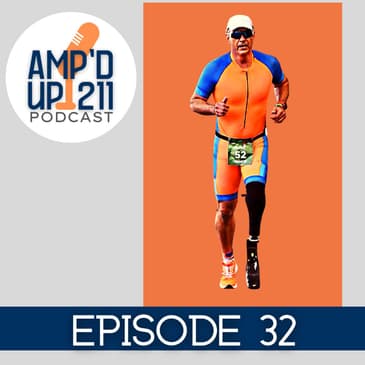
We are proud to present Mabio Costa. Mabio is a Motivational speaker, Triathlete, and two-time ITU Paratriathlon World Champion. This proud American citizen who was born in Goiânia, Brazil works as a practitioner at Prosthetic & Orthotic Associates (POA). Mabio continues to compete and thrive against able-bodied athletes while providing inspiration for the entire Amputee Community. The AMP'D UP211 Video Podcast is hosted by Rick Bontkowski, a right-below-knee amputee.
Subscribe to the podcast!
The AMPdUp211 Youtube Channel
Recorded at Audiohive Podcasting
Hosted on Transistor.fm
[00:00:00] Now on the app to 11 podcast, Triathlete, Mabio Costa, born with a congenital condition that stunted the growth of his left foot, he has lived much of his life with a prosthetic limb on his left leg.
[00:00:14] This 50 plus elite athlete continues to compete in his class and inspires anyone who encounters him. Since becoming a U.S. citizen in 2001, Mabio has competed with team USA multiple times and continues to challenge himself physically and mentally.
[00:00:32] It is our pleasure to welcome to the AMPD UP211 Podcast, Mr. Mabio Costa. Mabio, good to see you! Thank you for having me. Hope I didn't scare you there. So great to have you on the show, Mabio. And where are you at the moment?
[00:00:58] Where it looks like you're at work. Yeah, today it's a busy Friday here for us at the POA Orlando. So absolutely. Let's try the app twice and tell the audience what you do with POA. Well, I am a prosthetic technician but I work on the liner,
[00:01:17] making sure that we have the good feeding for all the liners that we make here. Wow. That's a nice one. Very, very critical part of the process. Are those liners? I can speak to that as well, given that I'm an amputee like yourself.
[00:01:39] Walk us through that process a little bit. Tell us what you're looking for, usually in that process with your patients. Well, first of all, we'll never gonna tell you that but my job is the most important one here. And I'll explain you the reason.
[00:01:55] Once we have the patient, you know, we cast the patient for a new liner. And that cast comes to me. I have to scan that cast, spend to the computer, make sure that once that it's made, you know, it's gonna fit well.
[00:02:12] I have to create the metal and the female side, though when we poured a silicone in between and eight hours later, it's cured. If my job is not done well, we have a lot of patients out of state, out of the country.
[00:02:27] If I don't do my job well next day when they fit that liner, if it doesn't fit well, we lost 24 hours. So it's very that the liner fits at the first treatment otherwise of being troubled. But I'll be doing this for 14 years and that's what I say.
[00:02:43] The liner, the cast on liners that we make, it is like your second skin. You gotta be right over and you gotta be feeling, you know, amazing with that liner. Can I be too tight? Can I be too loose?
[00:02:55] But has a, you know, a way that is gonna make you feel, a way that you never had before with got some liners. Yeah, and so many amputees, myself included, I do not wear a custom liner.
[00:03:08] You know, I've worn a standard liner and I wouldn't say have struggled with it. However, if I was to ever attempt some of the things that you do, when we talk about triathlons and going the distance so to speak,
[00:03:29] no way, man, I would absolutely never make it with the liner I'm wearing because, you know, where I notice, let's call it margin or, uh, you know, when things get bunched up as we say with liners,
[00:03:49] usually that comes from high level activity and then you're constantly resetting that liner. Right? Because it's, I mean, you know, these are expensive things. So there is some technology in them. However, they are not truly fitted to all the nuances of your residual limb.
[00:04:11] And as you know, you know, an activity that you do. You know, as you go, minute by minute, hour by hour, you have volume decrease. Yes. And if you have nothing that was really made for you,
[00:04:24] in that point, that means you're going to be losing a lot of the. Absolutely. And that's about the custom liner. Although I must say that I have a lot of friends in South America, I'm originally from Brazil, that they have the use of the shelf liners.
[00:04:39] And that's the thing that they have. So they got to do it. It is durable, but of course, to a higher level, you gotta go custom. There's no other way. I'm sorry. Yeah, there is no other way. I would agree. And that's what I hear in the community.
[00:04:52] I've done some reading on you and I appreciate your transparency in your website. I appreciate how you put yourself out there on social media. You are an inspiration to us all. And your history
[00:05:05] as an amputee is rich and it's full of massive accomplishments. And especially given that you and myself, although most people wouldn't think we're the same age, they'd look at me and go,
[00:05:21] well, that's the old guy. And then Bobby was the young guy. We are about the same age. So I look, I look at you. And of course, I think, will ship man anything's possible. I mean, this guy's
[00:05:35] my age and look what he's doing. You know? So I appreciate that. But at the same time, I'm fascinated by your history as an amputee, where you're from because, of course, I have friends
[00:05:52] that, you know, like yourself, became US citizens. But we're born in Brazil. And I think where I want to start the interview is going back to that 12-year-old mobio that found out he's going to lose part of his limb. And, you know, obviously in our 50s, we remember,
[00:06:23] I feel like I remember certain things from my childhood 12 years old seems like an awfully long time ago. But what do you recall? I mean, when you reflect on those moments when your life changed in that regard, I mean, what process do you go through in your mind?
[00:06:44] You gotta remember something that back at the days back in Brazil, everybody has a dream. Every kid that grew up had a dream. I want to be a soccer player.
[00:06:54] I want to have a Ferrari when I grow up. I want to have a, you know, want to be famous. My only dream as a grow-up was to be able to wear two his knickers. Believe it or not.
[00:07:05] Yeah. I was born as you, as you read on my, you know, very often about everything is that I was born away from off, I did, you know, was a, a work defect. So I have the left foot with only two toes,
[00:07:20] but from the need out, it never grew. So that's when they probably started. Then when my mom changed the doctor and what her young doctor said, no, let's cut that off because that could be much better. And he said that straight in our faith.
[00:07:38] And my first question was, would I be able to use two his knickers? And his peddias. Because that let's do it. That's my dream. Let's have that done, you know. And again, we're talking
[00:07:48] about back in the 80s now. And it was something that I knew that would be better for me back then, you know, and passing through this whole time, you know. And now going back to the
[00:08:02] liners and sometimes I see a patient or other, you know, complaining about a little bit on the liner, it was like brother back in the 80s we had no liners. Once they clumped, you wrecked in there
[00:08:13] as I did everything else. Of course things changed for better. But yeah, it's growing up and going back to the age, it's hard to look at the mirror and say, my, you are 55. I don't feel like that.
[00:08:28] My body doesn't feel like that. And remember, I stopped racing for nine years because, you know, I did everything. I represent TMS and many times. And there was a time I said, no, that's enough.
[00:08:40] My body, you know, I'm taking too much. And then Monday, my daughter came to me and said, I did it. I never saw you racing. And I said, well, so let me train Chumans and let's do a race,
[00:08:50] a local race. Yeah. I'm amazing that doing that race, you know, and crossing the finish line and being so close, you know, PR, let's keep on doing. So yeah, and that's, I mean, you know, I get choked up when I hear people's stories that involve inspiration that's drawn
[00:09:12] from their children. You know, something that their kids had hoped for or wanted, you know, so much of my personal comeback in my life had a lot to do actually with my granddaughter.
[00:09:27] I was, you know, going through a number of surgeries obviously ended up losing a limb too in my 40s. But the thing that kept me going was at the time my, my granddaughter had just been born.
[00:09:41] She had never, she had never met me. She didn't know me. But there's that feeling of, well, what do I want to leave behind? Will my granddaughter look at a picture and say, oh, yeah,
[00:09:56] that's, that's my grandpa. That's my mom's dad. I never knew him. He, he left this place before I ever got a chance to know him. And I kept saying to myself, well, no, no, no, I want this person to know me.
[00:10:13] I want her to ask me questions to get to know me to know me beyond just maybe a face on a photograph to see to see to have my granddaughter come up to me and say, hey, Grandpa, do you mind if I play with
[00:10:29] your robot leg? And then run off with my leg, right? And the family's laughing. And that's, you know, a wonderful moment to be able to experience that and say, okay, I did it.
[00:10:45] I got to meet her. She's part of my life. She will remember me more than just some vague, you know, person or memory or something. So yeah, when, when children are involved, but going back to you growing up in Brazil and experiencing life as a young
[00:11:08] amputee. And so many of this stories that I'm fascinated by like your own are people that I refer to and I think you sort of fit this category of lifers. Let's call them
[00:11:21] that this has just been a part of their life for a very long time, but try to understand because let's face it when I was young and you might have been different because you
[00:11:36] definitely seem like an extravert to me. I was a very shy kid. You know, I struggled to make friends. I struggled to get to know people. I was very insecure. So I always think to myself,
[00:11:52] let's say I had lost a limb during those four millilivars of trying to figure out who you are and you're sort of managing that difference from everyone. And I mean, I don't know what the
[00:12:10] technology was like when you were 12, I don't know necessarily what the healthcare system looked like in Brazil when you were 12. I mean, the friends that I do have from Brazil, I mean, they talk about certain aspects of that system. Let's call it that we're pretty antiquated.
[00:12:31] I mean, like pretty screwed up and there you go. Well, there you go. So so can you help the listeners understand what that experience was like? I mean, growing up Brazil, your 12 years old, you're losing a limb. You know, what did all that feel like for
[00:12:52] mobio? One thing that I am, I am the person that I am today because of my mom. My mom was the one. My mom was a nurse back in Brazil and she never treated me as a disabled person, okay?
[00:13:10] And one thing that I always make fun of myself before people started making fun of myself. So by the time that I had my leg amputated and put my first prosthesis was the time that we have the $6
[00:13:24] million that was showing TV. So in Brazil was a big thing. It was an anaclock Monday, Monday night, night PM and everybody was watching. So the $6 million man was the show.
[00:13:37] Yeah, it was the show. You know, it's Steve Majors. Yeah. So you know, I'll tell you, I keep on trying to reach out your him and I have to reach out to him because I must say that the easy childhood that I have
[00:13:49] was because of that show. Every time that we're going to play, oh, let's bring my brother the six minutes all the time. It was me. Yeah. And every time that I, you know, that I was making fun of me
[00:14:01] before people make fun of me and I was very open about my problem, let's say that. And again, back in Brazil, back at the 80s, my first leg was made of wood, plastic, and whatever they found
[00:14:20] and of course, back at the place you walked in, they make the measurements, they made the measurements, next a week later you come back, they put it on goodbye. That same day in the afternoon, I was playing soccer.
[00:14:31] But you gotta remember that before that, I used something that really helped me out to walk, but it was very heavy. So having a much lighter was much easier for me. Uh, first, uh, you need to walk in a shopping mall in my city. City is called Boirinha,
[00:14:53] is a capital office state of Goi ice that's very, it's like an hour and a half from Brazil. And everybody was looking at me like, oh, who's that guy? Who's that kid without a leg and walking
[00:15:04] shorts because back then, when the, everybody went, it started going to the malls to shopping to meet people. And it was like, so everybody might see the two million people. Everybody, I want to say everybody, but everybody knew who was one leg guy. It was me.
[00:15:21] Yeah. Because that's the only guy that only kid that was walking in shorts. Yeah. Again, it was never a problem for me. For me, the problem was when I was not noticed for what I was doing
[00:15:33] and I knew what I was doing at the time. And there was my mango was to show that listen, here I am, that's who I am, that's who I look like and that's how you're going to get it.
[00:15:44] So yeah, and that's, I think that's a, I mean, let's face it. It's, it's very much could even be served as great advice in terms of, you know, I'm pretty good at self-deprecating humor,
[00:15:59] especially as I get older. I'm like, I feel really young and then I take my shirt off and I realize I'm not really young anymore. But you know, it's like the hair thing, you know,
[00:16:13] I mean, you and I, I mean, we have the same barber, you know? So right, right, let it shine, I always say. So I think that offers a lot in that space of, let's say, a parent, someone that is, you know,
[00:16:31] has a child that is going through an amputation for some reason and trying to understand what components make all of that tolerable. I know, you know, POA specifically helps all kinds of children.
[00:16:49] So incredible organization. So the other thing I go to is given that, let's say, the technology in the 80s with somewhat antiquated, what were you able to do and were your activity levels such that you, you know, how long did it take? And I'm trying to phrase
[00:17:14] this correctly. How long did it take for you to get to a point where you felt like, hey, you know, I mean, I'm athletic. Like, I can do things as an amputee and I think I could pursue
[00:17:33] maybe becoming a world-class athlete. I think that's possible. And when one does that light bulb go off. Well, I always was a swimmer, okay? I use your swim since the age of seven.
[00:17:46] And even back then, because you know, in my city, especially in Brazil, that's when the whole parallel Olympic things started back then. And I was always able to beat Abobadis, Abobadikets. So I knew that I was pretty good in the water, okay? And, you know, once you,
[00:18:05] you're born Brazilian, they think that you should play soccer. No matter what, if you don't have legs, you don't, if you're blind, whatever you have to play soccer. Yeah. And that's why we all have so many soccer players, although our team sucks lately. But the point is that
[00:18:20] when I put my leg on, you know, my first put this is on, and I started playing soccer and I saw, I mean, playing soccer and doing everything. And then you how light it was in comparison to what
[00:18:33] I used to have. And the amazing things that as I started playing soccer and I started playing against Abobadikets, things changed in the sense that they're like, oh, you cannot do that. Or maybe
[00:18:47] you cannot do this or no, maybe you cannot be playing forward all the time. And actually, there are poor teammates to do that. And that's when I started being, you know, let me start running.
[00:18:57] Let me do this. Let me do that. And running for me back then, it was painful. It was very, you know, there was no way that I could run, let's say, a mile or a mile and a half, that when
[00:19:09] I finished and I took my socks off because there was no liners back then again, it was blood and takes like three or four days to recover. So that was the bad side of it. Yeah. And when they were playing tri-atlands and 85 in Brazil and they said, well,
[00:19:28] there is no impetus that we're not doing tri-atlands. So I said, let's watch, I'll be the first one. And I did. Was painful. And but I saw that I could open from there and that's was the main idea
[00:19:41] to we start doing the tri-atlands and then I came out, I cannot be the only one doing this. I got a more people to do this. And that's when the idea came out about tri-atlands,
[00:19:50] way that it is today. Yeah, it's incredible when I hear about these stories of sort of suffering through the pain just because you didn't have the gear, we didn't have the custom liners.
[00:20:02] We didn't have some of the technologies that we have today and for you to have been an amputee as long as you have and seen that evolution of technology and seeing how far it's come,
[00:20:16] but not only that, you've employed it. You've taken all of that education, all of that equipment and you've applied it in real life. So when I talk to you, I think, well this isn't just someone
[00:20:32] that figured out how to be active, this is someone who actually understands the science behind how you become active, right? Because you see all the so if I came to you and I said, well,
[00:20:46] you know, Mabio, um, you know, I want to be able to run, you know, I have a, I've done all my gate training, I can walk well, I can briskly walk, I can walk a 5k, you know, I can, I feel like
[00:21:00] that's my next step. I feel like you're the person I would, I would reach out to and say, okay, how do I go to the next level? Like what is the next steps in that?
[00:21:12] Correct. I think that the main thing that remembering back in the days when I was doing triathlon week after week and I think that what you need to do the most is you put your mind that you
[00:21:29] able, you capable of doing it. There is money and now pay a million dollars for any MPT that comes to me today including myself that say, I run without pain. There is no such a thing.
[00:21:43] There is no way. Oh, no, I have an amazing life as an MPT, I can do everything without pain. No, we can't. First of all, even for able bodies if you don't have pain that means you're not doing
[00:21:55] 100% of what you're supposed to do. In the bite, if you end off that right, you're not feeling pain on your bed and your legs means you have not done a very good right. So everything is about pain.
[00:22:07] Now talking about an MPT, it's more pain than ever but you have to learn how to live with that. You have to learn how to make that pain in a way that's not going to be so painful, that you can finish
[00:22:21] that 5k, that you can finish that 10 in the better way. Yeah, I think that's so truthful because let's face it very often. You know, the higher performing MPTs, let's say the elite out there
[00:22:38] the people that sort of project this very sexy, marketable kind of look in terms of MPTs. There's a whole other camp of MPTs people with limb differences that will say, you know, those people that come easy to them and to hear someone like yourself say,
[00:23:06] no, it's really, really painful to go through these trials and to be able to train to compete and then know what to do in between those sequences of events to keep yourself
[00:23:22] in the game to stay focused and know how to treat your body so that you can do it. Because so much of it comes down to that residual limb. And I think about someone like you
[00:23:36] who's doing everything that you are and that you've been an MPT for so long. I mean, I thought I saw you post something about your limb recently but tell me, tell me,
[00:23:50] what's a setback for you in this now kind of today's space? What's a setback for you right now? I mean, as you know, I stop racing with MPTs about the year and a half ago.
[00:24:09] So in order to race with able bodies on my age, I have to train much more than I used to do. My goal right now is to finish, I should qualify for the nationals as a normal person.
[00:24:27] So my training now is much more than when I was in my 30s, okay? Of course, our followers we have ongoing here. We have, you know, a day that there is a rock that I didn't see and I stepped out with my blade.
[00:24:44] Little things that makes me, it's back in a way of training. And you're right, you saw something that because of the training, I shrink so much by Friday, today because of the whole training,
[00:24:56] today I have to start my running at least with a 10-ply, no matter what, because of the training during the week. And let's say by any chance, I decided, you know, let me go to our 7-ply or 5-ply,
[00:25:09] knowing that I'm not supposed to do that, but I do sometimes, I hurt myself. Yeah. And the setback of two or three days will go for that to help tools me. Because I know in that same time someone else is training more than I do.
[00:25:25] You know? But you know, and again, what I believe now is that, and amazingly lately, I didn't know that because of it, but you inspire MPKs. You inspire MPKs. And I realized that 85% of people that reach out to me are non-ampraits.
[00:25:47] Every time that I pass someone on the race, because right now my 5Ks, they're strongest that I have ever, you know? And again at age 55, I can, you know, do the, I just did the 5K a couple of months ago
[00:26:00] at 2025, you know? And when I passed, you know, of course, in triathlon, you lose some time because of you just came from a bike. So I can do at 23 at my age group and I beat all able bodies on the
[00:26:13] 5K. And at the end, they come to me and say, I couldn't catch up with you. What do you have? Does that give you an advantage? So if you think it does, just catch your leg and try it.
[00:26:25] I know that I have my go now is 2023, 2024. Two more years, age 56, I will retire for good. I never retired though, because I never retired, I stop racing when I never retired. By the end of next year, I go as to retire.
[00:26:50] When comes to amputees and a lot of amputees that know name, that you know, they are a part of the USA team. And they come to me and say, what do you do? I want to be your age doing what you do?
[00:27:10] 26, 27 years, 30 years old. So at 55, I'm stronger than ever and I believe that anyone can do. But in the same time, I'm a third of you said that was for us,
[00:27:28] wrote people, there is no confusion. Like I do race every all the week and sometimes four times a week. I mean, four times someone, I'm sorry, four times I have a race every weekend and every race that I do,
[00:27:50] I can finish top five against able bodies. And again, people who still look at me as an old guy trying to prove something. There is nothing to be proved anymore. I'm just here showing that we can be
[00:28:06] here no matter how old you are, what time of or type of amputation you have. And that's my mango. Even though sometimes, I know that people get sponsorship from other people because they look nice, they look younger and I'm here fighting for my space in the sun,
[00:28:28] from my spot in the sun. And sometimes, high because people look at me like, why am I going to sponsor you? You're old. Yeah. Yeah. Old guy is doing everything and I'm still bringing people to go somewhere. Yeah, absolutely. Absolutely. No, there's your definitely,
[00:28:43] your definitely what I would perceive as a unique commodity. And certainly, someone given that spotlight could really, really help so many understand that age is just a number. And it's really more about what's in your head and in your heart than it is anything else.
[00:29:07] Because so much of what you're describing is it's being able to accomplish something through will, sure will and grit. And that's what I find most people that reach those milestones will say. It's always me against myself. It's all in my head. And getting past those barriers
[00:29:37] is how I do that mentally and that somehow carries my body through the rigors of pain, through the rigors of soreness, whatever you're experiencing in that space. And the thing I want to talk about too, because as I'm getting older as well,
[00:29:58] I find that there are two other components for me that seem to be major, major sort of determining factors as to how good I feel on the daily. One is nutrition and the other one is
[00:30:20] the amount of sleep that I'm getting. Because when I was young, my 20s, I did not need sleep. I could sleep three, four hours a night, go at it the next day, work a full day, work out, go out with my friends drink. Okay,
[00:30:40] get three or four hours of sleep and crank it right back up the next day. Whereas now as I've got an older that six, eight hours is almost like critical to me feeling recharge, refreshed,
[00:30:55] clear and ready for the day. And then there's the nutritional piece, which I was not very, let's call it food sensitive when I was young and there are certain foods now that just honestly
[00:31:10] my ability to make me feel like shit. I mean, I don't feel good. I'm a Chicago guy, Chicago style pizza beer. I could tear through that stuff and it never affected me. As I've gotten older, there are just certain foods. They may taste good, don't get me wrong,
[00:31:36] but within an hour, I'm thinking what an earth have I done to myself? Yeah, like I have to lay down and that is not how you want to feel after a meal. So for yourself in the training piece and everything that you're doing,
[00:31:58] where do those two components fit in for you? Well, I always really took care of everything. I loved to sleep. If they two things that Brazilians love the most, it's steak and the sleep. They speak as well but I was never,
[00:32:14] I crazy guy for beer. I drink sometimes, don't get me wrong. But it's very important, in hours has been for me my eight hours, no matter what, the other day, I mean the other day,
[00:32:28] four days ago, I did was raining when I got home. It's Friday, it rains all the time. And the site you run started running at eight o'clock. It was at 10 my run. I finished by 930,
[00:32:39] I got home and I decided to eat because it was late. And so let's eat of course. What I had was most of the things that I ate was protein and then had some carbs. And for some reason,
[00:32:54] my little girl, the youngest put some tacos in there that she loves so much. You know, tacos that are very spicy thing and at the site you eat too. Just to make fun of her,
[00:33:03] that is going to be to a why? Why have I done that? What is a whole night of burning and you know, but yes, you have to pay attention to everything that we eat, especially after the age of
[00:33:16] 50, that's you know, the one that we have. But one thing that I learned a lot about eating and again, I eat a lot. I love to eat. And but the most, the thing that I see that when I talk to other athletes
[00:33:31] is that the biggest problem for us is alcohol. If we drink too much, you know, and I get that I drink on Sundays, you know, I have my barbecue, I have my Brazilian shuhasco, and with my pick
[00:33:43] and I drink one or two beers. No, you have to, but it is very important to take care of our body. And again, when I decide to come back as an athlete again, and again, I'm running faster than I
[00:33:57] ever eat in my 30s. I'm doing everything. And sometimes I have friends that's like, how can you add 55 be faster than we were at 30s? It's a simple answer for that. At 55, I know that now is my time.
[00:34:18] I know that now it's the time for training. So before I'm at 30s, if I get home, it's rainy, like it was, I'll do that tomorrow. No, this time I put my chair on my garage, I waited all
[00:34:32] outside until the rain stopped. And I went because that's, as you said, it's the mind, you have to put the mind to do it. No matter how tight I am, I can see many patients doing the day.
[00:34:45] If I get there and I have to do my 20 miles bike, my 30 miles bike, even if it gets dark, I'm going to do it. It's the mindset that you can do it no matter how old you are.
[00:34:57] And again, why since I have this mentality, why am I stopping next year? Why am I retiring? I'm retiring off traveling. I'm retiring off doing Chicago, New York, our closenages. But I'm going to keep doing my local races. I'm going to keep doing everything that I can
[00:35:14] around me because it makes me feel alive. It makes me feel like, you know, I'm 55 but look, I mean, you know, I'm here and I'm beating you guys with two legs. So you guys got to be better than
[00:35:25] that. And that makes me feel better in the sense of taking more care of myself. And I get going back to the kids, have a 30 and a 10-year-old, I want to be here longer for them, much longer.
[00:35:38] Yeah. You know? And that's the main thing why I keep doing what I'm doing. You know, it's funny you say that I was reading an article the other day and they were talking about
[00:35:48] you know, indications of status or success. And they were comparing it by decade and they were saying that back in the 80s everything was about money. The only thing that was a prime indicator
[00:36:05] of success or status or a quote unquote, you made it was money. That's it. There was nothing else that's changed. They're saying now in this moment what represents status and success is your
[00:36:22] physical shape after 40 that if you take care of yourself and you're living well in a healthy space, that is actually considered a form of wealth that people perceive. Okay, these these more active lifestyle type people as highly successful. Having nothing to do with financial resources,
[00:36:52] it's simply that you are the master of your domain. You are the person that is in charge completely in charge of yourself, your body, your temple. Let's call it and that is something that
[00:37:08] is considered almost like a status symbol now. Like wow, he's over 40. He's in great shape. Takes care of himself. This has become a form of status. We're in the 80s. You could be a fat slap.
[00:37:22] It's lucky to have money. I've got a lot of money that's not matters. You were somebody, you know, which is bizarre now when you think about it. The other thing I was going to ask you about is I know
[00:37:33] you were at the amputee coalition convention and you did like a unit there. Can you tell me more about what that was? I was at the coalition, and unfortunately we never bumped into each other
[00:37:50] at the convention. Tell me about what you were doing there. I want to learn more about that. Well, I about 11 years ago I was invited to teach swimming for Opaf.
[00:38:05] And ever since I've been helping them out and about six years ago I want to invite it to be the National Director for swimming. I took that with all my heart. I love to teach
[00:38:21] a swimming, especially for new antities. And one thing that I love the most is not to make someone swimming faster. It's to make someone who just lost their legs, especially a girl with special
[00:38:37] old woman, to get back into the water. It has nothing to do to get into the water and swim, but has to do of baking that prosthetic leg and walking or hopping or jumping from that
[00:38:54] chair to the water. For that woman, or for that person, just to be able to show to everyone around that I don't have a piece of me, but it can still do in sport. It's priceless.
[00:39:08] Okay. So, at the Competition Coalition we had three clinics. Now, we always do have three clinics with AC and it's being always amazing. And the past month I was elected the President of Opaf,
[00:39:27] so I'm the new President starting. I'm depressed that elected, but there'll be the new President working, starting December 1st, congratulations. Thank you. We have our President now, Travis Young,
[00:39:40] we did an amazing job keeping Opaf alive. And my goal now is to bring everything to Pader and really work in the sense that this cannot end. And again, we are not here to make Michael Thelps in two hours.
[00:39:56] We are here to ensure that every single entry is not an athlete can get into the water, can swim and you can have a health life by doing that. And that's the mango that we have.
[00:40:09] Yeah. So, how would you prefer given that piece? Everything that you represent in the athletic space and what you offer the community, even through the organization that you work for now. How do you prefer other amputees or families of amputees reach out to you?
[00:40:35] I'm an open book as no, I show everyone on my social medium. Everyone that was not one single person that reached out to me, that I don't require. So DM's okay, that's pretty direct line to
[00:40:52] you as just to send you something in messenger. Messenger, you know, you know, search me on on Instagram. I'm always open for everything. I'm here to help you out with anything that you need.
[00:41:05] Always, you know? And just want to go back to something very quick. Sure, if you don't mind, is that you're talking about age and I really want to touch as much as I can on that.
[00:41:18] If you see some pictures of me on Instagram or Facebook, I don't have my shirt on. Most of them, I'm showing who I am right now. The reason for that is not because I want to show my
[00:41:31] body. I want to show that everybody's everyone can do whatever they want to do it. If you go back to the same Facebook, to the same Instagram two years ago, when I decided to hope to do that,
[00:41:43] you're going to see that I was about 25 pound heavier than what I am now. So right now, I am proud of what I am, what I became training and that's exactly what I pass to everybody
[00:41:57] in swimming, in biking and running. Anyone can do whatever they want. MPT or not is up to you. Just putting your mind and be consistent in what you're doing. And that's what matters the most.
[00:42:11] Yeah, and I appreciate that. I mean for you to be that vulnerable in these very kind of transparent spaces on social media to give that to the community and to represent something that's very
[00:42:32] transparent is fantastic and I appreciate it. And I certainly am one of those people that gravitates to someone like yourself when I see someone thriving in this space, not only talking the talk, but walking the walk as well. And in your case, biking and running and swimming and
[00:43:00] doing all of the things that I better on my own radar, I'm an avid cyclist. But I have not made the transition into actually running in a prosthesis. So that's a big
[00:43:16] goal of mine for 24 is to be able to jog around my neighborhood and who knows from there. But when I do talk to people like you, Mabio and I hear your story and I share that energy,
[00:43:31] that's when I realize anything is possible. That's when it all becomes real. And when you're going to do your first racing bike, and I want to be that with you. I appreciate that. I appreciate that. No, it's fantastic to me too. I appreciate you taking time obviously out
[00:43:52] of your workday to visit and share your story some more because people are curious. They see pictures, you know, they see postings. They see what maybe we project as this sort of like identity on
[00:44:07] social media but to be able to hear your voice and to hear a little bit more about your story and who you are as a human being makes it all that much better. So thank you so much for being here
[00:44:22] and I'm hoping that we will bump into each other. Maybe at the next convention who knows we're actually going to be doing a strategic partnership with the NPT coalition. We're going to develop some content with them together, procure some guests together and jump on some
[00:44:45] topics together and we're also going to be, this is kind of a first. I really haven't told anyone this. We're also going to be holding some interviews at the convention in Atlanta so that we
[00:45:00] can do some let's call it at the show episodes and that way some of some of our community that either cannot travel get to the conference, can have some episodes that will give them
[00:45:16] a sort of a lens to look through and to see what that's all about. So obviously lots of good things coming and again, Mabio Costa thank you so much such a pleasure to meet you and my name is
[00:45:32] Rick Bond. Caleski this is the Amped up to 11 podcast and we will see you next time I want to wish everyone health and happiness.