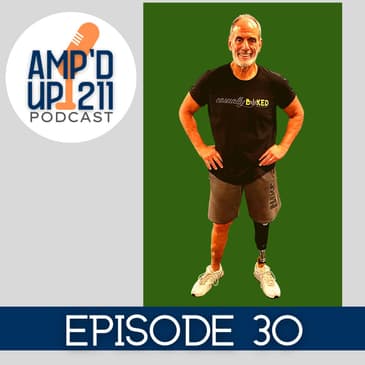
We are proud to present Denny Chipollini. Denny is a two-time Olympic Torchbearer, Public Speaker, Personal Trainer, and Adaptive Athlete. Denny truly has a zest for life and continues to inspire the amputee community through his video blog and lifestyle tips. This extraordinary amputee proves that there truly is a fountain of youth. The AMP'D UP211 Video Podcast is hosted by Rick Bontkowski, a right below knee amputee.
Subscribe to the podcast!
The AMPdUp211 Youtube Channel
Recorded at Audiohive Podcasting
Hosted on Transistor.fm
[00:00:00] Today on the AMPD UP211 Podcast, Denny Chipollini 30 years ago, Denny lost his leg in a terrible, single-car automobile accident on the Pennsylvania turnpike. This tragic event would alter his life forever.
[00:00:16] After years of managing pain with opioids, Denny has discovered a fountain of youth by utilizing natural and holistic approaches to health and fitness. Denny has taken these techniques to the masses and continues to mentor others through his motivational speaking and personal training.
[00:00:36] Denny has become a beacon of hope for so many amputees in the senior category, his amputee lifestyle is one that is filled with energy and positivity. It is our pleasure to welcome to the AMPD UP211 Podcast, Denny Chipollini. How are you Denny? What's up?
[00:01:05] Oh, how are you doing, Rick? I'm doing good. Good. Good. You look bright, I'd. That's good to see. And you are visiting with us from beautiful sunny Florida, what part of Florida? We're in Lakewood Ranch. It's outside Sarasota. Okay. I very much frequented Sarasota.
[00:01:29] I want to say places like St. Pete, Sarasota. I had some friends that had a place in CS to key and spent many, many summers there. My parents also had a home on the golf near Captiva and Fort Myers.
[00:01:51] So that's where God hit with the hurricane. Yeah, I know. I know. And I very much have enjoyed Florida. I know you're originally from Pennsylvania and tell me a little bit about how you ended up in Florida.
[00:02:07] Well, I moved back to my hometown when my parents got sick. My wife and I and to help, you know, we wanted them to finish their life here in their own house. Yeah. So my sister and I, my mother, my father passed away maybe what?
[00:02:27] Four years ago, five years ago, and my mother passed away last year. So that's, you know, that's why we hung up there. And then our landlord raised the rent and then we're like, whoa, you know, we could pay this in Florida.
[00:02:47] And have sunshine. So that's what we did. Yeah, that's wonderful. We don't regret it. It's beautiful down here. So it sounds like your parents lived a very long life. They did. My father was 91 when he passed away
[00:03:00] and my mother would have been 90. She was just a month away from 97. That's amazing. So I have some DNA on my side. Yes, some longevity. Well, and that's a great point because at least
[00:03:12] me to my first question today. When I think about you, Denny and giving your age and the group in which you represent, let's say, in the spectrum of what people go through at various points in their
[00:03:27] life, I think of you as someone who is incredibly motivated as an amputee very much an inspiration to myself because at 55, I look at someone like you when I say, how can I be like Denny when I'm in my
[00:03:47] 70s? How am I going to make that happen? So the first question I want to ask you and this might have something to do with your parents. Where do you feel like you get your primary motivation from?
[00:04:04] Well, my both of those were hard workers. They loved life. They loved the dance. They loved the eat. So they enjoyed life. I'd say a lot, a lot of my motivation, believe it or not, in high school,
[00:04:21] you know when they give you the award at the end of the year, you know, most likely to succeed this in that, you know what I received. Lazy is kid not in the class in the school. So they actually
[00:04:34] give out an award for that as that way you're saying, well yeah, it was kind of a comical, you know, and when they call my name out, I sent somebody else up because I'm too lazy to
[00:04:44] walk to the, to the, to get the award. They're kind of went over but yeah, I wasn't that motivated in high school. I mean it was party time, listen that. I got to be honest when I lost my leg,
[00:05:00] that is where it took off. It really did and that was, it's coming on next year will be my 34th year without a leg. So you feel like becoming an amputee, you know, going through the accident and
[00:05:18] the trauma that you did and then recovering from that, that sort of lit the fuse to say how, how am I going to make this work? Because I talk about this very often with amputees and I happen
[00:05:34] to be really in the best shape of my adult life right now and this is post amputee. Not that I was necessarily in terrible shape before my amputation, I did activities. I was an
[00:05:50] active guy. I'd go through let's call spurts or different sort of kicks where I get into going to the gym for a period of time. So I'd go through these phases. Let's call them a becoming
[00:06:06] active, aspiring to be active but I never really understood the difference between that endeavor and developing what I now refer to as an active lifestyle because active lifestyle. And when I look at
[00:06:23] you and I follow you and I see all the things that you're doing, that's how I view someone like yourself. I say, well, Danny lives a very active lifestyle. It's been woven into the fabric
[00:06:37] of everything that he does. It's not like, hey, I'm going to go to the gym, come home, indulge in a bunch of food, you know, hurt myself nutritionally and then lay on the couch. It's it's it's this thing that you're constantly visiting throughout your day to say how
[00:06:57] am I bringing my best self to this and becoming an amputee can really be that game change or and obviously it was for you as well. Would you agree? Absolutely. Well, I would run, you know,
[00:07:12] maybe a few miles a day kind of thing or a few times a week. But when I looked at a marathon, I'm like these people are crazy. 26.2 miles and I had both my legs when I was saying that.
[00:07:25] I'd lost my leg. I ended up doing a marathon 10 years later. Three of them, four ones and three halves. It's just it what happened was the best thing the doctors could have said to me is what they
[00:07:39] said to me. Most likely I would never walk again without the use of some kind of apparatus. When they said that, I said to my father, dad, you bring in my weights tomorrow. I start my rehab. I still had
[00:07:52] both legs. No, no, not at that point. No, they took the one the other one wasn't healing. That's what happened. And I just I just one little step at a time. Well, what can I do now? Where can I go from here?
[00:08:07] And I came up with a phrase, this is my quote and I love this. The finish line is just the start of another race. Meaning, okay, you set a goal, you reach it and that's not it's not over. You start another
[00:08:26] and just keep moving forward. So for me at 70 years old, I don't know if I felt this good at 40. I mean it. I have found, I say the fountain of youth. Good nutrition. And when I say that people's
[00:08:41] cringe, they're like, oh, I have to eat that. No, it's good foods. Good foods. I'm a, I love me. I love red meat. Good quality meat. I think it's important to keep protein.
[00:08:54] Keep your muscle strong, especially as we get older. It's hard. Yeah. And if I work out in the gym, I want to keep that muscle. Well, I've seen your posts. I've seen your posts on some of the food that
[00:09:06] you prepare. And I will, and I will tell you that very often I think, oh boy, I'm hungry. Because I'll see something that you post and you're, you know, let's put it this way. It's
[00:09:21] great food porn for me because I see it and I go, oh man, this is it. This is it right here. You know, I'm starving now and you're always very descriptive about what you've prepared
[00:09:33] how you've done it and things like that. And I do think I am a big believer in balancing nutrition, not not doing anything necessarily to an extreme. I do see a lot of people that
[00:09:51] I guess I perceive as doing sort of desperate things to reach certain goals in terms of whether it be weight loss or muscle gain where they sort of swing to one very far end of the
[00:10:05] spectrum in terms of their nutrition. And I have always felt that there is a way to enjoy everything in moderation. And if you want to, you know, treat yourself every once in a while to something
[00:10:22] that's a little indulgent. That's okay. It's just, don't do it all the time and I, I always recall, I can't, I've seen so many food docks. I remember this one documentary where there was this, this nutritional expert, World renowned guy, he said, nobody dies from one meal.
[00:10:47] People die from thousands of meals. They had habits. Bad habits. They had, yeah, they constantly eat the same non-nutrition's food. I have to be here today. Yeah. I love the taste of beer. So I have my two
[00:11:04] a day. Now of course I'm working out and I allow for that. But that's how I enjoy it. And I look forward to that. But here's one of the things I follow. Eat first what your body needs,
[00:11:19] then eat what you want. And most likely, you're not going to eat as much of that. Yeah. My first wife, we used to have the biggest fights. I make this beautiful dinner and she needs cookies right before
[00:11:32] dinner. I'd go out of my mind and I'm Italian and it's like, well, but yeah, it's so important to feed your body the right foods. And I do supplement because a lot of our food, unfortunately,
[00:11:51] is enough to snuff. Yes. And I had seen a post that you did the other day. It was kind of like, you know, let's let's just call it for lack of my knowledge. It was some sort of a protein shake
[00:12:06] that you would kind of put a whole bunch of different, yeah, my energy drink. Your energy drink. There you go. You created this energy drink that pretty much was your, I guess you could call it like
[00:12:18] your own secret recipe of a number of different minerals and vitamins and all these different things. And I thought, you know, what a commitment to his nutrition because let's face it,
[00:12:34] Denny. Everyone wants an easy fix. Everyone wants to take a pill. You know, everyone just wants to say, you know, just just give it to me in a bottle and I'll drink it and hopefully that'll, that'll fix me.
[00:12:50] And it seems like you're going after something that's a lot more high level in that you're, you're breaking it down and saying, okay, what do I, what, what am I feeling that my body
[00:13:01] needs? Either I'm, I'm lacking in, in terms of my, my food intake. I'm trying to build muscle. I'm trying to build my stamina, my flexibility. I'm trying to survive in this, this Florida heat.
[00:13:14] Yeah, exactly. You know? And, you know, what do I need and it was a pretty impressive list of ingredients that you would put together. Yeah, and there's no sugar in there, right? You know,
[00:13:28] if you can buy an energy drink and it's loaded with sugars and all kinds of, so I made my own and I use all the electrolytes but the thing that really has been big for me and I put that
[00:13:41] in my energy drink and I recommend this for a lot of people, research it, take a look at it. But I put bacon soda, quarter teaspoon in my water. And what that does,
[00:13:55] it makes it an alkaline water which is better for you. It also gives you those electrolytes. Now, the other day I'm out there in 115 index heat. I did five miles speedwalking and I'm sweating,
[00:14:11] but I'm not feeling the heat and I'm taking, and I have this water concoction that I make and you're getting a great tan by the way. Oh, yeah, and that's the other thing. I don't use
[00:14:22] sun tan lotion, but I've learned some other things and I apply them. I experiment on myself and then I want to share it. I want people to research it, but I really, you know, I'm old enough
[00:14:36] and I've always done that. I've always wanted to share things that I've picked up on. I just love doing that, love seeing people. That's why I've been a trainer for 35 years. Yeah, the thing I wanted to ask you because, I mean, we're not that far apart,
[00:14:50] age, you know, I have found. I spent about four years in my life where I was, I was very, very ill. Very sedentary. I had a number of operations obviously an amputation included.
[00:15:05] And I went through a lot of atrophy and I still feel like I'm very much a sort of deflated version of myself. And of course, the the spaces of what's called my skin suit that you
[00:15:25] to inhabit much larger muscle tone has now sort of deflated. And although I'm very much at a much stronger point than I've ever been much more flexible, building muscle mass is something
[00:15:44] that I have very much thought this is something that is important to me and I have read things that you've mentioned in terms of muscle being such a critical part of moving into old age
[00:16:01] and how it, it's sort of this building block that gives you all of these, all of that found new youth that you keep talking about. So help me understand from the, I'm trying to get some free
[00:16:17] personal training here. Well, absolutely. Okay. No, one of the most important things is strength training at least three times a week in the jammer at home you want to lift weights and you don't
[00:16:33] want to lift light weights. You want to go heavier. I'm not saying body building your, you know, power lifting weights but enough to put some resistance on the muscle because that's what makes
[00:16:47] grow. Yeah. Because basically you're breaking down that muscle and then it repairs and as it repairs it produces more fiber, right? And that's what makes the muscle strong. So you, you know, after you
[00:16:59] break it down you want to eat protein. Good sources of protein meets I've been drinking raw milk. I love that. I guess I've switched into more of an animal based diet and I still do my
[00:17:18] plant. But I do more animal days and I find that that really helps keep my maintain the muscle and that you mean in terms of a good solid protein source. Yeah, compare it away to some of the
[00:17:34] more vegan like sources of protein. Yeah. Because I tried to vegan thing and I just, I was getting sickly look at. You lose weight but guess what you're losing? Yeah, muscle. Yeah. And we need the
[00:17:45] muscle to sustain. You fall, I mean, I've read one statistic and I've read it over and over again. People that fall after the age of 65 usually only live a year. The majority now why? Because
[00:18:00] of muscle loss. Yeah. There's no one that doesn't take much. It just takes a commitment and it's something you do. And then I also like putting in this speed walking. You know, like I said,
[00:18:14] I used to run and I may run again. I'm looking at a half marathon possibly in in Sarasota but we'll see. But yeah, speed walking out in the sun because you know, we were told for years
[00:18:30] to add a son. What? What? I don't, I don't, I don't his life. Hey, just so you know, I don't listen to that at all. Yeah. People, I never use sun tan lotion. Yeah. People, I hate to me all the time. They're
[00:18:41] like, how are you so tan? And I'm like because I'm outside all the time. Yes. And I don't wear sunscreen. Yeah. And I'm not saying that all skin types, you know, don't burn. You know, I'm I'm part of
[00:18:56] spanix. So that helps me in the genetic sense that my my skin is got to be smart. Yeah. And if your light skin get out there for it, I just tell people this. Oh, I have to, I got to put
[00:19:07] something on. Okay, I said, tell them to go out for 10 minutes. No sunglasses on because it's amazing. The rays of the sun comes through the eyes and it produces a protective barrier
[00:19:19] on the skin for the sun. It's just amazing. Yeah. But we, you know, people flop on that the the sun screen and they end up with a deficiency in vitamin D. Yeah. It's, you really got to look out there
[00:19:35] because people, there's companies out there trying to sell their products and they'll do whatever it takes. No, I know. No, you're so right. And I want to, I would just want to back up a little bit
[00:19:45] because I know you've been a marathoner as an amputee. And I want you to try to recall what that looked like for yourself. And especially when someone is considering that type of event as an
[00:20:02] amputee, which to some of us myself included seems like an impossibility because how can I say it? Just because it just, you, you, you, that's in our head. Yeah, you get what guess what? I thought the
[00:20:18] same thing right. I was going to say it's a mental block and it's something that we go from this place of, you know what, Danny, I just want to walk. I just want to walk, right? And then you walk and then
[00:20:33] it becomes, well, I just want to write a bike that's all I want to do. And then you do that and then it just keeps going from there. Right? So when you, when you recall preparing for those events as an
[00:20:49] amputee, how would you describe that? Well, the very first marathon, let's say that you have a ran. What, what did you deal with not only in terms of your training regimen, but what things
[00:21:04] challenged you in the amputee sense from, you know, everything from your, your limb, your residual limb to, you know, even the detailed stuff like your, you know, your liners or your prosthetic
[00:21:23] or, you know, what did all of that feel like for you? Walk the listeners through that. Sure. Well, I knew when I decided to do, um, the first thing I did was a half a marathon, which is
[00:21:38] 13.1 and I did that Philadelphia, um, with the support of my family friends, I was back then this is over 23, 24 years ago, um, back then I was the only amputee out there. So I didn't know
[00:21:57] what to expect, does I, I really didn't see any, you know, anything on anybody else? So I knew I needed to make my legs strong. So I really did heavy weight work at the beginning and as my, my
[00:22:13] age went up in training, I cut back down on the weight work, which helped me sustain muscle. And you're talking about your residual limb, both. I worked in both. Okay. But you worked,
[00:22:25] you, you approached it in a way if I'm understanding, you, you were creating the same load for both limbs, meaning yes, your good leg. Let's call it in your residual. You weren't necessarily
[00:22:40] giving one more and one less you were like exactly. I'm just going to approach it like I've got two legs. I still do the same when I do late presses. They both get the same amount of weight got it on
[00:22:49] then I do them together. So I make them feel, you know, wanted. But yeah, and the thing was, you know, people told me hey, when, you know, you know, in the marathon, about the 20th mile,
[00:23:02] you hit the wall because your body's in your arms, but I just feel bad. Everybody today, I want to talk about the Ross. The Ross is a liner cleaning system that I really feel compelled to talk about with our listeners as most of you know
[00:23:18] that follow the podcast. I really don't do a whole lot of product endorsing, but I really feel that I want to get this out into the community. We all as amputees tend to struggle with
[00:23:32] cleaning liners, cleaning our gel liners. Whether you're below the knee or above the knee, we have these gel liners that have to stay clean. We don't want to develop skin infections things of that nature. And having a fresh clean liner seems to be one of the most important
[00:23:49] aspects of daily management of an amputee. And I was introduced to the Ross system through the company and basically this device is something where you can put your liner into this sort of tube, let's call it. And within 10 minutes or if you want a deeper
[00:24:10] clean within 20 minutes, you get a fresh clean liner. And I am just ecstatic about this. It provides me the ability to have clean liners all the time. I never have to put a liner in the
[00:24:25] tub in the sink. I never really have to use soap and water again. And it's really been just a wonderful product and experience in terms of what is available to amputees. So I want everyone
[00:24:40] to check out the Ross. It's a great system. Check it out. Here it is. The ozone generated by Ross eliminates germs and odor-causing bacteria that soap and water alone cannot leaving prosthetic liners smelling fresh, sanitized and ready to wear in as little as 10 minutes. Independent laboratory
[00:25:06] tested the device rapidly eliminates 99.9% of bacteria that causes skin and soft tissue infections. The Ross sanitation process is compatible with all liner types, makes and sizes as a clinical grade device for home use. Ross is convenient and easy to operate
[00:25:32] at the point of care in a clinic or at home while one sleeps eats or watches TV. Check out the Ross today. I feel like train pretty well as far as my strength that way.
[00:25:49] One of the biggest problems is the sweat. I have to stop every mile, my own a half just to pour the sweat out. And that's one of the issues. I met the 17th mile, let's say, I lean up against something, take the leg off and start it again.
[00:26:16] Every marathon I said the same thing. Within the first three miles, what am I doing out here? What are you crazy? I still got 20 some miles ahead of me and I'm like, and you start and then I went
[00:26:29] whoa, that's a negative. Let's reverse that and take that out of there. You're going to do this one mile at a time because a marathon I would split up and you could say five k and you got four of them, five
[00:26:44] or five. Yeah, no more not. But anyway, any way you split it up, it always comes out, wow I still got this much more to do but it was always good because people supported me and they
[00:26:59] run up next to me and run with me and that just made me feel good. And back when I did it, team in training was doing it and the good part about that is there was a lot of women that did
[00:27:13] that. So they made it fun, you know, they kind of huddled around me and we ran together so it was fun. It was good. I'll never forget my first marathon. Coming down, it was in San Diego,
[00:27:29] rock and roll marathon 2000, you're 2000. I'm coming down to the finish line. Now, my left leg, you know, the the imputation that is it's bleeding. It's just a mess so I'm literally
[00:27:45] limping on it and the right leg, all of a sudden it feels like I got shot in the hamstring. I go into a cramp. Both legs are like, oh but they allow me to finish with my kids.
[00:28:01] So about 20 yards from the finish line, my two kids are waiting for them, getting chills right now. When I saw them, I just sprinted, grabbed their hands and we headed for the finish line.
[00:28:16] I didn't feel any pain during that period of time. Later on, yeah, that's a different story. But that's what's important. I think how how how on mine plays, you know, distract the pain.
[00:28:33] I know with fan on pain, one of the worst things. One of the worst pains, anybody can feel. And I know you know what I'm talking about. Oh for sure. And I found that I found a way to help with that.
[00:28:44] We'll get into that moment. Yeah and, you know, the the story itself, you know, but your kids, I think is a huge, is a huge point to sort of highlight because very often
[00:28:58] when I do meet new MPTs and they reach out to me. And the first question I usually ask them is what is your support system like? It's usually the first thing I say because so much of
[00:29:13] what you're describing as this energy, this fuel that you had as an MPT, as an athlete. And obviously as a father came from your support system and people, all of us, I don't care what
[00:29:31] fitness level you are. I don't care what luck, luck of life you come from. So much of who we are is defined by the people that celebrate us and cheer us on. Absolutely. Absolutely. And, you know,
[00:29:48] so often people will say to me, gosh, you know, how do you do it? I mean, how do you make it look so easy, so normal. And my answer is always the same which is it's because I have some of the
[00:30:02] greatest people in my life that support me and give me everything I need to know that I can do whatever I want. It just depends on how badly I want it because I never have to worry
[00:30:17] if someone's going to support me in that. Right. So that and you know what's important to Rick? Yeah, I really believe because I see some people, you know, they're going through this and they
[00:30:28] feel sorry for themselves and they don't want anybody to help them and this and that, well, I found early going, that's wrong because they're suffering just like you are. And they want to be a
[00:30:38] part. So let them help you. Let them, you know, do it together, experience it together. And that has, that has been a big help for me. Yeah, I want to, I want to touch on that real quick
[00:30:50] because this, this idea of toxic positivity keeps sort of entering my orbit and I actually, when I first heard the term, I actually thought it was like made up. Like it wasn't an actual thing. I thought toxic positivity, like what? I don't understand
[00:31:17] what I don't think I ever heard. Well, it's kind of actually to hear yeah, apparently it's a thing and there is a camp of people amongst many communities of people who have survived a trauma
[00:31:33] like you and myself that believe being positive can be toxic that it can actually create more of a problem than help. And I very much push back hard on that. I push back very hard on it.
[00:31:53] And I say, you know, just like any other piece of advice, you don't have to listen. If I don't like what's being broadcast on the news, I turn the channel. If I don't like what someone is saying at the cocktail party that I disagree with,
[00:32:16] I leave the room. I don't necessarily allow anyone or anything dictate who I am, what I want, we are individuals and we have our freedoms. So to condemn someone for allowing their positive nature, their light, their vibration to try to tamp that down
[00:32:48] I think it's cruel because that's about telling me. They're too lazy to get up off their own butts. Seriously, I mean put other people down that are doing things. Yeah, seriously.
[00:33:00] But here's one thing though out of that that I was thinking of. One of the things that bother me, especially on social media, amputees and even able-body people doing these stunts that are
[00:33:12] dangerous. That I don't agree with. I mean you can get hurt and people watch that and they go attempt it. I don't agree with stuff like if you're an amputee and you climb them out,
[00:33:24] that's a different thing but some of the stuff, you know, you know, want to skateboard. They're I mean one false move. You're done. Yeah. Now there's a lot of, there is certainly a lot of content that tends to revolve around these sort of extreme sensationalism. Yeah, there's
[00:33:46] sort of these extreme stunts. Let's call them and you know, I know that so much of it is motivated by but you know, it's like clickbait people are just wanting to get likes and get noticed and
[00:34:00] and I'm in the same camp as yourself. I think yeah, that's just not really something that I subscribe to or that I want to promote. But at the same time, I really feel that the
[00:34:17] amputee community in general seems to be divided very divided into two categories, which is people that want to engage be positive look towards sources of inspiration, things that are going to create forward movement in their lives and then there tends to be this other group that is
[00:34:41] in a very, very dark space. Very, very sort of down on what it is to be an amputee the prime. It's why. Yeah. Yeah. Why how did this happen to me? Yes. But if they're looking at it the wrong way.
[00:34:58] Yeah. I mean of course we all said that. Yeah. I said that laying in the hospital when friends would come and see me and I never knew if I was going to walk again. I didn't know. And
[00:35:08] but I got to tell you a bigus get best gift I ever got. Ever got. It's, I am so content where I am and how I got here and I want to, I want to reach this to other people. A lot of
[00:35:22] people and I get haters, you know, you must love yourself. You damn right I do. Don't you? Don't you love you. If you don't who will? Yeah. I've got to spend the rest of your life with you.
[00:35:33] Yeah. So you've got to like you, you are and if you don't fix it. Yeah. I actually agree with that sentiment, 100% because so much of my, my later years now, you know, my, let's call it my true adult
[00:35:47] life has been in realizing that to be happy, truly happy and experience joy, you have to love yourself. Yeah. You, you really have to take care of prioritize and love yourself because I, I spent so many
[00:36:05] of my adult adult years constantly saying phrases like I have to or I'm supposed to or it's expected of me and very often that was to serve the needs of others. So there were so many outside
[00:36:19] forces that were sort of driving my motivations that had very, very little to do with what I wanted to do or what I wanted to give myself and certainly becoming an amputee, it really kind
[00:36:36] of recalibrates that thinking of if I'm going to make this work. And when I say this, I mean, this limb loss thing, this sudden change of yep. Oh my gosh, what has happened to me?
[00:36:53] I've got to start loving myself. I've got to start taking care of myself. I have to start treating my body like nature intended. I'm a machine and I have to, I gotta think about it. You're going
[00:37:05] to put that gas in your car would you or they had oil. Yeah, I always say like would you, would you fill your gas tank with milk? Exactly. So you want to put the best in for whatever and
[00:37:17] the amazing thing is the car will run but so will we, but we heal ourselves and need to feed it the right things. No, absolutely. I want to, I want to touch on some of what you battled with earlier
[00:37:30] in your amputee journey. You talk in a very transparent way which I appreciate about your struggle with opioids and being an amputee as as you are familiar, I am familiar. Many of our listeners are familiar that managing pain, whether that is chronic pain, incision pain, bone issues,
[00:38:00] and the the biggest natural evil of all which is phantom pains, you struggled for a decent amount of time in 28 years. Yeah, and I'd really like to hear your perspective because obviously
[00:38:19] you have gotten on top of this and you were living in a way in a holistic sense that is really a game changer and I think would provide inspiration to a lot of folks out there. So I'll let you
[00:38:35] I'll let you run wild on that one. Yeah, yeah because there's, there's something, yeah, a few things I'd like to say about this. Well obviously during this time was the opioid,
[00:38:48] you know, let's give them out, you know, kind of thing. So pills, you know, whatever I wanted came to me and the problem with opioids, you need more, more, more to take the pain away. And what I
[00:39:02] learned through the years, sometimes it's not just that it's the actual opioid and what it does to you, what it does that causes more pain. I've couldn't leave the house without my satchel of pills because every three hours, there it is calling me sending the pain.
[00:39:24] You know, hey, you got to feed us, you got to feed us and I did because I would go to my doctor, they give me more, more, I mean, I tried everything and the pain never totally went away. It just
[00:39:39] just numbed it. So I went 28 years on opioids. I mean, I think though at the end when I finally quit, I was up to 200 milligrams of oxycodone a day. And yeah, a few times I think my heart stopped.
[00:40:05] I can remember that. I remember, you know, going to work and on the way home, waking up in a intersection, passing out. These things were, you know, these things are Satan's pills they are
[00:40:20] deadly. So about six years ago, I said, hey, I got to get off these things. So I went to a rehab hospital and I wanted to talk with them. And I said, listen, this is my situation. I've
[00:40:35] been on opioids for 28 years. I want to get off them. I want to detox. And I said, what is that, what is that detail? And they said to me, they said, well, we'll keep you here a week and you'll
[00:40:49] never feel a thing. You're going to, we'll give you drugs to get you off of this. And I'm like, wait a minute, I don't want any more drugs. I says no thanks. I want to feel the pain. So I never
[00:41:05] go back here again. I wanted to mess myself to feel that the crawling skin, the whole horrible sense of it. I wanted to feel all that. So what I did is I locked myself in my bedroom. I told my wife,
[00:41:28] I said, this is what's going to happen here. I told my doctor what I was going to do. He was he was on alert. I would monitor everything, you know, my blood pressure got high at points where I thought
[00:41:41] I would go to the emergency room, but I didn't have to. I didn't take any drugs. I just went cold turkey. Was it was a bad, yeah, it was horrible. It took a while for the physical part to go. The
[00:41:56] mental part stayed with me for months and my gut, it took years to get it back. But now I can honestly say because it's a cycle. They give you drugs that the same companies, you know, they make the same drugs.
[00:42:13] It just doesn't get you high, but you're still on narcotics. Now and then when I research that only 5% usually are successful. Yeah. I'm like, I'm going to do it myself. Now with that said,
[00:42:30] what was I going to do about the fan and pain? Because there's nothing worse than that. And I would get it for sometimes four days. And, you know, it's like the worst pain that I've ever felt. It's like
[00:42:42] being electrocuted every five to eight seconds. And the worst part of it, you know it's coming. And then it's like, ah, and you know, it just, you know what I mean? I do. And anybody that's
[00:42:57] experienced them, no, it's horrible. But what I did is I coincided with Pennsylvania was getting the medical marijuana. So I started on the medical marijuana and, um, and that's a shame because it was so
[00:43:17] helpful. But it takes, you have to learn how to use it. It's not like you take a pill on it works. You need to be your own pharmacist. You've got to know the right dose. Right now I use the
[00:43:31] tincture and I use it throughout the day, maybe three or four times a day. And what it does, I take it to the, you know, not to the cycle activity. I don't get high on it. I take it right below that
[00:43:43] level. And I have not when I tell you have not had any fan of pains. More so even like I said with the opioids, I still had them this, the key that I've learned through the years is when that
[00:43:59] starts kicking down there. When no scanners start jyolating or whatever, you know they're going to start running up the leg. That's when I make sure I've got control because once it starts running
[00:44:12] up the leg, you can't stop it. It's really, really hard. You're trying to get ahead of it. And I understand and there's a supplement too that is very good for nerve pain. It's a natural, we make it
[00:44:24] in our bodies. It's an antioxidant called alpha, lapoic acid. It really helps with nerve pain. I highly recommend that to listeners to take a look at it. It's very safe and I think you would
[00:44:40] have some. I want to make sure that we, we tell all our listeners what is the way in which you prefer people reach out to you because obviously you have a lot to offer the community
[00:44:55] in terms of guidance, in terms of personal training and coaching. How would someone go about getting in touch with you? Well, you can Google my name. I'm on Instagram, I'm on Facebook
[00:45:08] and I also have my own website. It's Denny Chippelany.com. That has to be updated a little bit but it shows some of the videos of my earlier years when I did the marathons and speaking in
[00:45:20] schools and things like that. And you'll take just a straight-up DM from someone so if someone just messes just you, that's okay. Yeah, you know, I've got to feel it out but you know, I've learned
[00:45:31] you've got to filter out the scammers. Yeah, usually you can tell right away. You go see their profile and they have one picture. I always know it's a scam but it's some really good looking girl.
[00:45:48] She's 21 years old. Why are you getting in touch with me? That's usually a first sign for me. You don't want this old geaser. I know that you, you carried the Olympic torch, correct?
[00:46:05] I carried two of them. So I carried in 2002, I carried the Olympic torch in Philadelphia. Yeah. And then I went out to Utah and carried the Paralympic torch up Olympic, you know, the Olympic
[00:46:20] mount, the hill to the stadium. Holy shit. Yeah. That's a big deal. I got to be proud of that. Very proud. Big deal. I mean, that's actually told I was only the only person to really do that.
[00:46:33] That's your legacy right there. I mean, that's a big deal, man. Wow. It's Velka and again, this is this all comes from the amputation. Yeah. You know, the amputation doesn't define who I am.
[00:46:47] Right. But it sure got me off my ass. You know? And it made me realize, hey, and here's the other thing people don't realize we when you find solution and it's tough, you know, you've had both your legs and all of a sudden they're going. You know, one's
[00:47:02] going or both are going, it's all new. But you find solutions. And when you get those solutions, they build yourself a steam. They build your confidence. And you just keep going. Hey, where can I go with this?
[00:47:18] Yeah. I mean, I'm 70 years old and what I was told you folks that feel like it's 70. I ain't stopping right now. What? I'm going to keep going. And if I die, do I want what I love?
[00:47:28] You know, people say you can die out there on the street. But then I die doing what I like. Yeah. When I wanted to do. So no wasting away in a bed somewhere. Yeah. I do. I mean,
[00:47:40] I like my downtime, too. But I first got to get my activity in because it feels so good. I've got a question just because you're, you know, the accident that sort of lit the
[00:47:55] wick on all of this many, many years ago. Do you? I mean, is there any part of you that ever thinks about that at all and in what regard do you do think about it? What, you know, what goes through your mind?
[00:48:14] I think about it all the time. You do. But I don't, I don't, you know, I don't, it doesn't make me sad. It makes me realize what I gained from that. One of the most important things I gained when I was
[00:48:24] out on that turnpike, both legs were severed. Yeah. One was under the guardrail. The other one was on the dashboard and the blood's coming out of me. And I'm like, I'm going to die within two minutes
[00:48:37] if I don't figure this out. Yeah. So there we go with the solutions. So I made a turnicot and put it on the one leg, the other leg I held with my hand. And the pain was excruciating.
[00:48:51] But then it got real comfortable where it was like, was in a cloud and I'm like, that's when I got scared because I'm going to die. This is what death is. But what I did, that piece of
[00:49:06] arm and position slip away. Yeah. What I did is I visualized, I visualized, I was going to be in a safe place within a couple hours with doctors working on me and patching me back up. And I put
[00:49:20] that in my head, and I believed it. You should have sold the blood. It started to slow down, coming out of me. And that's how powerful our minds are. That is how powerful it is.
[00:49:32] Like today, I was out doing my speed walk. And the other day I kicked it up a few extra miles so I've got a sewer on there. And it was hurting. But I'm like out there, I got to get out,
[00:49:44] and it started and in Florida when it rains, it's not drizzling. It's pouring. So it's starting to pour. So I started to kick it up, see headtoes, some shelter. And again, it just brought to mind
[00:50:00] the pain was going. I distracted myself enough because I wanted to get to dry spot. So our minds, if we sit around, especially during fan and pain sessions, you sit around feeling, you know, it's going to be worse. What I find sometimes,
[00:50:19] you've got to create other pain kind of to take that away. Who inspires Denny Chippelini? Now I want you to understand this and I don't mean this in a conceded way. And because I used to go around the schools, when I spoke at schools, I would say this,
[00:50:43] the kids. I'd say guys, you remember, you know, in kindergarten and your teacher would say, hey, I want you to draw a picture of your hero. People that you, you look up to. And some people
[00:50:59] would do superheroes or firemen or policemen or brothers and sisters. And I always said, and I would say to them, how about a picture of yourself? How about you inspiring yourself?
[00:51:17] And I don't mean that in a conceded way. But yeah, I look around and I see some of the, you know, different people and I look at them and see what, how, you know, they got to where they got.
[00:51:30] And I borrow a little bit, but I want my own, you know, and I just try to inspire myself. And I tell other people to do the same. One step at a time, slowly,
[00:51:43] you know, is that the kind of advice that you would give to a new M.P.T? Absolutely. Yeah. Just stay positive. Keep your, keep yourself moving forward. If you can only walk 10 steps, then the next day do 11. And as you keep moving,
[00:52:03] you will create another road. They'll be more roads to travel. As long as they're moving forward. Yes, we do have our setbacks. And you do, hey, there's nothing wrong with feeling sorry for yourself.
[00:52:15] I've done it over and over again, but don't stay there. Turn around at that's when you go inside and say, hey, what can I do to change this and make it better? And you find solutions.
[00:52:26] It's, um, I love life. It's so, you know, sharing it and, and, um, has been such a joy for me. Well, I, so I've had the personal pleasure of following you. I've had the pleasure of
[00:52:42] drawing from your energy and being able to kind of how you said, take some of that. Right. And then infuse it into my own life, into my own experience. And, you know, you sharing all
[00:52:59] of that today is, is going to help more people than you realize. I had someone the other day said to me, you know, and she's a cancer survivor. And she's, oh, she's, she's been through so much.
[00:53:16] And she said to me, I'm so inspired by you and your story and she's just going on and on and on. And of course, every, every, you know, awkward alarm bell is going on in my head thinking, okay,
[00:53:33] this is, I'm not a big deal. First of all, second of all, you inspire me because of what you've been through and multiple surgeries can't so revisiting your life multiple times. And she said,
[00:53:47] you know what it is? She said, you never know who you're inspiring. You just take exactly. You don't. And that's able body people and everyone we're being watched. And we got to be the best we can be.
[00:54:01] You know, unless you just, you know, um, you're those people that say positive, you know, what's the Holy Talks of Positive, the positive. Yeah. Oh my god. I can't stand it.
[00:54:14] You know, one of the best, the best compliments I ever got. I worked for a company and I worked on a truck delivering packages when after the accident, I couldn't do that. So I had to go inside
[00:54:27] and I worked quality control. And I'll never forget this maintenance guy, he was a friend of mine. He pulled up to me and his little cart and he says, I got to tell you something. You make me want to go home
[00:54:39] and cut my leg off. I went, wow, that's like the best compliment I've ever heard. You know what I mean? He said, you make it look so easy. You look like, you know, that you're, well, you know, it's
[00:54:53] one or way or the other. In two years, I will have had, you know, an amputation, one leg for as long as I had two legs. Yeah. So then after that, you know, I would be more an amputating,
[00:55:09] longer an amputating than I was with, you know, when I was born. So he just learned. Yeah, that's such a mind blow to me in terms of, you know, looking at the course of your lifetime.
[00:55:21] Yeah. And then, and then measuring, you know, what part of this experience has been, you know, more predominant in my journey and to identify, I'm going to, I'm actually going to live
[00:55:39] as an amputee longer than I did as what's considered to be an able-bodied, you know, not missing any limbs kind of person. And that's such an interesting perspective to sit back and examine that
[00:55:53] and say, and the thing is, too, it gives purpose to what happened to us. If we're inspiring people and we're getting to people and getting them to, to look into themselves and like who they are,
[00:56:08] then this whole thing, my accident had a purpose. I didn't want to waste it. Yeah. And every day, it gets even better. It gets even. You, you have not wasted it. I can attest to that. I,
[00:56:22] I so appreciate you taking the time to share your story, to share your wisdom as an amputee. I, I very grateful for that and I'm grateful for you having. You know, I, I hope that you continue
[00:56:37] to allow us to follow you and be part of absolute. This amazing journey that you're on, absolutely. Danny Chipolini, thanks for being here. My name is Rick Bonkowski. This is the Amped up to 11 podcasts and we will see you guys next time. Thank you.